

[R]ep. Patrick Brennan was eating a hamburger and fries in the Statehouse cafeteria last week — with two packets of relish — when a lobbyist asked the Colchester Republican what he would tell town meeting voters the Legislature had accomplished so far.
Brennan, chair of the House Transportation Committee, thought for a moment.
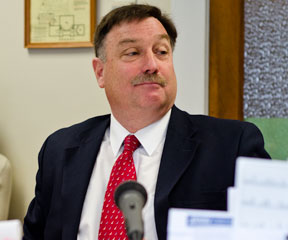
A few fries later, he added with a smile: “Maybe they’ll be just fine with that.”
The following day, Sen. Jane Kitchel — nursing a coffee (which she doesn’t want taxed!) as she chatted in the Senate Appropriations Committee room where she serves as chair — made the same point.
“Oftentimes people are actually happy to say just let us keep some stability and I don’t think you always need to be on the cutting edge,” the Caledonia County Democrat said. “You hear the message too: Maybe sometimes it isn’t bad to not think you have to keep doing all kinds of different things.”
“Sometimes, as I say to my son, no news is good news,” she said with a laugh.
With lawmakers home for the Town Meeting Day break this week — the unofficial halftime in the session even though it’s closer to a third of the way to adjournment — many lawmakers and observers say there is not much to show.
Yet.
Nor are they surprised. They say the slow pace of passed legislation is not unexpected, particularly given it’s the first year of the biennium. The two chambers often work independently on their own legislation until the crossover deadline, which happens after the town meeting break. Also, the top leadership posts are held by newcomers still learning the ropes. Not to mention there is an undercurrent of uncertainty lawmakers cite about what the federal government might do that’s giving some pause.
Even Gov. Phil Scott says he and his administration are getting their sea legs.
Plus, as former Gov. Peter Shumlin bluntly put it, the last 72 hours of the legislative session, usually in May, are when many of the big legislative deals get cut, including the budget. In many ways, the weeks prior can be a lead-up to that grand finale.
For sure, there have been accomplishments lawmakers can tell town meeting voters. The Senate quickly approved an ethics commission as well as Scott’s immigration proposal, a response to President Donald Trump’s executive orders Scott asked the Legislature to fast-track. The House appears ready to vote on it shortly.

Affordable housing and economic development proposals are being debated. Budget committees are deep into hours of grind-it-out testimony. Both chambers are seeking solutions to immediate crises like the backlog of mental health patients in emergency rooms.
Thus far, the most significant action taken by the Legislature was an early rejection of Scott’s education overhaul plan. Lawmakers, including Kitchel, called the timeline Scott laid out unrealistic: expecting communities to put off their school budget votes as they were about to print their town reports. Then he expected them to go back and make cuts to level-fund in order to boost spending on child care and higher education.
Former House Speaker Shap Smith called Scott’s budget proposal “actually a brilliant shell game” but said it couldn’t pass the straight-face financial test.
Scott’s plan, Smith said, was balanced by taking expenses that had been in the general fund, such as the state’s contribution to teachers’ retirement, and adding them into the education fund, paid for by property tax payers. Smith said Democrats would have been pilloried had they proposed the same idea.
Lawmakers also turned thumbs down to Scott’s executive order merging the Commerce and Labor departments, an idea some lawmakers said was not fully thought through. The major objection was having one department that would both promote and regulate. Lawmakers said administration officials, new on the job, struggled when they testified.
However, even though his plan was rejected, some on the left concede Scott is winning the hearts and minds of voters. The reason, they say, is that Scott appears to be at least trying to address kindergarten-through-12 education spending.
“He does, and it looks like we’re not or that we’re just balking at doing anything, which I don’t think is true,” said Sen. Jeanette White, D-Windham. “That proposal couldn’t work. It didn’t make any sense.”
But lawmakers, she said, “will look like the bad guys.”
Sen. Chris Pearson, P/D-Chittenden, called Scott’s education proposal “a crude first draft dropped on our desk.”
But Pearson and former Speaker Smith said Scott is also winning strong public support for pushing back against Trump on the immigration issue — even though the legislation is sharply limited and may be more symbolic than substantive.
Again, they say, the public sees action.
Scott was also able to tweak the Democratic majority for taking days on a recount that was widely viewed as politically motivated and then, because of a procedural glitch, never even happened. Some quietly wondered if the new speaker, Rep. Mitzi Johnson, D-South Hero, had made a misstep.
Meanwhile, observers and lawmakers say the 800-pound gorilla in the Vermont Statehouse is Trump and what will happen in Washington, D.C. — whether the state will have to prepare for some budget-shattering cuts. The effects could be enormous with 35 percent of Vermont’s budget coming from the feds.
“Mostly what I hear from people is: ‘Can you believe what Trump did today?’” Smith said.
Pearson agreed: “It’s not the time to take on big new initiatives, given that huge uncertainty, that is really unprecedented.”
Sen. Richard McCormack, D-Windsor, said lawmakers are operating in an environment where all taxes are judged as bad, as taking something away from people, as opposed to providing a common good. He said that view hardened with the rise of the tea party movement and that the anti-government rhetoric would sharpen under Trump.
And it’s not just conservatives, McCormack said.
“People who were complaining 40 years ago that the government was going after them for pot say the government is now preventing them from building shopping malls,” McCormack said.
In addition to taxpayers having questions, lawmakers will be doing some watching of their own. Johnson told reporters Friday that legislators are keenly interested in how many school budgets pass and how the school district merger proposals under Act 46 being considered Tuesday pan out.
For lawmakers, Smith said, town meeting is a “check-in point, an opportunity to talk about issues that will be coming up and get feedback on that.”
What voters really care about, he said, is what laws pass by the end of the session, with the biggest question how lawmakers spend money and if they try to raise taxes.
On the budget, lawmakers hope to whittle the gap they need to fill. The estimates are from a manageable $30 million if no new programs are added to more than $50 million if spending is boosted in areas Scott has recommended.
Sen. President Tim Ashe, D/P-Chittenden cautioned before the break against making deep cuts to balance the budget. Many other states that have tried that are in financial holes, he said.
Even though his call for level-funding K through 12 has died for this year, Scott planned to use savings to expand early childhood and higher education programs. The expectation has been raised, Kitchel said, without a way now to pay for it with the K-12 savings unrealized.
“Higher education folk feel they have been starved. Child care feels that they’ve been starved, and so once that’s been put out there, it’s like having food at a table but then to say not for you,” Kitchel said.
At public hearings, advocates for higher education and child care have come forward, Kitchel said.
“That doesn’t make you very popular,” she said.
The uncertainty of federal funding continuing at the same level hangs over Kitchel’s committee, but she said all members can do is move forward.
“You can’t respond to an unknown,” Kitchel said.
