


Sen. Jeanette White, D-Windham, the chair of the Senate Government Operations Committee, said she was worried the proposal would draw a lawsuit.
“I am nervous about us taking this on and potentially having to defend it,” White said. “I believe we would lose, given the makeup of the (U.S.) Supreme Court, which would be an expensive venture for us.”
White wondered if Vermont would face less legal exposure if the bill, S.77, went into effect only if a certain number of other states passed the same measure.
“If we want to go forward, maybe we can do something like that,” White said.
Officials said 17 states are considering similar legislation, which would not allow a presidential candidate on the ballot without releasing tax returns. In the case of Vermont, it would be five years of returns and include candidates for both the primaries and the general election.
Paul Burns, the executive director of the Vermont Public Interest Research Group, a supporter of the bill, told White that using a “trigger mechanism” would not ensure Vermont would avoid a legal challenge. He questioned White’s assumption that Vermont would lose a court battle.
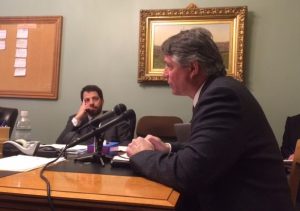
Two of the five members of Senate Government Operations, Sens. Claire Ayer, D-Addison, and Alison Clarkson, D-Windsor, favor the bill. Sens. Brian Collamore, R-Rutland, and Chris Pearson, P/D-Chittenden, are dead set against it. Collamore called it “overreach,” while Pearson said the law would interfere with federal rules.
White is a co-sponsor and said she supports the concept in the bill, but she said there were higher priorities for the Senate.
“I think this should happen,” White told the committee. “There are so many things we can do to combat what’s coming out at the federal level and the tone of everything that’s coming out of there, and I need to be convinced that this will have a big enough impact that we should spend our time and our potential resources on it instead of other things that might make more of an impact. That’s my concern.”
Vermont lost a high-profile campaign finance case before the U.S. Supreme Court that cost the state an estimated $1.6 million. The case involved an effort to limit campaign contributions and spending and was one of several federal cases former Attorney General William Sorrell was criticized for taking on and losing.
White promised to have the committee hold one more hearing on the issue to gauge support following Town Meeting Day. If White remains unconvinced, the bill would die in committee with three against and two in favor.
Burns acknowledged after the hearing the bill now faces an uphill battle.
