

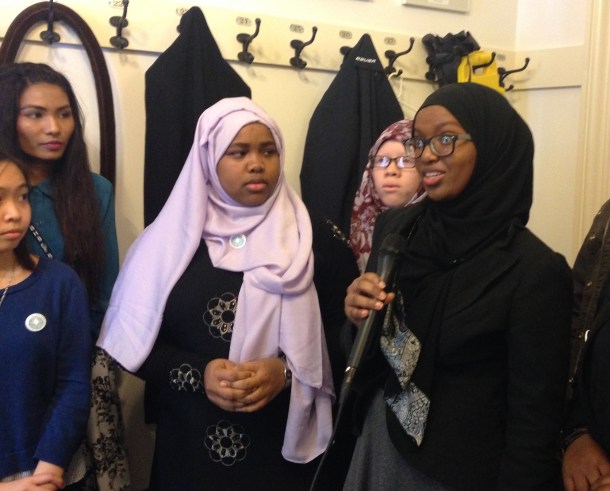
As lawmakers discussed S.79 on the floor, a group of students from the International Club at Burlington High School looked on from the gallery.
After the vote, one student, Noorto Mohamed, said recent political changes have caused her family some concern. She and her family came to the U.S. recently as refugees from Somalia, she said.
“Even though we’re citizens, we don’t really feel part of America that much,” she said. “It’s just become a little bit more difficult” since the election, Mohamed said.
The support in the Legislature and elsewhere has been heartening, she said. “It’s good to see,” she said.
After the election of Donald Trump to the presidency, as concerns about anti-immigrant rhetoric mounted, the group launched the “all are welcome” campaign. The students designed a symbol of two cupped hands holding a dove and have distributed it around the Burlington area.
“We wanted a symbol that signifies, kind of, acceptance and welcoming of immigrants and asylum-seekers and refugees,” said Quynh Vo, the club’s president.
Sen. Dick Sears, D-Bennington, chair of the Judiciary Committee, introduced the legislation on the floor.
“What it does, it’s a small bill, small issues,” Sears said. “But it is a big bill.”
S.79 would require approval from the governor before any law enforcement agency in Vermont could enter into a type of agreement with the federal government under which officers are deputized to enforce immigration law.
It also would forbid any agencies in Vermont from collecting personal information about people and transferring it to the federal government for the purpose of creating a registry based on religion, race, immigration status, sexual orientation or other criteria.
During the campaign, Trump proposed establishing a Muslim registry.
The legislation was launched by a tripartisan coalition of officials and lawmakers, including Republican Gov. Phil Scott.
The bill will not stop federal authorities from enforcing immigration law in Vermont, Sears said. “Immigration is a federal responsibility, whether we like it or not,” he said.
Senate President Pro Tem Tim Ashe, D/P-Chittenden, said the bill’s passage marks a “special day” in the Senate.
“It really does send a different kind of message not just across the country,” Ashe said. “It suggests that at a time when there’s so much polarization, people of good faith, good conscience, protective of our Constitution, inclusive, with our values can put aside party politics, join together and unite to send a conceptual message.”
“Whether you look different, pray differently, whatever it is, that you’re welcome here,” he said.
Sen. Joe Benning, R-Caledonia, a member of Senate Judiciary, said the bill is about establishing the boundaries of Vermont authority and federal authority.
“This is not a shot across the bow of the Trump administration,” Benning said. “This is rather a point blank broadside aimed at establishing the constitutional grounds by which we live as a republic.”
The upper chamber gave preliminary approval to the legislation on a roll-call vote with all 30 members voting in favor. If it passes its third reading later this week, it will move to the House.
Some say the bill does not go far enough.
Jay Diaz, of the American Civil Liberties Union of Vermont, said the bill’s passage is a “positive measure” but that the language is very limited in its scope.
“I think it’s clear that the Legislature is sending a message here, and that’s an important message to send, but no one should be under any illusions that Vermont is doing all it can to protect our immigrant communities,” Diaz said.
Many law enforcement agencies have not fully adopted a model policy on fair and impartial policing drawn up last year that restricts officers from asking about immigration status. The ACLU-VT is urging lawmakers to require all Vermont law enforcement agencies to adopt that policy.
Meanwhile, the bill will likely face more opposition in the other chamber.
The House Republican caucus has not taken a position on the bill, according to Minority Leader Don Turner, R-Milton.
Some Republican representatives in border districts feel the bill is attacking those who work in federal law enforcement, he said. Others believe the bill gives rights to people who are not entitled to them because they are in the country illegally, he said. Turner said he has not yet decided how he will vote.
After the Senate Republican caucus signed onto the bill, Turner was not surprised by the unanimous vote in support. That won’t be replicated in the House, he said.
“I know you’re not going to see that in the House,” Turner said.
