

[B]URLINGTON — Owners of construction and engineering companies told members of the Senate Government Operations Committee last week how they believe the state can improve its contracting processes.
They said Vermont has too many bureaucratic requirements for both businesses and state workers who manage the projects. The problems include paperwork, inspection requirements and the setup of requests for bids, according to the business representatives.
The Senate committee held the public hearing Thursday at City Hall in Burlington. The panel is looking at numerous ways to change the state’s contracting processes, including how to get more Vermont companies involved in state-funded projects.
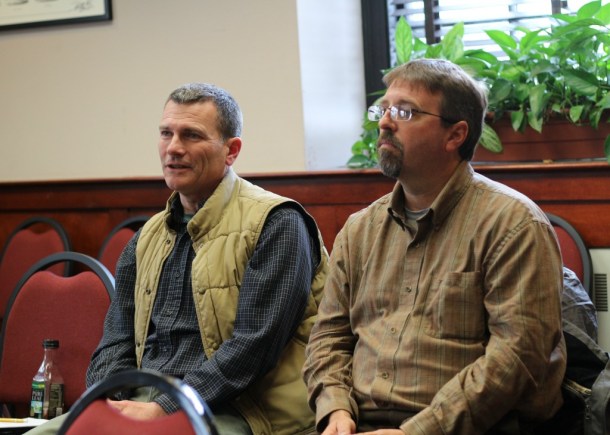
Three people participated in the majority of the discussion: Paul Sipple, the owner of Necco Inc., a construction company in Waitsfield; Ken Pidgeon, a co-owner of Engineers Construction Inc., a civil engineering and construction firm in Williston; and Jason Sicard, the owner of J.P. Sicard Inc., an excavating firm in Barton.
Sipple said it takes too long for the state to process documents for contractors. He pointed to a case when his company submitted a change order — which documents a change of scope in a construction project — and the state worker had to perform a long list of tasks that Sipple said were unnecessary.
“It was just a total bureaucratic snafu, and a totally unnecessary bureaucratic snafu,” Sipple said. “I don’t mind them having to check off their boxes, but they need to be able to do it in a meaningful and valuable way.”
Pidgeon said the state hires too many consultants to work as inspectors on a job. He said work should be inspected but that there should be an appropriate ratio between the number of inspectors and the number of workers.
“Sometimes we’ve had three or four (inspectors) on our jobs when we don’t even have more than 10 people doing work,” Pidgeon said.
Sicard said he has had to ask questions of the state repeatedly to get answers. “We can ask a question and receive no answer, and we can ask a question again and receive no answer,” he said. But Sicard said his firm is still expected to continue working on the project.
On a handful of projects his company did in New Hampshire, Sicard said, he had a different experience. He said New Hampshire manages contracts more efficiently, answers questions for his company within a day and is better at performing inspections.
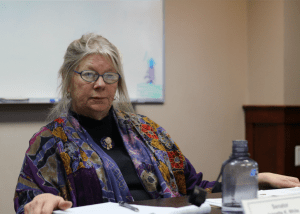
Sen. Jeanette White, D-Windham, the chair of the committee, asked for feedback on a $60 million project in Brattleboro to replace a bridge on Interstate 91. White said an out-of-state firm was hired to do the project.
Sicard said the project was too expensive for a local contractor to take on. He said local construction companies don’t have the bonding capacity for such a high-priced project.
Pidgeon said the bridge was also expensive because the state used a process called “design-build,” in which the same company both designs the bridge and constructs it. He said that process costs firms more money.
Jennifer Chiodo, an owner at Cx Associates in Burlington, which works on energy-efficient buildings, said her firm has lost some big projects to Boston firms that underbid.
Chiodo said those firms can charge low prices only if they are offering to provide fewer hours of work than her firm. She said the state should therefore require firms to break down how many hours they propose to work on a project and who is working on the project.
Chiodo said she and her business partner have decades of experience and personally work on every project. In contrast, she said, many engineering firms in Boston provide people with lower skill levels.
“Many other firms are going to provide junior level staff who actually don’t know buildings,” Chiodo said. “They don’t know systems. They’re cheap.”
She said the state should look “for ways to select really on skills and what are the skills of the people who are working on the project.”
The Senate Government Operations Committee will take more testimony Friday.
