

[V]ermont spent $300 million on special education in 2016. About 16 percent of all students in the state receive special education services. The majority attend public schools.
Under federal law, public schools are required to offer special education programs. Some private schools also provide programs for students with learning disabilities or physical impairments, but state data show that parents in school choice districts overwhelmingly opt for public schools for special education.
In Vermont, 11 private schools offer special education programs, but only the Village School of North Bennington, an elementary school, is approved to provide services in 13 categories. The four traditional high school academies — Burr and Burton in Manchester, Lyndon Institute, St. Johnsbury Academy and Thetford Academy — also offer all special education categories applicable to the grades they teach.
A VTDigger analysis of data from the Agency of Education on 36 private schools (general education, excluding ski schools and other special-purpose schools) in Vermont that are approved to accept public students found that when given the choice, special education students pick a public school instead of a private one. It found a similar pattern with low-income students.
There are 31 private schools in the state that provide services only for special education students. These schools are not part of the analysis.

Nicole Mace, executive director of the Vermont School Boards Association, said few private general education schools offer special education. She has been pushing the state to require that all schools offer open enrollment for students with learning disabilities.
“You shouldn’t see this level of disparity,” Mace said. “There are a number of private schools that do not offer all categories of special education, and that is de facto saying, ‘We are not welcoming students with disabilities.’”
The State Board of Education is proposing a requirement that would prohibit private schools from screening out special education students.
The first set of draft rules would have required private schools to offer every category of special education. Right now, nearly a dozen private schools offer some or all of those categories.
The rules now under consideration wouldn’t require schools to become approved to teach a category of special education instruction unless a student with that need enrolls.
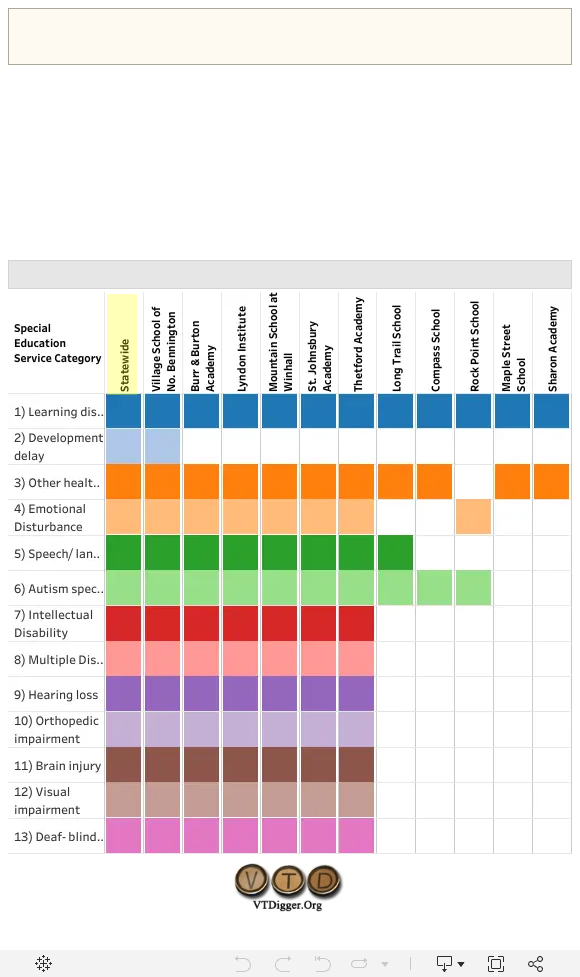
Among all students with school choice — not just those in special education — a majority attend either Burr and Burton Academy, Lyndon Institute, St. Johnsbury Academy or Thetford Academy. The schools are in areas of the state where a private school has historically been the only option available for local students.
The four academies, which are private nonprofits, have a special relationship with the state and communities. As a result, they can charge towns more for tuition than other private schools around the state.
While the four academies are approved to teach special education in all applicable categories, just like public schools, they do not have to accept all special education students who apply.
Jo-Anne Unruh, executive director of the Vermont Council of Special Education Administrators, said private schools don’t have to report data the way public schools do. Unruh is concerned that children could be asked to leave because of bad behavior that may be tied to special education-related needs.
“If a child is invited to leave due to a discipline issue, the [school district] doesn’t get that data,” Unruh said.
National data show that students with disabilities are twice as likely to be suspended as nondisabled students, according to the U.S. Department of Education’s Office of Civil Rights. Students who are disciplined in this way have an increased risk of dropping out.
When Unruh was a special education director, some students were prevented from attending private schools in choice districts or were “invited to not be there any longer because of issues that came up behaviorally or academically,” she said.
The school felt like it was no longer a match, Unruh said. “I have numerous reports from other special education administrators that this is still the case.”
There is a broader issue at play, according to Unruh, and it has to do with where the special education students end up. If they aren’t accepted by private schools in choice districts, then the nearby public schools end up with a larger percentage of children with disabilities.
Unruh said it is worth exploring what is going on and why. “I just want students with disabilities to have the same opportunities and to make sure that happens in our enrollment process,” she said.

Tom Lovett, the headmaster of St. Johnsbury Academy, said the data don’t apply in his region, where one public high school serves about 100 students.
“I’m guessing that over 90 percent of students on an (individualized education program) and 90 percent (on free and reduced-price lunch) go to an independent school,” Lovett said. “The inference is that there is discrimination going on or segregation going on that needs to be remedied through these rules. I know that is not the case in our area.”
Lovett told lawmakers on the Senate Education Committee last month that St. Johnsbury already complies with proposed changes to the rules. Smaller private schools, he said, would be adversely impacted if they had to comply.
“St. Johnsbury will be fine. The smaller ones will not. I remain concerned that this is a solution without a problem,” he said.
Long Trail School in Dorset and The Sharon Academy in Sharon are two smaller private schools that rely heavily on public funding and would find it more difficult to take on additional special education students.
Long Trail is approved in four categories of special education, Headmaster Steven Dear told the Senate Education Committee in January, and his school doesn’t want to compete with public schools for special ed students.
“I don’t want to pull away from the local public schools,” he said. “We want to serve everyone that is within our mission, but we want to keep our costs down, and we don’t want to be in competition.”
Dear said that if the school adds more categories of special education it will cost more. “It drives our costs way up,” he said.
“What I see is cost going up and not having the physical space to take the students,” Dear said. “We accept every student that is in one of the four categories we offer, and all students that are focused on academics. The ones that don’t come self-select out. Their parents choose not to come because of the academics. Maybe they are looking for more gym.”
Michael Livingston, headmaster of The Sharon Academy, said that in a state with declining enrollments, public schools are often favored by the supervisory unions. “If the public school system has the same services, in some cases, they appear reluctant to make the placement to us because they say the student can be served in-district.”
The following map shows where each of the general education private schools is located, how many categories are offered, and how many special education students are served.

