

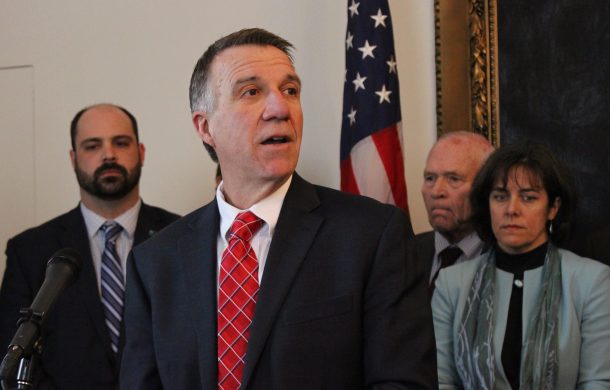
Scott, alongside the attorney general and legislative leaders, signed on to legislation that would require the governor’s approval before state and local police could conduct federal immigration enforcement work.
The legislation introduced in the House and Senate would also prohibit the creation of registries based on protected classes including religion, national origin and immigration status.
“This is an important step to ensure that all who reside in our state and visit Vermont feel safe and free to engage with law enforcement and other government authorities without fear,” Scott said at a news conference. He said Trump’s executive orders amounted to “overreach” by the feds.
Scott and Attorney General TJ Donovan were adamant the bill would not create a “sanctuary state,” a designation Scott said the state wanted to avoid because it could lead to a loss of federal funding. In sanctuary cities or states, law enforcement officials take a hands-off approach to immigration enforcement.
Scott said the bill had been crafted to take into account the concerns of law enforcement. The legislation has the backing of police agencies including the Department of Public Safety, the State’s Attorneys and Sheriffs Association, and the Association of Vermont Chiefs of Police, Scott said.

“Vermont will not be complacent, nor will we be compliant in what is federal overreach,” Donovan said.
Scott, a Republican, and Donovan, a Democrat, were flanked at the news conference by legislative leaders from all three parties, including House Speaker Mitzi Johnson, Senate President Tim Ashe and Lt. Gov. David Zuckerman. Several Republicans attended, including Rep. Heidi Scheuermann, of Stowe, a co-sponsor on the House legislation.
Scott came out against Trump’s executive order banning immigration from seven Muslim-majority countries soon after it was issued in late January.
The governor acknowledged some Republicans do not support his efforts opposing the president.
House Minority Leader Don Turner said he declined to sign on to the legislation because he had unspecified concerns and had heard other worries from residents, including that the bill would establish a “sanctuary state.”
One of Trump’s executive orders bars so-called sanctuary cities from receiving federal aid. Scott noted as much as half of the Vermont state budget is federal money.
Turner, R-Milton, also said he was worried when he heard the House speaker say other legislation may follow.
Scott noted Vermont’s history of “proudly and peacefully” welcoming immigrants and refugees, many of whom have started businesses. He mentioned refugees from Somalia, Vietnam, Bosnia, Bhutan and Syria as well as immigrants, including the granite workers from Italy in his hometown of Barre.
Scott and Donovan said the bill would prevent the collection and dissemination of information for a registry based on sex, gender orientation or identity, marital status, race, religion, national origin, immigration status, age or disability.
“It does not matter who you are, where you’re from, who you love or whom you worship. This bill simply says one thing: When we identify people in this state, we use one word — ‘Vermonter,’” Donovan said.
The House and Senate are taking up the bill in a joint session Friday morning. Sen. Dick Sears, D-Bennington, chair of the Senate Judiciary Committee, said he planned to fast-track the bill.
