

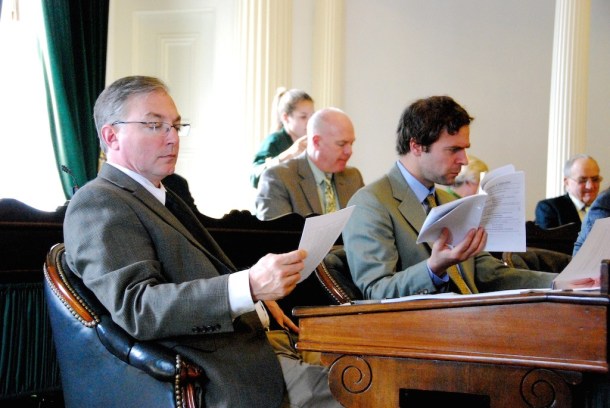
The Senate Committee on Education sent a strong negative message Tuesday on the chances of the governor’s education overhaul plan passing this year.
Gov. Phil Scott asked lawmakers to postpone the date for school budget votes to May 23. Towns typically vote on school budgets Town Meeting Day, the first Tuesday in March.
The Senate panel refused to consider that option and voted not to postpone school budgets from March until May as the governor had hoped.
Sen. Philip Baruth, D/P-Chittenden and the chair of Senate Education, said he took the straw poll to see if his committee, after listening to constituents and limited testimony from the administration, believed it was feasible or desirable to shift school budget votes from Town Meeting Day to May 23, as Gov. Phil Scott called for in his budget address last week.
The vote was unanimous, 6 to 0, with the two Republican members, Sen. Joe Benning, of Caledonia, and Sen. Kevin Mullin, of Rutland, voting no, but “with regret.”
Moving the vote on school budgets from March to May was key to Scott’s plan because it depends on communities level funding their school budgets for next year. Many communities have been working on their budgets and were prepared to send them to the printers soon for March voting.
Rebecca Kelley, spokesperson for Scott, criticized the committee’s action. She said the Senate panel isn’t serious about stopping increases in property taxes.

“The Senate Education Committee’s straw poll results — taken after less than 3 minutes of testimony from the commissioner of finance — shows some committees are not even willing to take the time to consider these bold and decisive steps to halt unsustainable increases in property taxes,” she said.
Baruth had planned on nearly an hour of testimony from administration officials, but a member of the committee had to leave early, so he sped things up to hold the vote.
A week ago, Scott proposed a balanced budget by mandating school districts level fund their school budgets. He also hopes to achieve savings by requiring communities to renegotiate teacher contracts so they pay 20 percent of their health care premiums.
Critics point out that fiscal year 2017 school budgets were artificially low because school boards spent down their reserves to avoid tax penalties under spending caps that would be revoked in fiscal 2018. Also, any savings from health care would not be available to use in this year’s budget.
Confusion ensued as school boards looked for direction on what to do since they are required to warn their school budgets 30 to 40 days before town meeting (a few school districts vote on their budgets in February, so they would already have been warned). The clock began ticking Thursday, and Sunday will be the last day. Secretary of State Jim Condos advised all school districts to move forward and warn their budgets until and unless the Legislature moved to do something.
Baruth was hoping to provide more clarity for school districts by holding the straw vote on the election part of S.46, a Senate bill that embodies the governor’s budget proposal. Baruth said he would take up the vote date change separately because it was time-sensitive. He pledged to go back and spend time working through the rest of the governor’s proposal with an eye toward implementing some provisions next year.
Baruth said he was “treating the election piece as a separate issue today and straw polling it that way to at least give guidance to communities that are wondering (if) we will or won’t be moving forward on the election piece.”
Sen. Becca Balint, D-Windham, vice chair of the Senate Education Committee, said the governor’s proposal needs to be considered in the bigger picture of Act 46, the school district merger law. “We are midstream on Act 46,” she said. “The savings are projected several years out. How does that work with these parts that are already in movement?”
Balint said many of the people she heard from over the weekend are part of Act 46 study committees and on school boards and they say the governor’s proposal is a wrench that has been thrown in the process.
There will be 10 more district unification votes on Town Meeting Day, according to Baruth.
Baruth and Balint said that in meetings around the state they are hearing that the mergers have resulted in immediate savings and “visible” educational opportunities for children.
The savings have come from increasing class sizes and reducing teaching slots, according to Baruth. He said a new unified district in Rutland could have created 15 teaching openings but chose to fill only four. “No one was fired, yet there are 11 less positions to be paid for simply by moving students within that one district,” he said.
For four years, Baruth helped craft and pass voluntary school district merger laws, acts 153 and 156, but they didn’t amount to more than a handful of unifications. But in the two years since Act 46 was signed and with votes on Town Meeting Day, Baruth said, about two-thirds of the state will have merged into larger school districts.
“That is a miracle of public policy,” he said.
Baruth admitted it hasn’t been “all ice cream and roses” and that “the successes have been hard won and after hundreds of grueling hours they have realized real savings, real benefits.” He is also aware that not all communities are ready to unite with their neighbors in school governance. “The miracle hasn’t happened for many communities. They are still working on it,” he said.

Sen. Christopher Bray, D-Addison, asked Secretary of Education Rebecca Holcombe if changing the date to vote on school budgets would confuse towns working on Act 46 merger votes.
Holcombe said school boards have found ways to implement universal pre-kindergarten, early college, dual enrollment and personalized learning plans without adding significant costs to the Education Fund. “They are starting to right-size staffing,” she said. “I take that as a signal our boards understand we have pressing financial concerns.”
She urged lawmakers to provide the time for everyone to think through the proposals and consider “all the ways we can help them do that hard work.”
Baruth said boards have sat through “excruciating public meetings” on Act 46, they have communicated their plans and now, “simultaneously we tell them you are going to have to throw out your budget work and go back. … They will throw up their hands and say the Legislature doesn’t understand what human beings working for no pay are capable of doing.”
Andy Pallito, commissioner of finance and management, implored lawmakers to extend the date to May. He said the vote was just one necessary piece of a set of proposals in a balanced budget.
“This is a package of reductions, and if the date is not pushed out it kind of backs into the corner other places the Legislature will have to go to balance the budget,” Pallito said.
Baruth disagreed, saying there are an “infinite number of ways of balancing the budget.”
Earlier, Senate President Pro Tem Tim Ashe, D/P-Chittenden, said the governor didn’t have to balance the budget on the backs of K-through-12 public schools, that he could have capped hospital spending as Massachusetts is doing. In Vermont, Ashe said, hospital expenditures outpace education spending.
Benning said he thought the straw vote was political. “I’m not sure what we accomplish here other than make a political statement,” he said.
Mullin, who also voted no but with regret, said he didn’t know why they couldn’t take the vote the next day. “I’m not sure of the fairness of doing a straw poll so quickly,” he said.
Baruth said people have been calling and emailing and want to know what the Legislature is going to do so they can make decisions. After discussing the situation with Ashe, they decided on this approach.
“It was forced on us,” Baruth said.
Benning agreed but added that he sympathized with what the governor is trying to do. “We have to wrestle as a committee with education spending. My constituents contact me about property taxes going through the roof. It is a problematic situation, but I just don’t see any of us getting a bill through the Legislature” in the tight timeframe.
Kelley said there is still hope because the House has a bill, H.158, that would change the date for the vote on school budgets. “If they take time to have the discussion, we are optimistic that the Legislature will see the governor’s proposals are a direct path to creating a ‘cradle to career’ education system,” she said.
House Education Chair David Sharpe, D-Bristol, said that anything can happen but “in this case, it is extremely unlikely the bill will move forward.”
