

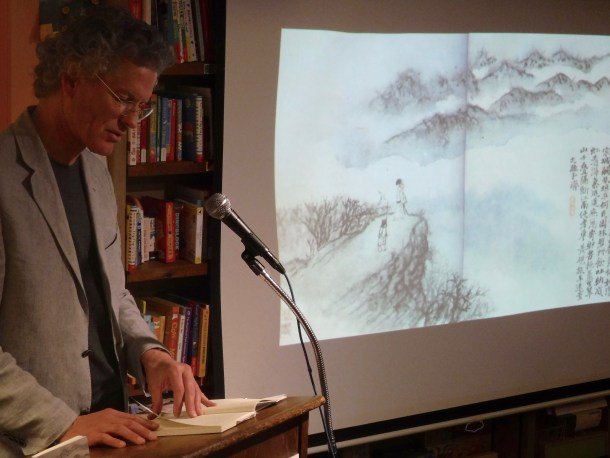
Vermonter David Hinton advises them to hit “delete” and start again.
“Forget everything we know, all of the ideas and knowledge and assumptions about ourselves and the nature of things, all of the thoughts and memories defining us each as a center of identity.”
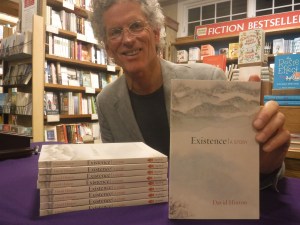
So begins Hinton’s new book, “Existence,” a meditation on ancient Chinese art that’s ultimately about the present moment.
The East Calais resident — one of the most lauded modern translators of classical Chinese poetry and philosophy in the English-speaking world — offers a work for Saturday’s Lunar New Year that urges readers to push the reset button, in part by disconnecting from technology and discovering the world for themselves.
“This painting,” he writes, “appears at first glance to show someone gazing into a landscape, an artist-intellectual accompanied by his attendant. But mysterious dimensions quickly reveal themselves, suggesting there is much more here than meets the eye.”
Western civilization focuses on thought, memory and individual identity, Hinton notes, with 17th-century French philosopher Rene Descartes summing it up, “I think, therefore I am.”
But what if today’s smartphone set acted more like China’s historic sages, who didn’t aim to talk up, text or tweet about Shih-t’ao’s painting so much as just experience it? Could the average American dig past the stories looping through their minds, earbuds and screens and ground themselves in seeing, hearing, smelling, touching and tasting what’s actually around them?
“Dwelling here,” Hinton writes, “is where we are most fundamentally ourselves, and also where deep insight into the nature of consciousness and reality logically begins.”
The 144-page Shambhala paperback goes on to explore how Taoist philosophy, Buddhist practice and Chinese poetry and calligraphy illustrate the power of the present moment and the constant of change.
Hinton is touted as the first English writer in more than a century to translate the five seminal masterworks of Chinese philosophy: I Ching, Tao Te Ching, Chuang Tzu, Analects, and Mencius. He’s also the author of the 2012 meditative memoir “Hunger Mountain: A Field Guide to Mind and Landscape” and the upcoming “The Wilds of Poetry: Adventures in Mind and Landscape.”
One might wonder: Why does a Chinese translator live and work some 7,000 miles from his source material?
“Artist-intellectuals found their spiritual home in mountains, thought of mountains as their teachers,” the Vermonter writes in “Existence.” “Indeed, rather than an expanse of physical terrain, they saw in the wild forms of mountain landscape the very workings of the Cosmos.”
And so, settled in the Green Mountains, Hinton is sharing his stories in hopes of helping others see past their own inner narratives.
“We dwell in our everyday lives at the origin place where this vital intermingling of heaven and earth takes place,” he writes, “at the center of a dynamic cocoon of cosmic energy, an all-encompassing generative present, but we are rarely aware of this wondrous fact.”
Or as Twitter might translate: Let go of mental clouds and open to a larger truth.
