

So much for Phil Scott’s reputation as a politician without bold ideas.
The knock on Scott during his more than 15 years in Montpelier — and on the campaign trail for governor last fall — was that he spoke in platitudes and avoided specifics. His call for “affordability” was a classic example: He criticized increased state spending and ever-climbing property taxes but spoke only vaguely of how savings would be achieved.
Even on the racetrack, where he is a champion, Scott has the reputation of holding back, waiting for the right opening.
On Tuesday, Scott blew up that image with an education overhaul idea that one lawmaker said “took my breath away.” Others called it “unprecedented” and “radical.”
Scott’s plan — the centerpiece of his first budget address — would squeeze out savings at the K-through-12 level to boost spending at the two ends of the education spectrum: preschool and college.
The governor’s administration secretary, Susanne Young, told reporters the proposal amounted to a “realignment of priorities” as the number of K-12 students declines and more needs to be spent on higher education and early education programs, particularly with children suffering the fallout of living in families with opiate addicts.
Sen. Philip Baruth, the Senate Education chair, described the shift in priorities more vividly.
“It was like being offered a gorgeous buffet lunch and you know in order to eat it your kids are going to go with two meals a day rather than three,” said Baruth, a Chittenden County Democrat. “I knew throughout much of the speech that there was a big, big set of cuts that I would be uncomfortable with at the end that made it difficult to applaud for the things that had been offered up front.”
Sen. Anthony Pollina, P/D-Washington, said it “sounds like a shell game.”
Scott laid out the increases in early education and college funding before he revealed that they would be paid for by requiring local communities to level fund their K-12 budgets next year and command teachers to pay 20 percent of health care premiums in their next contract. Both dictates — not to mention requiring communities to vote on their school budgets at the end of May and not on the traditional March Town Meeting Day — run counter to Vermont’s tradition of local control and resistance to mandates from Montpelier. But Scott said “incredibly strong measures” were needed to provide taxpayer relief.

“I’m sure we’ll be hearing from local communities soon,” Senate President Tim Ashe, D/P-Chittenden, said after the speech. He and other senators said they’d keep an open mind but sounded doubtful on many of the concepts and how quickly they could happen.
Rep. Maida Townsend, D-South Burlington, said she was taken aback by many of Scott’s proposals. The former teacher and onetime head of the Vermont teachers union appeared overwhelmed after the speech, trying to take it all in.
“There’s a lot I need to digest and process,” she said, “but the pieces that I did catch kind of took my breath away.” The biggest, said Townsend, was the “potentially enormous impact” of adding other financial requirements to the education fund.
She called the notion of the state dictating a teacher contract provision on health insurance contributions “unprecedented.” Given that wages and health care are the two biggest negotiating points, Townsend agreed “it’s not an unlikely scenario” that teachers will request higher wages, an increase that would be borne by the property taxpayers Scott seeks to protect.
“Let’s be clear: The governor’s proposal adds costs to the education fund and raises property taxes,” said Rep. David Sharpe, a Bristol Democrat who is chair of the House Education Committee.
Pollina called the health insurance directive the first step Scott would take to set the framework for a statewide teachers contract.
House Minority Leader Don Turner acknowledged “it will be hard to swallow” for communities to be told they have to level fund and require a 20 percent contribution from teachers.
“It has to be done,” insisted Turner, R-Milton. “I think it’s a bold proposal. I think it’s going to take a lot of work on a lot of people’s part.” As the governor did in his speech, Turner said schools were being asked to do what Scott proposed at the state level — a flat budget, with no increases in taxes or fees.
Pollina said “level funding is cuts unless he’s figured out a way to level fund the cost of fuel or health care.”
Senate Majority Leader Becca Balint, D-Windham, a former teacher, couldn’t hold back a laugh of disbelief that level funding would not hurt kids in the classroom.
“What I thought was so interesting was he juxtaposed boldness and action with stubbornness, that the antithesis of boldness and action is stubbornness. And I would say it is due diligence and not stubbornness,” Balint said. She, like others, called the Republican Scott’s proposal “a heavy lift.” The Legislature is dominated in both chambers by Democrats.
House Majority Leader Jill Krowinski, D-Burlington, questioned the timing of Scott’s proposal while Act 46 changes are ongoing.
“To propose such a major overhaul right now, we just don’t think it’s the right time,” she said.
In future years, Scott’s plan would require local school budgets to go down as the student population decreases (and allow increases if more students attend). Young, the administration secretary, acknowledged that could lead to small community schools closing sooner than they would otherwise.
Scott told lawmakers it would take “difficult decisions” to complete the education overhaul and that “the need to act is urgent.”
He laid down this request: “Please don’t instinctively lock up with resistance to change. I promised to make difficult choices to put Vermont on a more sustainable path. And this is one of them.”
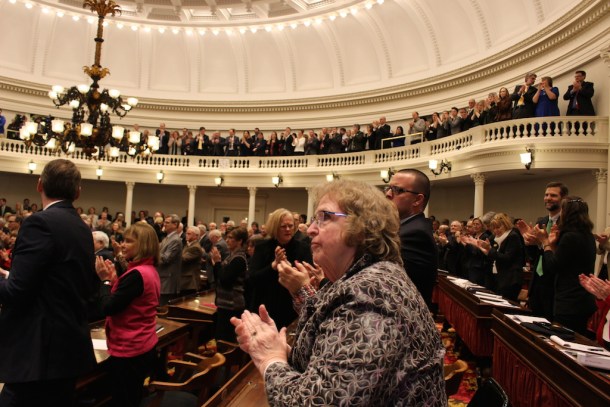
Lawmakers cheered several parts of Scott’s speech, including his education vision early on, but not when he laid out the mandates later to a quiet chamber.
“There wasn’t a lot of applause in the room,” Turner said.
Although some lawmakers yawned after Scott’s inaugural address three weeks ago that he had been his usual vague self, none made the same critique Tuesday.
Even though he no longer drives — the state police now behind the wheel wherever he goes — the racing champ-turned-politician has clearly shifted gears.
