

(Jon Margolis is VTDigger’s political analyst.)
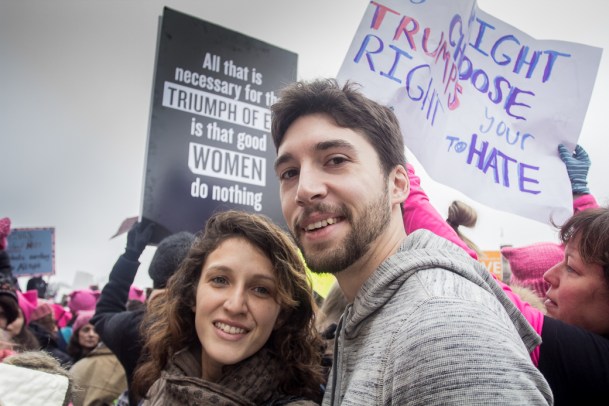
[T]hat was a whole lot of folks that gathered in Montpelier Saturday to defy the new president.
Crowd-counting is an inexact science, but the local police, who have done it before and have some basis of comparison, figured that at least 15,000 people, maybe closer to 20,000, came to the Vermont “sister march” of the Women’s March on Washington.
They came in enough cars to clog up Interstate 89. There were enough people (guys were welcome, too and were there, though clearly in the minority) to cover the big lawn in front of the Statehouse, where they heard speeches challenging President Donald J. Trump and his barely-24-hour-old administration.
Last week the organizers of the march said they were hoping for as many as 7,000 people. Half of that would have been impressive. Twice that and more was huge.
Figure in the half-million, including several hundred Vermonters, at the “main” march in Washington, which was more than twice the crowd at Trump’s inauguration one day earlier. Then add several hundred thousand people in cities large and small around the country.
Now consider that all this was put together in a relatively short period of time by people who were not very well known, had little clout in the political establishment, and modest (at best) access to big money.
In Vermont and elsewhere, something is going on. Not for decades – if ever – has a new administration been met by similarly intense opposition. Trump and his party are firmly in control of the federal government, and nothing they saw over the weekend is likely to scare them. But perhaps it should concern them. Those crowd numbers indicate that the intensity of this opposition could be transformed into potency.
Unless it fizzles.
Which left-of-center political movements have tended to do of late. Remember Occupy Wall Street? It drew some impressive crowds for a while, too, back in 2011. It had a catchy name and a great opening sentence: “We are the 99 percent.”

But it never found a second sentence. It hasn’t disappeared. But it is no longer a political force.
The Black Lives Matter movement faces a similar danger. It isn’t clear what its second sentence is, either, and it is more a confederation of like-minded (but not always cooperating) entities than a distinct organization.
So is the anti-Trump world. The scores of feminist, civil rights, labor union, and professional groups that came together to organize Saturday’s event all have their own agendas, some of which conflict. Ignoring those conflicts to arrange a protest march is easy. Not so when the task is choosing a candidate for Congress or deciding which legislation to support or oppose.
The obvious unifying institution for the anti-Trump movement is the Democratic Party. But a lot of the organizations and individuals who helped make the Women’s March a success don’t think much of the Democratic Party, which right now has no leader, no common message, and pretty close to no idea of where to go from here.
Besides, marches are uncomplicated and fun. Running for office, supporting candidates, proposing or fighting legislation is a slog. As Barack Obama said in his farewell speech, to succeed in politics, one has to “persevere.” Perseverance can be boring.
The big crowds and the high spirits of the marches could also obscure some of the self-inflicted problems of the anti-Trump forces. Perhaps their first vital task is to make sure that all of their allies accept the reality that a great many thoroughly decent, intelligent and thoughtful people voted for Donald Trump.
Only then could they try to figure out why, a necessary step toward figuring out how to oppose him.
Without those decent, thoughtful and intelligent voters, Trump would not have won. So close was the election, that every faction which supported him was decisive.
That means that so were the voters who – while perhaps decent in their personal lives – held some attitudes which Hilary Clinton foolishly but accurately called “deplorable.”
Actually, she said the people themselves were “deplorables,” which was even more foolish, and was itself deplorable. No one is irredeemably deplorable. But people who vote on the basis of their racial bigotry cannot really be described as “thoroughly decent,” either, and Trump needed their votes, too. But the anti-Trumpers err when they lump all his voters into that less-than-decent category.
Once they get those distinctions straight, the Trump opponents could work on their own first and second sentences. Right now, they could use some good editing. To start with, they might delete the sentence: “Not My President,” a slogan found on all too many hand-made posters Saturday. Being dead, solid wrong is rarely good politics. Donald Trump is everybody’s president. It’s an objective fact, not a personal emotion.
It also might be a good idea to stop calling the president a “fascist.” Fascism, according to the dictionary, is “a political philosophy … that exalts nation and often race above the individual and stands for … severe economic and social regimentation, and forcible suppression of opposition.”
Granted, it is only a few days old, but the Trump administration has so far regimented nothing and suppressed no opposition. Patience is sometimes a political virtue.
But so is vigilance. The president did emphasize in his inaugural speech that his policy would be “America first.” Not that long ago, this was the slogan of a political faction which – to put it gently – was reluctant to criticize fascism. It is unlikely that either Trump or his speech-writers were ignorant of this history.
By something close to a consensus, that speech pleased the new president’s base but did not expand it. He entered office with the lowest personal approval rate of any incoming president in the history of polling, under 40 percent in the two most recent polls.
Those poll numbers help explain why the Women’s March and its many “sisters” drew such big crowds. So does the fact that Trump lost the popular vote by a large margin. So do some of the recent statements and appointments of the new president.
He enters office politically weak. But institutionally strong. In Vermont, the state that gave Donald Trump his lowest vote percentage, the liberals and centrists (and the anti-Trump conservatives; not a tiny faction) who marched in Montpelier or were pleased by its success have legitimate reason to hope.
But a great deal of work to do.

