

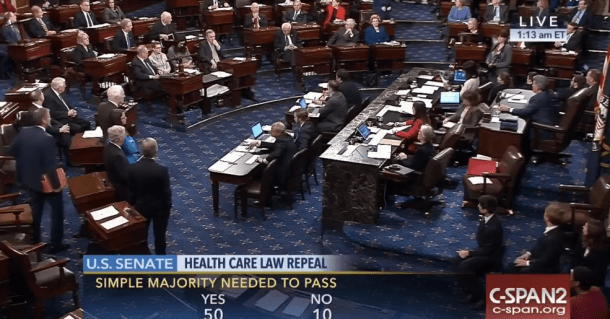
[W]ASHINGTON — Senate Republicans took the first major step in repealing the Affordable Care Act in the wee hours of Thursday morning, invoking an arcane budget reconciliation process that eliminated the threat of a Democratic filibuster.
With a simple majority, Republicans passed Senate Concurrent Resolution 3, which lays the groundwork to repeal ACA by mandating that the House and Senate committees that oversee health care draft major cost-cutting measures — essentially a repeal bill — to be submitted to the House and Senate budget committees by Jan. 27.
The vote on the legislation split essentially down party lines, 51 to 48.
Fifty-one Senate Republicans voted for the resolution, with only Rand Paul, R-Kentucky, breaking from his caucus to vote no. Paul objected to the resolution because the underlying budget projections would add nearly $10 trillion to the deficit over the next 10 years. He also said he was concerned that Republicans were repealing the ACA without offering a replacement plan.
Those voting against the resolution included every Democrat save Dianne Feinstein of California, who did not vote. The two independent members of the chamber — Bernie Sanders of Vermont and Angus King of Maine — joined Democrats in opposing the legislation.
The lights stayed on in the Senate chamber early into Thursday morning as Democrats expressed grave concerns over the legislation, even as the Republican chair interrupted them, saying that “debate is not allowed during a vote.”
At 1:12 a.m. Thursday, Sanders expressed his disgust with the resolution, saying, “On behalf of elderly people who cannot afford prescription drugs I vote no.”

Sen. Patrick Leahy spoke right after Sanders, saying, “I join my colleague from Vermont and I vote no.”
Democrats offered 11 amendments aimed at stopping the resolution as part of a “vote-a-rama” process. The amendments intended to force Republicans to take politically toxic votes that could potentially be used against them during campaign season.
The amendments — none of which passed — were sharply written in order to inflict as much political damage as possible.
One introduced by Sen. Sherrod Brown, D-Ohio, aimed to halt the legislation as it “would undermine the historic coverage gains the United States has made in children’s health, which have resulted in the lowest uninsured rate for children in the nation’s history.”
Another amendment, offered by Sens. Sanders and Amy Klobuchar, D-Minn., would have allowed for American pharmaceutical distributors to import and sell lower-cost prescription medicines from Canada and other countries.
Sanders has long railed against the ban on prescription drug importation, even traveling to Canada two decades ago with Vermonters to purchase cheaper cancer medicines.

Sanders seemed hopeful that his amendment might pass, since Republican President-elect Donald Trump endorsed medication price regulations in a Wednesday news conference.
“There’s very little bidding on drugs,” Trump said Wednesday. “We’re the largest buyer of drugs in the world. And yet we don’t bid properly. We’re going to start bidding.”
“You know what?” Sanders said in a floor speech Wednesday afternoon. “Mr. Trump is exactly right. Pharma is getting away with murder. Pharma has gotten away with murder for many, many decades.”
The Sanders-Klobuchar amendment failed, 52 to 46, but 12 Republicans voted for it. Leahy supported Sanders’ amendment, though 13 Democrats voted against it.
With the repeal resolution passed in the Senate, it is expected to pass in a House vote on Friday.
While Republicans have rallied around repeal of the ACA, the party has yet to introduce a comprehensive replacement plan.
“Maybe they will develop a plan, but right now, what they are talking about is repealing legislation which has brought millions of people health care and they have no substitute,” Sanders warned Wednesday.
Although Republicans can steer repeal through a budget resolution, any replacement plan would require 60 votes to pass, meaning that a handful of Democrats would have to come on board.
A repeal of the Affordable Care Act is expected to have a significant impact on insurance coverage across the nation, including in the Green Mountain State.
According to data from the Agency of Health and Human Services, the uninsured rate in Vermont has fallen 53 percent since the enactment of the Affordable Care Act.
The Kaiser Family Foundation recently reported that Vermont receives more than $70 million in federal health care tax credits annually through the ACA, with the average monthly middle-income tax credit totaling $300 per person.
In addition, the ACA expanded Medicaid eligibility in Vermont. A combination of state and federal dollars pays for the increased coverage.
More than $2 billion of the state’s $5.8 billion budget in fiscal year 2017 came from federal funds. The largest share of that $2 billion — roughly $1.1 billion — went to the state’s Medicaid program, according to a tally from the Department of Finance and Management.
A comprehensive breakdown of Medicaid spending in Vermont is available here.
Top health care officials in Vermont have predicted dire consequences if the Affordable Care Act is repealed entirely, predicting that many residents would drop insurance, while others would have to pay much higher premiums.
A recent study by the Commonwealth Fund found that ACA repeal could also harm the overall economy in Vermont. The study predicted that Vermont could lose as many as 6,000 private and public sector jobs. A majority of the jobs losses would be in the health care and insurance sectors.
On Wednesday — before the Senate vote — Gov. Phil Scott said he was opposed to a repeal of the Affordable Care Act. He said his budget team was “in a holding pattern” regarding the impact on federal health care subsidies.
Scott said his team was looking to find savings in state Medicaid spending, which is the largest portion of Vermont’s budget.
Asked if he would welcome more federal help to ease state Medicaid spending, Scott said: “I’m not advocating for more federal Medicaid money, but I wouldn’t imagine we would turn it down.”
He didn’t say how his administration would respond to the more likely scenario, wherein the spigot of federal health care money is tightened, or even eliminated. Scott instead reiterated his pledge to “build a budget within our means without raising taxes or fees.”
