


S.10 would apply to any company found responsible for contaminating public water supplies with the suspected carcinogen perfluorooctanoic acid, or PFOA.
It was introduced by Bennington County Sens. Brian Campion and Dick Sears, both Democrats. Their district has widespread water contamination from PFOA. It is believed to have come from a factory once owned by the company Chemfab, now part of the chemicals firm Saint-Gobain Performance Plastics.
Last year hundreds of Vermonters were found to be drinking from wells and other water supplies polluted with PFOA, an industrial chemical. This class of substances is associated with a variety of maladies including developmental problems for children and fetuses, decreased fertility, hormonal imbalances and cancer.
State officials have pushed for Saint-Gobain to cover the cost of extending water mains to residents with contaminated wells — a cost that would likely exceed $25 million.
Saint-Gobain on Dec. 22 sent a letter to incoming Gov. Phil Scott indicating that carbon filtration systems installed on affected residents’ water supplies is an adequate solution instead.
Saint-Gobain has purchased carbon filters for affected residents, and the company “thus believes that there is already an effective permanent remedy in place,” the letter states. When the filters were purchased, state officials characterized them as a temporary response to an emergency situation and said the proper long-term fix would be new water mains to affected homes.
The new bill would assign strict liability for municipal water-line extensions to any company that introduces PFOA into the environment.
Strict liability is a legal concept meaning a party committing certain behaviors is held liable for harms that result, regardless of whether the party acted intentionally or negligently.
One clean-water advocate said this is the proper approach to industries that taint Vermonters’ water supplies.
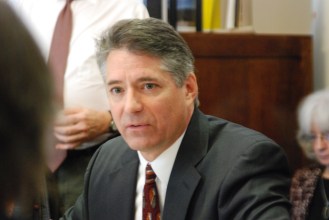
The bill’s insistence that polluters permanently fix the problem with a municipal water supply, rather than a carbon filter, “would go a long way toward giving the public greater confidence they’ll have access to clean, safe drinking water even in communities where this toxic chemical has been used,” Burns said.
The bill might also “have the effect of encouraging Saint-Gobain to negotiate in good faith now,” he said.
In response to the bill, Saint-Gobain spokeswoman Dina Pokedoff said only: “We are aware of the bills proposed today by Sens. Campion and Sears in Vermont regarding potable water supplies and municipal landfills.”
Campion and Sears are sponsoring a separate bill, S.11, that would make the state, rather than municipalities, responsible for cleanup at landfills with toxic pollution.
An industry representative, who didn’t want to be quoted by name, suggested the PFOA bill might scare off investors and companies because of potential future liability over substances not yet known to be toxic.
Campion said the Legislature’s lawyers had examined the question of whether the bill would represent retroactive lawmaking, which the U.S. Constitution bans. Precedent and the Vermont Constitution both support the legislation, he said.
“This is about polluters. This is about people whose actions have changed people’s lives for the worse,” Campion said.
“I believe it’s the responsibility of the government to provide clean water to citizens,” he said. “I want the state of Vermont, as we make citizens whole, to have as much power as possible to do that.”
Campion hailed Gov. Phil Scott’s pledge, made during Thursday’s inaugural address, to fight for the safety of Vermonters’ waters and for Vermonters affected by PFOA pollution.
“I believe he will be a very strong advocate for my community, and I’m looking forward to working with him on that,” Campion said.
Members of the House have said they plan to introduce similar bills, said Rep. David Deen, D-Westminster, chairman of the House Committee on Natural Resources, Fish and Wildlife.
The Legislature convened a working group last year to propose responses to toxic releases. The Senate bill is one result, said Vermont Conservation Voters’ political director, Lauren Hierl, and more recommendations are expected from a report to be published next week.
Many of those recommendations have to do with giving Vermonters leverage when seeking damages for toxic releases, said the Vermont Natural Resources Council’s policy and water program director, Jon Groveman.
