


But she had another motivation for returning to Vermont: She thought it would be the perfect backdrop for a residential community based on the model she helped develop in Houston — only this time in a rural setting.
Stein’s hope was to offer a continuum of care whereby residents would live in a highly structured, home-like environment but still be encouraged to work or volunteer in the community.
There are a number of similar treatment facilities in Vermont, though each with a slightly different emphasis. Spring Lake Ranch in Cuttingsville is a work-centered therapy program with an active farm and animals. Forty Seven Main Street in Castleton is a small group home for men with mental health issues that offers a bridge between full-time care and independent living. Spruce Mountain Inn in Plainfield, a residential care program for young adults, is one of the oldest treatment programs of its kind in the United States.
Stein was hoping to create an environment that would “mirror real -world independent living.”
Two years ago Stein happened upon a large abandoned home on Colvin Hill road in Danby.
Situated on 39 acres of farmland with dramatic views of the Green Mountains there was ample room for animals, including horses, which would be a key part of the treatment program. The home had been foreclosed on and, aside from some minor vandalism and a ruined boiler, was in good shape.
“It was happenstance that I found this place,” Stein said. “I was not specifically looking in Danby. I was looking anywhere in Southern Vermont that I thought would be a good location.”
Stein borrowed money and used her own savings to purchase the house and refurbish it. PATH at Stone Summit (PATH is an acronym for the Program for Adult Transition to Health) received its license from the Agency of Human Services in August.
PATH is currently permitted to have four residents, but Stein says eventually the facility will be able to accommodate up to 8 young adults between the ages of 18 and 30. The facility will specialize in treatment of depression, anxiety and personality disorders, and PTSD.
On a recent afternoon the facility’s horses ambled about on the snowy hillside. Holden goats and a couple of pot bellied pigs rooted around in the semi-frozen soil.
Last month PATH’s first resident moved in and Stein says they expect to be full by January. “I’ve developed my fantasy program,” Stein said.
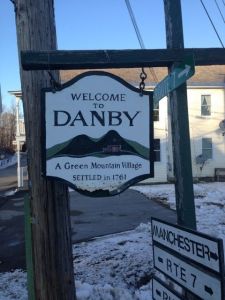
But Stein’s dream has also been a source of friction for the town of Danby, which has a population of just over 1,300. Soon after word got out that Stein was planning to open a residential community, a group of neighbors got together to find out more about the facility.
They felt that Stein’s application before the Green Mountain Care Board was flawed and that it seriously low-balled the true cost of opening and running such a clinic. Stein held an open house and then participated in a public hearing at the local school but neither seemed to mollify her critics.
Christopher Wright, former chair of the Danby select board, said the open house at the facility left a lot of questions unanswered. “There were a lot of evasive answers, non-answers that sort of thing,” he said. Still, Wright, who has lived on Colvin Hill Road for more than 10 years and walks his dogs past PATH everyday, says he’d like to see the clinic succeed.
About 10 residents, under the name Danby Residents Against Psych Facility, has since challenged the Green Mountain Care Board’s decision not to require PATH to obtain a certificate of need — a review process mandated for health care facilities that have annual costs exceeding $500,000.
In her application and in interviews, Stein maintains that PATH’s budget will not be greater than $500,000.
Danby Residents Against Psych Facility is represented by Rutland Attorney Jay Kenlan who has made a request for a fair hearing to review the Department of Health’s decision to license the facility.
“We have two different avenues that concerned neighbors have taken,” Kenlan said. The state has filed a motion to dismiss the request for a hearing.
Annie Davis, who has lived on Colvin Hill road for 29 years and is a party to the lawsuit, says her primary concern is for the residents of the facility. She acknowledges the need for expanded mental health treatment in the state but questions the facility’s location and the fact that it is a for-profit institution.
“If somebody had a medical emergency it takes the rescue squad 40 minutes to get there,” Davis said.
Annette Smith, director of Vermonters for a Clean Environment who lives in Danby but is not involved in the lawsuit, says it’s a bad location for a residential facility. Smith says the old Silas Griffith Inn in the center of town, which is currently vacant would have been much more sensible — closer to Route 7 and services in Manchester and Rutland.
“It’s an inappropriate place for a residential facility of that sort,” Smith said.
Other residents have raised concerns about the impact on property values and several neighbors, including the owners of a large farmhouse directly across from PATH, have put up signs opposing the facility.
Stein says she expected people to ask questions given the nature of the work they do. But she was taken aback by the intensity of the local response.
“I could not have imagined people would be so concerned about a tiny group home,” Stein said.
Despite the pushback, Stein was careful to point out that a number of Danby residents have been very welcoming and that one or two businesses have agreed to work with patients.
Wright, who thinks the lawsuit is a waste of money, said PATH could eventually be an asset to the town. “As this thing goes on, hopefully it will be a non-issue,” Wright said.
Though she understands neighbors may have fears, Stein says the clinic is highly structured and well staffed. There are two house managers who live on the premises and two staff members always on site. In addition to Stein, who is the director and primary clinician, there’s a registered nurse psychologist, a master’s level vocational rehabilitation specialist, and an equine assisted teacher who work with the residents. There’s also a consulting medical director. The chief operating officer, Jerry Rudd, lives in a house just down the hill.
The day begins at 8 a.m. with chores and a family style breakfast. Throughout the day there are group therapy sessions as well as individual meetings with clinicians. All residents, even those without any prior substance abuse issues, are encouraged to attend NA or AA meetings. Residents have only about an hour of free time a day. Family can visit anytime.
“The goal is to get people back into the community,” she said. Depending on their treatment plan residents can stay anywhere from six weeks to six months.
“We have tried and will continue to try very hard to have a good relationship with our neighbors,” PATH’s attorney Michael Munson said. “Being new to this community it’s very important for PATH—for its employees and for its residents—to be a valued part of the community.”
“As nothing happens, people will realize we’re good neighbors,” said Stein.
Michael Wells, former director of Spring Lake Ranch, a therapeutic community in Cuttingsville says opposition to mental health facilities is fairly common. Spring Lake Ranch has been around for almost 85 years and can accommodate 33 residents.
Board member Jim Alic says the facility has mostly been an asset for the community. “It’s fundamentally a non-issue,” he said.
However Wells noted that it is incumbent upon the directors of the facility to reach out to the community and to give neighbors the opportunity to voice concerns.
He said younger patients tend to cycle in and out of facilities at a higher rate than older residents, which can be unsettling for local residents. In addition, patients with substance abuse issues can also add an element of unpredictability (PATH will only accept individuals who have been free of addiction for at least 30 days).
“You only need one episode with one person to get everybody’s brains rattling,” Wells said.
Willem Leenman, director of Forty Seven Main Street, a group home for men with mental illness in Castleton knows well the challenges associated with running a residential clinic in a small town.
Leenman’s parents, who had been gardeners at Spring Lake Ranch, founded Forty Seven Main in 1969. The former nursing home is licensed to accommodate 11 men ages 20 and up. Leenman says they’ve had the occasional run in with law enforcement, mostly due to shoplifting.
“I take responsibility when something goes wrong,” Leenman said. Though mental illness is very common—Leenman says few families are immune from it—it is still widely misunderstood. “People are fearful of what they don’t know,” he said.
Stein says she’s hopeful that over time residents’ opposition to PATH will fade away. Though the signs along Colvin Hill road can be jarring, Stein doesn’t think they’ve dissuaded anyone from coming. Since getting licensed Stein says they’ve received more and more calls and referrals. “It’s been wonderful finally being open,” she said.

