


(This story is by Emily Greenberg, a freelance writer in Charlotte who contributes to several Vermont-based publications. She has also written for periodicals in Washington state and New York state.)
COLCHESTER — When the Plouffe family moved from Quebec to Colchester and began dairy farming in 1949, Chittenden County was a different place.
“It was all farms from Winooski to St. Albans. There was nothing in between,” said Napoleon Plouffe, 78, co-owner of Elm Hill Farm in Colchester. “You can’t go back, but I prefer how it was before when everybody knew each other.”
The Village Scoop ice cream shop on Main Street in Colchester was a one-room schoolhouse for eight grades. Route 2 barely saw any traffic, and the herd of cows would be led across the road to graze twice a day.
According to the USDA Census of Agriculture, there were 2,185 farms in Chittenden County in 1945. In 2012, the time of the last census, that was down to 587.
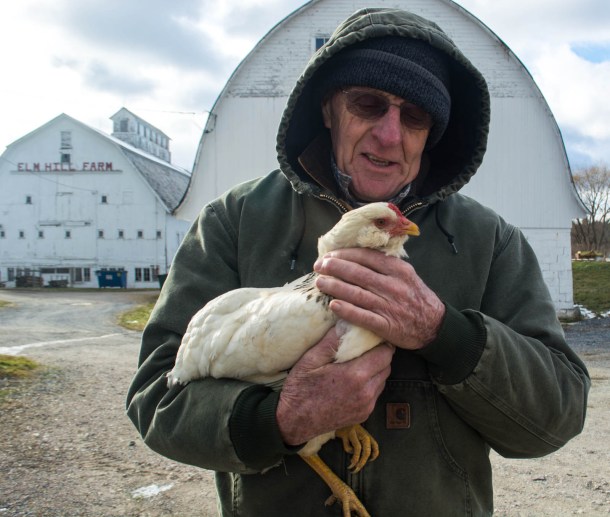
The Plouffe brothers still own and operate the 180-acre estate their parents started in the postwar era. These days, the main commercial endeavor is a shed, fencing and chicken coop business, owned and operated by younger Plouffe brother Pierre, 77. The farm also grows and sells hay and has a few sugarbushes. Napoleon Plouffe raises chickens, mostly for fun, and sometimes sells eggs to neighbors.
In October the farm became certified organic in its hay production, with a total of 50 acres that yield 7,000 bales.

The decision to go organic was an easy one, Napoleon Plouffe said. Because woodlands border much of the property, the risk of contamination from neighboring farms was low. About 7 acres of hay grown on the farm isn’t organic, because the field is 200 feet from a neighboring farm that uses conventional fertilizers. The nonorganic hay bales are sold as mulch.
While most of the hay is sold to horse farms, with the new certification there is the opportunity to increase hay production at Elm Hill and begin selling to organic dairy farms.
“As people move toward certified organic dairy, the demand for organic feed increases,” said Gregg Stevens, certification specialist for Vermont Organic Farmers, a USDA accredited certification agency. “If farmers can’t produce enough on their own, they’re required to buy certified organic feed.”
Vermont Organic Farmers reported 51,462 acres of organic hay land in 2015 that has been certified through its agency. According to the USDA Organic Integrity Database, 218 farms in Vermont are producing organic hay.

Elm Hill Farm originally functioned as a dairy farm, and in 1966, at the age of 28, Napoleon Plouffe accidentally took over the dairy operations. When his father decided to sell the herd, eight cows near the end of their milking cycle were in the back of the barn come auction day and completely forgotten as part of the sale.
When Napoleon saw the cows had been left behind, he made a bid to his father.
The dairy farming kept going for another 10 years at Elm Hill, and the original eight forgotten cows turned into a herd of 28. But when a bout of what would become an ongoing illness hit Napoleon Plouffe, he had to give up his animals.
“I always worked and lived on the farm. That was an opening for me to keep going,” he said. “When I had to sell the herd it was like selling me. They were a part of me.”
From then on, the land was leased out and farmed, but still belonged to the first-generation Plouffes. It wasn’t until the early 1990s that Pierre and Napoleon Plouffe inherited the property from their parents, and the brothers returned to Elm Hill.
While Elm Hill Farm may have come a long way, the future of the land remains uncertain.
The Plouffes have enrolled their farm in the state’s Current Use program. Administered by the Vermont Department of Taxes, the program aims to keep forest and agricultural land in production and help slow development pressure, by valuing property for tax purposes on its actual use instead of its value in the real estate marketplace.
As of 2015 more than 2.4 million acres in Vermont were enrolled in the program.
“It’s near the end of the line, and there’s no one left in the family that wants to take it,” Napoleon Plouffe said. “We want to keep it going as a farm. Keep it original and never sell any lots.”
