


Noelle MacKay, director of the Community Economic Development Office, told a City Council committee that the administration is waiting to hear from the University of Vermont about whether it’s interested in partnering to build an arena in that location before moving forward with redevelopment plans.
Burlington had prepared a request for development proposals for Memorial Auditorium and several adjacent parcels collectively known as the Gateway Block. But the city pulled that request last year after UVM and South Burlington announced they were exploring the possibility of an arena.
There is little appetite among city officials to restore the early 20th century building, which needs roughly $8 million to $12 million in repairs to be structurally sound.
The Queen City entered talks with the university about locating the arena at the Gateway Block. Such an arena would host roughly 60 hockey and basketball games a year and would otherwise be available for concerts, conferences or other large events.
UVM hired a consultant to evaluate the prospects for an arena in Burlington or South Burlington, or upgrading current on-campus facilities to serve that purpose. That report is expected to be completed in early January, according to UVM.
University officials have said a major factor in their decision will be which city can offer them a better deal as the primary tenant of a new arena. Both cities have acknowledged they’d likely need to raise taxes to pay for such a project.
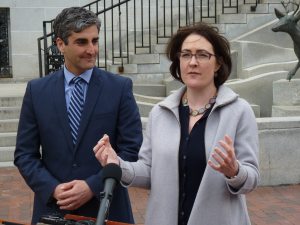
“The economic benefit to other businesses in the community has great potential,” she added.
Burlington wants to know whether UVM is interested in being the anchor tenant of an arena that would replace Memorial Auditorium before it sends out a new request for development proposals and seeks public input on what should be built there, MacKay said.
“That allows the logjam on the public process to kind of break,” said Jeffrey Glassberg, a consultant the city hired to help it develop the Gateway Block.
“There is a viable redevelopment project sitting there on Main Street,” regardless of whether that includes an arena or some other combination of uses, Glassberg said.
At the same time, the city is exploring issues related to parking, financing and how to structure ownership of the arena. Mayor Miro Weinberger has said he doesn’t want the city to manage the property and indicated Burlington would partner with a third-party developer to build and operate it.
That could take a number of different forms, including an “event center authority,” Glassberg said, which would get some of its money from the city but would operate independently. As for whether the city would retain ownership of the property, Glassberg said that’s an open question.
City Councilor Tim Ayers, D-Ward 7, said traffic is a particular concern.
“Parking isn’t so much the issue, as how do we get people out of downtown after a Division I NCAA basketball game,” Ayers said.
The arena would be expected to seat a maximum 4,500 people for hockey games, Glassberg said, adding that Memorial has already hosted concerts for as many as 2,500 people without any dedicated parking.
Members of the committee said they were open to the idea of an arena replacing Memorial Auditorium, but they said they want any new development to preserve the type of community spaces the auditorium has historically offered residents.
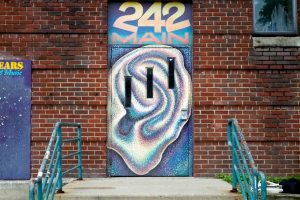
Jim Lockridge, with the Big Heavy World Foundation, urged councilors to find a way to preserve the all-ages punk venue 242 Main, which is the lone former Memorial Auditorium tenant that has not found a new home.
Lockridge said an online petition calling on city officials to include space for 242 Main in any request for development proposals has more than 500 signatures. The city has an opportunity to preserve a unique cultural asset, he said.
“The city has something to claim for itself that was essentially given to it by its youth,” Lockridge told the committee.
City Councilor Selene Colburn, P-Central District, said she agreed that historically the venue had offered Burlington’s young people a youth-directed space for music and self-discovery.
However, most recently the space has booked hardcore acts for shows that have declining attendance and is no longer the teen-driven venue it once was, she said.
The Department of Parks, Recreation and Waterfront managed 242 Main until it closed last week. Department Director Jesse Bridges echoed Colburn’s assessment, particularly the dropoff in attendance at shows.
Bridges said his department is working with the Fletcher Free Library to engage young people in the city and ask them what they want out of youth-directed city programs regardless of where those programs are located.
In the meantime, the library is partnering with venues across the city to launch a 242 Presents concert series, the first of which will be held at the Fletcher Free Library on Jan. 13.
