


(This story is by Matt Hongoltz-Hetling, of the Valley News, in which it first appeared Dec. 8, 2016.)
[W]OODSTOCK — After more than four hours of sometimes-tense courtroom arguments that raised serious questions about Vermont’s statutory recount rules and procedures, Rep. Sarah Buxton, D-Tunbridge, and Royalton Republican David Ainsworth reached an agreement Wednesday that will allow the votes in their House race to be counted for a third time.
The initial count on Election Day showed Buxton with a three-vote lead in their Windsor-1 District, but the Nov. 21 recount showed a tie at 1,000 votes apiece. Uncertainty remained over whether two Ainsworth votes had been included in that count.
Superior Court Judge Robert Gerety said he would issue an order scheduling a new recount, which will be held under rules designed to overcome flaws in the Nov. 21 recount, as soon as possible.
Ainsworth and his attorney, Rep. Janssen Willhoit, R-St. Johnsbury, began the day hoping they could persuade the court to find that the two ballots had not been counted by the tabulator. But by the end of the day, Willhoit said it was important to address doubts.
“It became clear toward the end that there was true dispute over whether those were counted,” Willhoit said.
Buxton also said she wants an outcome the public can have confidence in.
“I’m hoping in the next step that there can be certainty one way or another,” she said.
Flaws in the process
During the evidentiary hearing, as attorneys for the two candidates cross-examined a series of witnesses, Windsor County Clerk Pepper Tepperman admitted she had not followed certain state laws in conducting the recount.
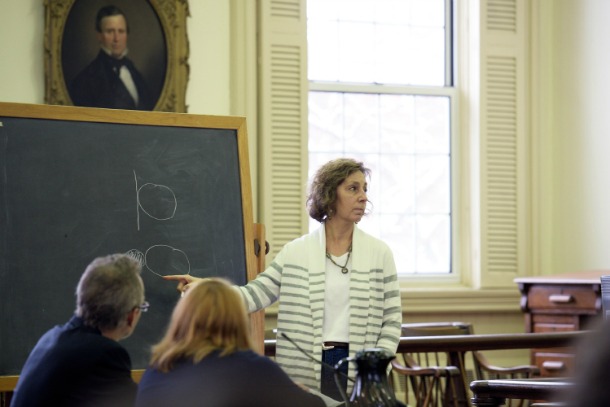
Under questioning from Rep. Willem Jewett, D-Ripton, who was serving as Buxton’s attorney, Tepperman said she had not followed a state requirement that the recount team use voter checklists as a means of verifying that the number of ballots cast was accurate.
“It was not compared to the checklist,” Tepperman said. “Royalton didn’t even have a checklist there.”
Jewett also argued that Tepperman had failed to meet another requirement: that she form a “clerk observer team.” He said she instead assigned a single person to act in that role.
Tepperman testified that she had called the secretary of state’s office for guidance and was told that having a single person fulfill that role was permissible.
Jewett also established that, while the software inside had been swapped out, the actual physical machine that tabulated votes on Election Day also was used in the recount, which goes against state law.
Brenda L’Italien, a representative of LHS Associates, the company that provides automated tabulator machines to Vermont communities, testified that the AccuVote machines were not, in the cases of certain types of votes, completely accurate.
Willhoit asked L’Italien whether she could determine whether the machine had counted the two questionable ballots.
In both cases, she said, it was likely the machine had not counted them, but she stopped short of saying it was impossible.
“Most likely, it was counted as an undervote, but I cannot be sure,” she said of one vote.
New law questioned
Until recently, recounts could be conducted by hand.
But in May 2014, Gov. Peter Shumlin approved a set of new election laws. One change, which received wide bipartisan support, requires the use of vote tabulation machines — generally accepted as being more accurate than hand counts — in all recounts.
Votes that the machine might misread — a category that includes overseas ballots, ballots with smudged ink, ballots that have been filled in too lightly, and ballots in which the voter indicated a preference without filling in the scannable bubble — are counted by hand, then transferred onto readable ballots, under the new law.
But in the Buxton-Ainsworth Nov. 21 recount, there was a hiccup in this procedure.
Each vote was first fed through the machine, and then teams of officials looked through each ballot, searching for ballots that the machine would not have been able to read.
But most people in the Woodstock courtroom agreed Wednesday that it should have been done in the reverse order.
L’Italien said the questionable ballots should be separated out before the rest are sent through the tabulator.
“Anything that is not a perfect mark should be set aside as a hand count,” she said.
State law is mum on whether the problematic ballots should be separated out before the machine count or after. In the wake of recount problems that have surfaced this year, William Senning, director of elections for the secretary of state’s office, has indicated he would like to make that adjustment for future election recounts.
Jewett pointed out to L’Italien that the same ballots, run through the same tabulator on both Election Day and Nov. 21, had produced two different results.
During the Nov. 21 recount, some ballots were inserted face-up, some face-down, some top-first and some bottom-first.
L’Italien said the machine would be more likely to produce consistent results if the ballots had been fed through using the same orientation each time.
Tepperman said that during the recount, the first she has overseen, she realized there was less guidance from the state than she would have liked.
“I feel that some of the statute is ambiguous. You have to interpret it on your own,” she said. “I asked a lot of questions of the secretary of state’s office. I was ill advised on how to do certain things. If I had to do it all over again, I probably would have done a hand recount and not used a tabulator machine.”
Gerety, the judge, said his forthcoming order would direct county officials to conduct a new recount under rules that would address the flaws that had been identified during the proceedings.
Gerety said he recognized that the case was operating under time constraints; if a recount were to result in an uncontested tie, a runoff election would have to be held.
The timeline for a runoff could extend beyond the seating of the incoming Legislature, which is scheduled for Jan. 4.
The two candidates have sparred over recounts in the past.
Buxton first won the seat in 2010, after a recount in another tight election showed she had unseated Ainsworth with a one-vote margin.
It is unclear whether Gerety’s ruling will affect another recount case pending in the Vermont Superior Court in Chelsea, where Rep. Susan Hatch Davis, P-Washington, asked a judge to order a hand recount of ballots in the Orange-1 District.
In that race, a machine recount conducted under the same rules showed Davis lost to Chelsea Republican Bob Frenier by six votes. If that tally stands, Frenier will be seated alongside Rep. Rodney Graham, R-Williamstown, in representing the two-seat district, which includes the towns of Chelsea, Vershire, Corinth, Washington, Williamstown and Orange.
