

[K]ILLINGTON — Mikaela Shiffrin put the exclamation mark on the first weekend of World Cup ski racing on the East Coast in a quarter century, pumping her fist Sunday as she crossed the finish line in celebration of her win in the slalom.
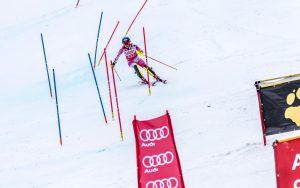
Shiffrin, who honed her ski skills a few years earlier at Vermont’s Burke Mountain Academy, said she could hear the crowd at the base of Killington Mountain roar as she stood in the starting gate, the last racer of the weekend to speed down the course.
“I hope I don’t screw up,” the reigning Olympic gold medalist in the event later said was her thought at that moment.
A day earlier she finished fifth in the giant slalom, but by Sunday she was the leader going into the second run of the slalom race. She spoke later of “the fight” she put into attacking the course on her final trip down the mountain.
“I hope it looked like I wanted to ski fast,” the 21-year-old said.
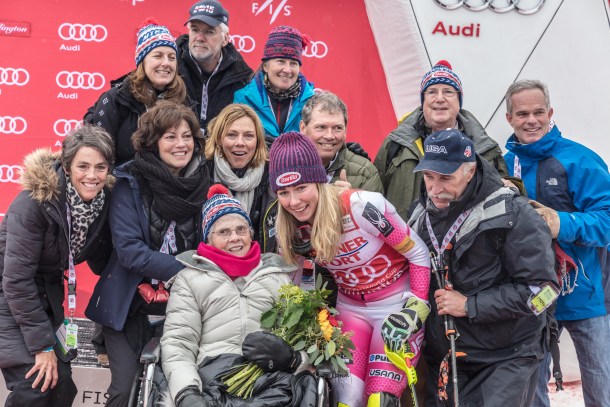
Shiffrin said the victory was particularly sweet because it took place in front of so many friends and family, including her 95-year-old grandmother.
“The most proud I’ve ever been is to win a race in front of my Nana, and the best part about it is she doesn’t care if I win or lose,” Shiffrin said. “Thank you, Nana, for your unconditional love and your incredible pies.”
Big turnout
The event marked a return of World Cup racing to the East Coast after a 25-year absence, with the last event taking place in Waterville Valley, New Hampshire, in 1991. The wait in Vermont has been 38 years, after the last such ski competition in 1978 in Stratton.
Organizers estimated crowds at about 15,000 people for each of the two days of the Audi FIS Ski World Cup.
“There’s no women’s World Cup race in the world that draws crowds bigger than this,” Tom Kelly, vice president of communication for the U.S. Ski and Snowboard Association, said Sunday. “This is one of the biggest crowds in the history of the women’s World Cup.”
The fans, some waving flags from tradition-rich ski nations such as France, Austria and Canada, seemed to release that nearly four decades of pent-up energy over the weekend, bringing a partylike feel to the base of the mountain. Temperatures in the low 20s Saturday and teens Sunday didn’t seem to tamp down the excitement.
In between ski runs, many of the bundled-up spectators who filled the stands sang — and danced as best they could in tight spaces — to party tunes like “YMCA” and “Shout” (think of the repeating lyric “a little bit louder now”).
More people lined the trail near the bottom of the course, getting an even closer view of some of the top skiers in the world.
The racers who tackled the giant slalom course Saturday, and the slalom Sunday, spoke later of hearing the loud cheers and clanging of cow bells that greeted them as they sped past the finish line.
Shiffrin, the crowd favorite, said she tried to capture that enthusiasm. “I’m just trying to hear them, take their energy,” she said.
Joining Shiffrin on the podium Sunday for the slalom race was Slovakia’s Veronika Velez Zuzulova in second and Switzerland’s Wendy Holdener in third.
Tessa Worley, of France, took the top spot a day earlier in the giant slalom, followed by Norway’s Nina Loeseth and Sofia Goggia, of Italy.

Making the snow
The races over the weekend marked the culmination of nearly a year’s worth of work at Killington to prepare, with committees formed to take care of tasks including booking the entertainment, ensuring enough parking and figuring out the housing. Hundreds of volunteers stepped up to take part.
But perhaps the biggest challenge was making sure there would be enough snow to provide the conditions required for World Cup racing.
Warm temperatures earlier this month brought back memories of last season’s snow-starved terrain.
However, nearly a foot of natural snow that fell early last week coupled with a nearly round-the-clock snowmaking operation ensured the trail was in shape to be certified as good to go.
“We had at the max about 140 guns on Superstar,” Mike Solimano, Killington’s president and CEO, said of machinery called to duty to pack the race course in snow.
“For comparison,” he said, “some of the smaller resorts on the East Coast might not even have 140 guns.”
Solimano estimated that over the last month about 16 million gallons of water fed the snowmaking operation to make Superstar ready for the weekend competition.
That concern over snow conditions, especially early in the season, was one of the leading factors for the long wait to see a World Cup race back on the East Coast, according Herwig Demschar, senior vice president of Powdr Corp., Killington’s parent company.
“Little did they know the Beast of the East has serious snowmaking power,” he told reporters, using Killington resort’s branding nickname.
Both Solimano and Demschar said it was too soon to say if Killington would host another World Cup race next year. Solimano did say it would certainly be a bit easier after having done it this year.
The spot on the schedule opened up for Killington this year when Aspen, which in the past has been the home to Thanksgiving weekend World Cup races, moved to hosting them in March.
Solimano declined to say how much the company spent on hosting the event this year, though he said the impact of the investment would be difficult to measure in the short term.
“You’re not going to get that return right away,” he said. “If you do the math, you might not choose to do it.”
Instead, he spoke of the long-term benefits of the exposure the event brings to the resort and the sport of skiing. The second runs of the races Saturday and Sunday were broadcast on NBC, with many viewers getting a high-definition look at the snow falling in the mountains of Vermont.
The economic impact could be felt throughout the weekend farther down the mountain, where all along the roughly 5-mile stretch of Killington Road leading to the resort, restaurant and nightclub parking lots overflowed with vehicles, many sporting out-of-state license plates.
In addition, some Killington residents sought to pocket some of the World Cup dollars traveling off the hill, with fliers posted in stores announcing rooms to rent throughout the weekend as well as the days leading up to it. On Craigslist, one sprawling Killington eight-bedroom home with a hot tub was offered for $8,000 for a seven-day stay.
Nearby communities, like Woodstock to the east and Rutland to the west, also worked to garner a share of some of the weekend windfall, with both towns sporting banners in their downtowns promoting the event as well as their local amenities.
Next generation
Beyond the economic boost, organizers talked of the impact of the race on the next generation of skiers, who may be inspired by watching the top-notch racers up close.
“You see what you’ve been told by your coaches, how to train, and you see how they apply that,” said Carolina Auerbach, 14, from Massachusetts and a member of the Killington Ski Club.
Katie Snow said she stood in the crowd for several hours in the cold, damp air in hopes of providing her daughter a lesson.
“This little one is 7, and we wanted her to see these wonderfully fast and strong women,” said Snow, of Camden, Maine, with her daughter Amelia Mills at her side.
Felicia Lynn, a former Killington Mountain School coach who now works at a ski school in New York, said after Saturday’s race that one of her lasting memories won’t come from the slopes at all.
A day earlier, Lynn said, many of the competitors went to the school to sign autographs for younger girls who are students.
“You should have seen the smiles on their faces,” Lynn said of the girls. “You could tell they were all inspired and ready to go for the season.”
Shiffrin, speaking to reporters a day before the competition, recalled that some of her most vivid memories of ski school at Burke Mountain Academy also didn’t involve runs down the snow-covered hills.
What she remembers most, she said, was singing her favorite songs in the car with others traveling to competitions and gathering with everyone around a small but powerful heater in the warming shack after a cold, wet training day at Burke Mountain.
“That was throwing off an insane amount of heat,” she said.
Shiffrin, who at 18 became the youngest slalom champion in Olympic alpine skiing history at the Sochi Games in 2014, did offer some advice to the up-and-coming racers who are attending training school or clubs.
She said it’s important to simply enjoy the sport and celebrate even the smallest improvements.
“Like getting more on your outside skis through one turn you’ve been struggling with … and really getting excited about that,” she said.
Tiger Shaw, president and CEO of the U.S. Ski and Snowboard Association, said the young skiers in the schools and clubs attending the event this weekend may find themselves on the World Cup circuit someday.
“There’s going to be a future medalist in the crowd somewhere,” he said.
