

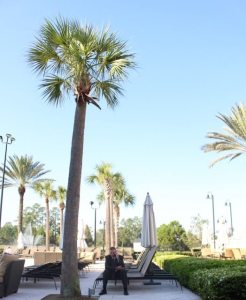
[O]RLANDO – Sitting in a lounge chair Wednesday morning — in a suit and tie near a big blue pool at the Waldorf Astoria — Vermont Gov.-elect Phil Scott was on the phone, all alone.
It was the last day of the Republican Governors Association’s annual conference, and Scott was giving an interview with Vermont Public Radio’s Bob Kinzel.
Brittney Wilson — a top Scott aide who worked on the campaign — was sitting near the hot tub, giving Scott space to talk. Beside her was a three-person security detail keeping six eyes on the soon-to-be chief executive.
Inside the Waldorf Astoria were dozens of governors — from New Jersey’s Chris Christie to Arkansas’ Asa Hutchinson.
They were all gathered to celebrate their electoral wins on Election Day and to take marching orders from the Republican Governors Association.
RGA leaders at the group’s annual conference this week urged their conservative colleagues to take advantage of the current political atmosphere and expeditiously push through GOP policy.
Vice President-elect Mike Pence, who currently serves as Indiana’s governor, visited the conference Monday evening and pledged to be a direct line of communication for the governors to President-elect Donald Trump. Pence said the repeal of major parts of President Barack Obama’s Affordable Care Act would begin on day one.
Scott opted to skip the first day of the conference — and instead spent time with his mother following a busy, long campaign that ended only a week ago.
As bubbles in the hot tub jumped wildly, Wilson nodded at her boss and said that he felt a bit like “a fish out of water” at the RGA conference. Sitting at the edge of the pool, Scott said he hadn’t had time for a swim, and he hinted that he would have rather been in the Vermont cold than the Orlando heat.
Back in Vermont, Scott’s team is working with Democratic Gov. Peter Shumlin’s staff to transition management of state government. He has had little time to prepare a budget that will find cost savings in education and health care, two areas of high spending he identified in the campaign. The process of setting budget priorities and hiring staff for the governor’s office and key positions in state government is “daunting,” he said. His office has received a deluge of applications for jobs in the administration.
“It’s exciting,” Scott said. “But at the same time it’s an enormous amount of work.”
Throughout his gubernatorial bid, Scott worked to distance himself from the national Republican Party, and he came out early in his disavowal of Trump and never backed down. Still, Scott received more than $2.8 million in support during the campaign from an RGA-backed political action committee.
Like Scott, a number of other Republicans had denounced Trump during their campaigns, but several softened their stances at the conference.
South Carolina Gov. Nikki Haley, who also serves as the RGA’s vice chairwoman, accused Donald Trump of using “dangerous” and divisive language back in March.
On Tuesday, however, Haley had nothing critical to say of Trump. She promised that the president-elect would be a willing and able partner of red state governors, adding that she was “giddy” about what was to come.
Still, Haley and other governors seemed to think that both Trump and a Republican-controlled Congress may not last.
“We can’t celebrate too long, we’ve got to get to work,” Haley said. “And that means 30 days, 60 days, 90 days, 120 days, all of us have to get to work.”
“Do it bold and do it early,” reiterated Bill Bennett, a popular conservative radio host.
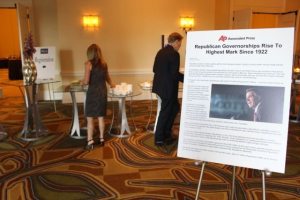
Out of the many RGA meetings at the conference, panels and parties hosted inside the golden walls of the Waldorf Astoria this week, just three events were open to the press.
Most of the governors — including Scott — spent most of their time either in private panels or policy meetings where guards blocked the doors.
Because much was kept secret, the RGA game plan was hard to pinpoint. In public, leaders broadly encouraged a governing strategy where business interests are prioritized and the government meddles in as few issues as possible.
They said the best way to foster economic growth is to eliminate programs and policies set by President Barack Obama.
“Think about the regulations we can roll back,” Gov. Haley said Tuesday, smiling.
Target No. 1 is the Affordable Care Act, which has helped insure tens of thousands of Vermonters. However, health care costs remain high, and many Republicans say that government-controlled services aren’t effective. While premiums have increased annually, costs are rising at a slower rate than under President George W. Bush.
Other federal statutes could be quickly rolled back once Trump becomes president in January, including overtime pay rules and regulations set by the Environmental Protection Agency.
RGA leaders promoted a conservative agenda for states, everything from tax cuts to so-called Right to Work legislation, which has reduced the bargaining power of trade unions. Marijuana legalization was also sharply discouraged at the conference.
Many of the attendees – which included governors and their staffers as well as Republican donors and corporate lobbyists — applauded these initiatives.
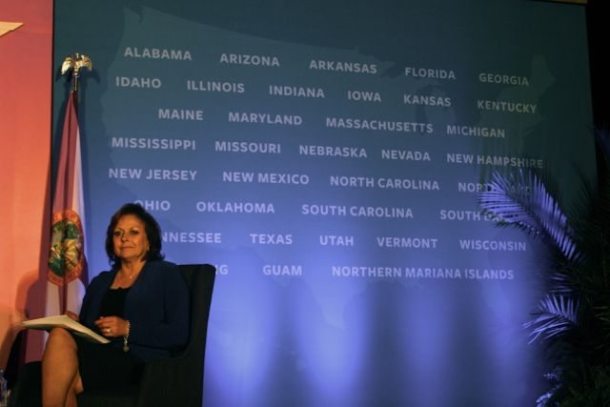
Scott, however, made clear that he’s not on board with a number of national Republican priorities.
While he supported a transition away from the Vermont Health Connect online exchange during the campaign, Scott supports the fundamental tenets of the program. He wants to transition the state exchange to a federal exchange under the Affordable Care Act.
He said the possibility that Vermont could lose millions of federal dollars — for everything from health care subsidies to the cleanup effort of Lake Champlain – was troubling.
He spoke about the positive interactions he had with more moderate governors, and hinted that they may push back against certain Trump policies.
“I certainly won’t be afraid to push back,” he said.
Wilson said Scott’s office had not been in touch with staffers for the president-elect.
“If there is a point in time where it’s necessary to have a relationship I guess that would be something we would want to consider just to make sure Vermont doesn’t suffer,” she said.
Scott is also more open to marijuana legalization than some of his Republican colleagues, and he didn’t rule out signing legislation in the next session, now that the neighboring Republican states of Massachusetts and Maine are legalizing.
He added a caveat — that any bill would have to include a sensible timetable for implementation. He said he would talk to Massachusetts Gov. Charlie Baker soon about how the commonwealth is moving forward with its legalization plan.
“If it’s inevitable, and it appears that it is because other states are doing it, we don’t want to — I’m not looking for Vermont to be an island,” Scott said. “So we’ll take that into account.”
There were some ideas promoted by RGA leaders that Scott has voiced support for, like an audit of Medicare and a streamlined permitting process for businesses. Scott also supports educational
investments in strategic technical education programs, and he said Vermont could get better at figuring out the sorts of jobs Vermont businesses are offering.
“Maybe we aren’t training in the right areas, maybe we need to develop better private-public partnerships so there’s not this disconnect,” he said.
Scott’s 50-page economic plan also calls for a number of tax cuts, including “lowering the personal and business tax burden across the board.” He is also calling for the elimination of taxes on Social Security benefits and equipment companies purchase to upgrade broadband service, among others.
In a panel Wednesday, Georgia Gov. Nathan Deal touted his state’s tax credits for film production, another policy Scott supports.
“We are the third ranked state in the country in terms of film production, only behind California and New York and it is about a $7 billion economic impact in our state,” Deal said.
A similar film credit in Massachusetts has been controversial and Gov. Baker has proposed its repeal.
Among Scott’s informal conversations during the conference was one with a representative from the Motion Picture Association of America. The governor-elect said he would be meeting with the MPPAA in the near future.
“He has a lot of ideas of how that can work, he knows the industry,” Scott said.
Scott said that while the RGA conference didn’t bring any specific ideas to the table, his team would be looking at work done by moderate governors including John Kasich of Ohio and Baker of Massachusetts.
“It was too much to really absorb,” Scott said about his flurry of meetings and panels, which ranged in topic from workforce development to energy policy. “It was more that I got a flavor.”
In a short interview with VTDigger, former Mississippi Gov. Haley Barbour said in a southern drawl that RGA conferences offered many resources for new governors.
“Governors get to spend time with each other, learn from each other and talk about problems that exist in more than one state and how to deal with them,” he said.
Barbour added that “for this particular conference there are lots and lots of donors and they get a chance to meet governors, to talk to ‘em, to hear from ‘em, to sort of feel like they get to know them some.”
Scott’s team provided VTDigger with a list of all the formal meetings Scott held with business interests, though other informal conversations occurred between Scott and attendees.
There were dozens of corporate representatives at the RGA conference, who swapped stories and handshakes over drinks and food. None of the large power players wanted to talk to the press.
A lobbyist from British Petroleum said, “I’m not authorized,” while a Honeywell representative scurried away when asked why he was at the conference. Another man in a crisp gray suit from Pfizer pharmaceuticals said “I’m corporate, so I’d have to refer you to media relations.”
Just one lobbyists talked to VTDigger, Tony Ravosa of The Vince Group, a small firm with a smattering of corporate clients throughout New England.
Ravosa said he attended an RGA fundraiser for Scott this fall in Boston, and said he was happy to see a Republican governor in the Green Mountain State.
Ravosa said he had been attending RGA conferences for years, explaining that the access to governors was unparalleled.
“You don’t have to go through a staffer you just see them walking through the lobby,” Ravosa said. “It’s a nice environment, not so formal.”
Ravosa — whose firm has an office in Boston — said he had no current clients with pending business in Vermont.
But as a big Red Sox fan, he said he encouraged Scott to produce political lawn signs aimed at undercutting Liberty Union Candidate Bill “Spaceman” Lee, who ran for governor and used to pitch for the Sox.
“I thought he should make lawn signs that said ‘Another Red Sox fan for Phil Scott,’” Ravosa said, chuckling.
Scott said the RGA conference was a chance to network more with governors, not lobbyists, and he made it clear that the conference was not exactly his cup of tea.
The governor-elect said that while other governors shared economic stories from their states, he focused on communicating a need for bipartisanship.
“I mostly spoke about the ability to work across party lines,” Scott said. “But I’m at a Republicans Governors Association meeting, so I don’t know if they like to hear that.”
