

The claim
“Phil Scott is the only candidate in this election who is unequivocally against a tax on carbon. In stark contrast, Sue Minter has expressed support for a regional carbon tax that could add up to 88-cents to a gallon of gas and heating fuels; as well as a carbon cap and trade scheme that increased the price of gasoline by 11-cents when it was implemented in California. In addition, when pressed in a WCAX interview on her support for a carbon tax, Sue Minter abruptly walked out on the interviewer.”
— Jeff Bartley, executive director of the Vermont Republican Party
The facts:
Some House Democrats proposed a carbon tax bill last year, and are almost certain to do so again this year. In year one, the proposal would put a 10 cent tax on fossil fuels. That rate would increase to 88 cents in a decade. Ninety percent of the revenue would be used to lower other taxes. The remaining 10 percent would be used for investments in public transportation and weatherization.
The purpose of the legislation is to discourage use of fossil fuels. No state in the U.S. has attempted to pass a carbon tax on its own. Critics of the plan say that the tax would hurt Vermont’s unless other states in the region passed similar legislation. Gov. Peter Shumlin has said a carbon tax should be implemented at the national level.
Phil Scott, the Republican candidate for governor, has said he does not support a state carbon tax.
Democratic gubernatorial candidate Sue Minter has also said she opposes a go-it-alone carbon tax plan for Vermont.
“I do not think at this time with our economy that [a carbon tax] is something appropriate for just the state of Vermont,” she has said.
But Minter has refused to say whether she would veto a carbon tax bill should it land on her desk. Instead, she talks about an expansion of a cap-and-trade program that Vermont participates in called the Regional Greenhouse Gas Initiative.
Minter wants the Regional Greenhouse Gas Initiative’s cap-and-trade program to include Vermont’s transportation-fuel emissions, as a further means of “pricing” carbon pollution. She has said her opponent has mischaracterized her position and doesn’t understand how the cap-and-trade program works.
Scott and the Vermont GOP assert that Minter supports a Vermont carbon tax, pointing to her refusal to say she’d veto a bill.
An exchange that took place at a debate Oct. 6 in Colchester illustrates the disconnect.
“I do not support a carbon tax for Vermont,” Minter said in Colchester. “What I am looking forward to is building on the work I’ve been working on for the last three years, in the transportation agency, working with other states throughout the Northeast region… That’s why I want to continue the work I’ve been doing on expanding the Regional Greenhouse Gas Initiative.”
“It sure looks like she supports a carbon tax,” Scott said.
“Phil, I’m so sorry you don’t understand policies that relate to reducing emissions,” Minter said. “The Greenhouse Gas Initiative is actually a cap-and-trade program where states like Vermont, that reduce emissions, receive benefits in terms of investments.”
“Cap-and-trade in California costs them 11 cents a gallon,” Scott said. “That sounds like another tax increase.”
Economists say a carbon tax and a cap-and-trade program are not the same. Both fall under the category of “carbon pricing,” which Minter said she supports.
Jon Erickson, a professor of ecological economics at the University of Vermont’s Gund Institute for Ecological Economics, says there are big differences between the two approaches.
Economists tend to prefer a carbon tax over cap-and-trade programs, Erickson said.
“It’s simple, it sends a clear signal to the market, and you know exactly what the tax is and how it’s going to change over time,” Erickson said.
British Columbia, for example, enacted a carbon tax in 2008 that is revenue neutral. The province has used the carbon tax to reduce property and income taxes, he said.
By contrast, a cap-and-trade program specifies how much carbon pollution a state may emit, and power producers pay for the privilege of polluting. Cap-and-trade programs are subject to market influences like the price of oil. That makes it difficult to predict how much revenue they’ll generate, Erickson said.
Minter presumably wants to expand RGGI, Erickson said, because it’s a regional carbon-pricing scheme that’s already in place.
“By taking advantage of RGGI, what that seems to say is, ‘We don’t have to go it alone — we have a big bunch of states already pricing carbon, let’s just exploit it,” he said. “The carbon tax would very much be Vermont going it alone… That’s a big difference in favor of going to RGGI.”
Minter insists Scott has mischaracterized her views.
“I want to repeat — which I have said over and over again, in many debates and on many forums and in many interviews, I do not support a carbon tax bill, and you continue say that I do,” Minter said at the WCAX debate on Oct. 23, after Scott accused her of supporting “the idea of a carbon tax.”
The score:
Scott equates cap-and-trade programs with carbon taxes. Cap-and-trade is no different than a tax, he said, because, as one example, a cap-and-trade program in California raised the cost of gasoline by 11 cents.
In Scott’s defense, legislators are likely to bring forward a carbon tax proposal this year, and no matter how much Minter says she wants to expand RGGI, her support for “carbon pricing” could be the dog whistle carbon tax supporters are seeking to move forward.
Also, Scott’s not the first to suggest that RGGI and other such cap-and-trade programs are the functional equivalent of a carbon tax, only without the objectionable name.
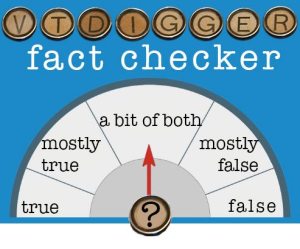
We rate Scott’s claim that Minter “supports a carbon tax” as DEBATABLE.
