

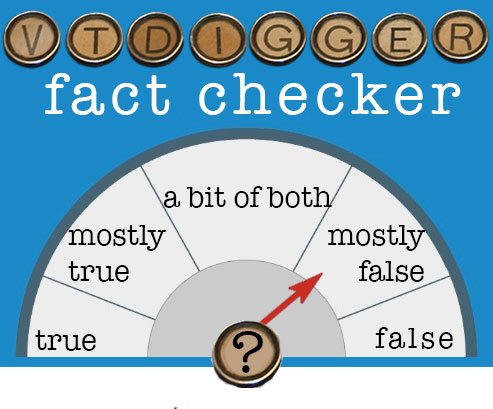
Editor’s note: VTDigger Fact Checker is an analysis of statements made by candidates.
Claim: “In the last six years alone, Vermont lost nearly 16,000 workers from its workforce. This amounts to a loss of about $750 million in potential wages.” (Phil Scott’s Comprehensive Blueprint for Economic Growth, Page 9.)
While Vermont’s total workforce numbers declined between 2010 and 2016, the number of people in Vermont with jobs in 2016 is at the highest level in several years. The unemployment rate has declined since mid-2009.
The workforce has dropped by 14,013 over a six year period, according to the Federal Reserve of Boston, not by 16,000, as the campaign says.
The terms Scott uses, however, are misleading.
The workforce includes people who are either (1) working or (2) unemployed, but actively seeking work. The workforce does not include retirees, students, stay-at-home parents, retirees, or people who were unemployed for so long that they have given up looking for work.
When people leave the labor force, they could be retiring, newly disabled, going back to school, becoming stay-at-home parents, or they have been unemployed for so long that they are giving up on their job search.
The notion that people leaving the labor force represents $750 million in “lost wages” is false, according to Doug Hoffer, the state auditor. If a person retires from the labor force, he or she is often replaced by another worker, meaning that money has not necessarily been lost, Hoffer said. If an unemployed person stops looking for work, the person has exited the workforce but not lost any wages.
“The whole premise is fatally flawed,” Hoffer said. “They’re assuming that a decline in the workforce is equal to a loss in jobs, and that is absolutely not true. Some people will find that incongruent and difficult to accept, but it is true.”
The math behind the $750 million is also flawed. The campaign calculates lost wages based on median household income, which the U.S. Census Bureau defines as all money that all wage-earners in a household take in, not one person’s earnings. In contrast, wages are the money one person makes, according to the U.S. Bureau of Labor Statistics.
Footnotes the Phil Scott campaign cites in the Blueprint for Economic Growth show that the campaign arrived at the $750 million by multiplying $50,000 (the median household income from 2007) by 16,000 workers. The footnote shows the campaign arrived at “the approximately $750 million” figure instead of $800 million. It then multiplied 16,000 by $46,000 (the mean annual wage from an unknown year) and got $736 million. The campaign apparently settled on $750 million.
