


Claim: Sue Minter has said that if she wins the election she will introduce the “Vermont Promise,” a plan to pay tuition for Vermont high school graduates to attend two years of college at the Community College of Vermont or Vermont Technical College. She plans to pay for it with a franchise fee on the state’s largest banks and by expanding Vermont’s corporate income tax to big banks. She said it will cost $6 million the first year and $12 million the second year.
Facts: Minter hopes to help low-income students pay for college. She modeled the Vermont Promise on Tennessee’s Promise program. Like that one, Vermont’s would be a “last dollar plan,” which means that the state doesn’t kick in money until a student has exhausted federal grants and scholarship opportunities.
Since 2014, Tennessee, Oregon and Minnesota have set up free community college programs. There are at least 10 more states that will be considering similar plans during the 2016 legislative session, according to the National Conference of State Legislatures.
Promise programs that pay tuition only, however, have been criticized for hurting low-income students because costs for textbooks, transportation and living expenses are not included, according to the Atlantic Magazine.
Debbie Cochran of The Institute for College Access and Success said that money is better spent targeting low-income students who have obtained scholarships but don’t have money to live without working full time. Both Oregon and Minnesota provide additional funding beyond scholarships to help defray fees and expenses.
Minter has proposed with a bank franchise fee and corporate income tax on the state’s largest banks. Vermont has five large banks, according to the Vermont Bankers Association. (The state does not currently charge banks a corporate income tax. Credit unions don’t pay the state franchise fee.)
Currently, Vermont taxes 0.0096% of bank deposits. The bank franchise fee raises about $10 million a year for the general fund, according to Sara Teachout, a senior fiscal analyst on revenue and tax at the Vermont Legislative Joint Fiscal Office.
Teachout said that in order to raise an additional $6 million for the plan, the current tax on banks would need to increase by 55 percent to 60 percent. “As for how to raise this under the corporate income tax, that would take a significant amount of analysis because banks currently do not file any income tax information,” she added.
Minter’s proposal is not sustainable for the few large banks in Vermont, according to Christopher D’Elia, president of the Vermont Bankers Association. He said that such a dramatic increase in taxes would lead to job losses. “The bottom line is these banks will not be able to just absorb the increase and go about their business,” D’Elia said. “They will have to find ways to cut costs.”
Vermont offers dual enrollment to high school students to enroll in two college courses at no expense through Act 77, the Flexible Pathways law.
There is also an early college program that allows student to finish 12th grade entirely in college while taking college courses. The Community College of Vermont, the University of Vermont and the Vermont State Colleges participate in the program. This program is a voucher plan paid for by the state. This is the third academic year that students can take advantage of the program. There was an increase between the first and second year, according to a 2016 AOE report. Last year, 1,800 students took part in the dual enrollment program costing the state $1.277 million. That same year, 121 students enrolled in early college at a cost of $1.25 million.
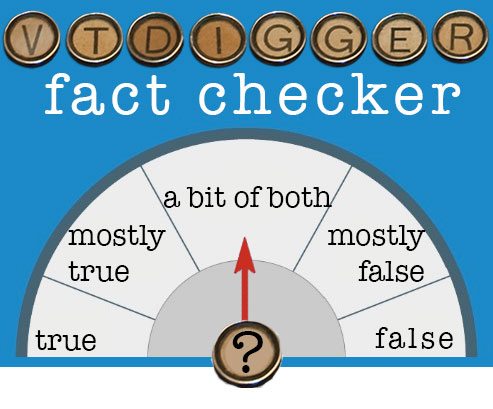
Score: Debatable. It is questionable whether lawmakers would want to put such a high tax burden onto the banks and trigger negative consequences to the state’s economy. It also isn’t clear without further research as to whether the funds can be collected through an income tax. Some might also argue that the program isn’t necessary since there already are early college and dual enrollment programs in place in Vermont and paid for by the state at a much less expense.

