

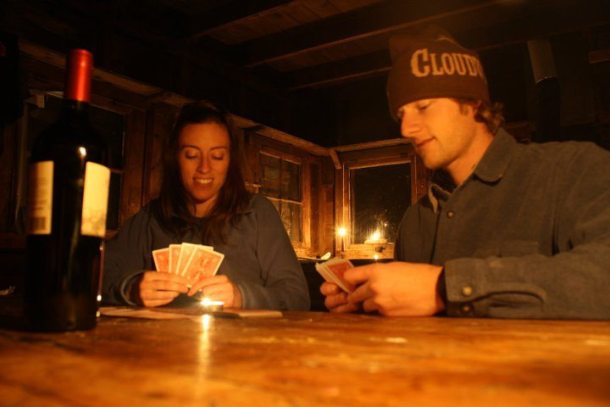
[T]wo Vermont men are seeking partnerships and funding for a venture they hope will permit hut-to-hut backcountry excursions across the state.
They’ve started a nonprofit called the Vermont Huts Association, and they say the hut system they’re trying to create will prove a boon to the economy and a valuable amenity for cyclists and backcountry skiers.
Around 30 huts, yurts and cabins already await outdoor athletes across the state, said the Vermont Huts Association’s RJ Thompson. At either end of the state, however, are 30- to 40-mile stretches with no permanent backcountry lodging.
“The southern part of the state is severely lacking in any sort of cohesive network of huts or cabins,” Thompson said. The same is true to the north: “Once you get beyond Killington, there’s not a lot going on in terms of accommodations,” he said.
Thompson and Devin Littlefield — the organization’s two co-founders — are working with academics at the University of Vermont to gather evidence of economic benefits associated with backcountry skiing, and they say this data could help to secure grant funds.
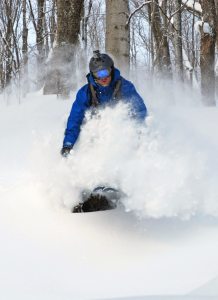
Anecdotally, they said, plenty of evidence already exists that “there’s big enthusiasm behind this movement.”
For example, while the duo disclaimed any political allegiances, they noted that gubernatorial candidate Sue Minter includes promotion of Vermont’s existing hut systems as an item on her campaign platform. Minter claims the huts represent an often-overlooked economic opportunity for the state, and Littlefield said she’s right.
Burgeoning turnout at the annual Backcountry Forum — held this year in Rochester on Nov. 3 — shows that large numbers of Vermonters ski outside resorts, Littlefield said.
Ultimately, the two men want to provide backcountry lodging sufficient to ski or mountain bike from the northern end of the state to the southern border, more or less uninterrupted. This could take decades to accomplish, they said. They envision working with other groups such as the Catamount Trail Association, which has developed a public access ski trail running the length of Vermont.

With Littlefield having worked for years on Alaska’s and Maine’s huts and trails system, and with Thompson having organized successful Vermont outdoor endurance events, they say they’re well-prepared to put the project in motion.
Last winter’s poor snowfall didn’t discourage them, Littlefield and Thompson said.
“Last season was an exception and not the rule, to winters in Vermont,” Thompson said. “We do recognize — having studied it in grad school — climate change and its impact on the economy, but I don’t think that should dissuade us.”
“By no means are we going to let a fluke winter put a damper on our plans,” he said.
Vermont’s got some of the best backcountry skiing on the East Coast, Thompson said, and additional huts and yurts will bring tourists and provide jobs for Vermonters.
Reactions have been overwhelmingly positive, both men said, but some Vermonters might see a downside to opening up Vermont’s backcountry terrain to flatlanders.
“If there are naysayers, they’re probably locals, and probably people protective of their backcountry areas,” Littlefield said. “They put in the labor to create glades and trails, and they want to enjoy it for themselves.”
The counterargument to that, Thompson said, “is that the more people that get into the backcountry on skis, or on a mountain bike or hiking, the more likely it is that these individuals will support conserving and protecting that land moving forward.”
More information on the Vermont Huts Association can be found at its website.
Correction: The attribution of the last two quotations has been corrected.
