


(Editor’s note: VTDigger is profiling the major party candidates for lieutenant governor. A profile of Progressive/Democrat David Zuckerman is still to come. For more election-related coverage, see our Legislative Candidate Guide.)
[P]artway through a debate in St. Albans last week, the two leading candidates for lieutenant governor were arguing the pros and cons of marijuana legalization. Progressive/Democrat David Zuckerman, a lead supporter of legalization in the Vermont Senate, was extolling the upside, which he said included a huge untapped market that could generate millions in tax revenue to fight opiate addiction and even enough to help lower the cost of higher education.
When it was Randy Brock’s turn, the Republican punctuated his answer with this bottom line:
“The notion that cannabis could be used as an economic development tool — the same goes for higher education — is utter nonsense,” Brock said.
Later, Brock was equally dismissive when Zuckerman advocated raising the minimum wage. Quite simply, said Brock, a former financial services executive who served one term as state auditor, increasing the wage to $15 an hour would fuel inflation and press employers to pass along the increased costs to their customers.

“It sounds great,” Brock said, but he suggested it was naive to think businesses wouldn’t take a hit. Zuckerman, on the other hand, said many of those in low-paying jobs qualify for food stamps and other benefit programs.
“We’re robbing Peter to pay Paul,” Zuckerman said.
The gap on economic issues between Brock and Zuckerman couldn’t be more stark. In addition to raising the minimum wage, Zuckerman thinks all Vermonters’ property tax payments should be based on income, in part so wealthier residents, who he says are not paying their fair share, will pay more.
Brock, on the other hand, worries property taxes are punishingly high and are pushing residents to flee to lower-tax states. He said if the economy doesn’t improve, property tax rebates will increase and stress the system. Brock is echoing many of the economic distress themes advanced by Republican gubernatorial candidate Phil Scott, including calls to slow the growth of the state budget. As part of his campaign, Brock pledged to find $100 million in savings or new revenue.
Brock and Zuckerman are also at opposite ends of the spectrum on some social issues: Zuckerman fought hard for same-sex marriage; Brock voted against it. Zuckerman was a leader in the fight to require the labeling of genetically modified foods, making Vermont the first state to do so. Brock views the GMO legislation as a classic example of the left’s zeal to pass laws untested anywhere else.
“Vermonters are tired of being guinea pigs in some grand social experiment,” he said.
As far apart as they are on policy (though both are pro-choice), the gulf of respect between the 72-year-old former Army captain in the Military Police Corps who served in Vietnam and the 45-year-old pony-tailed organic farmer may be equally as wide, at least from Brock’s side.
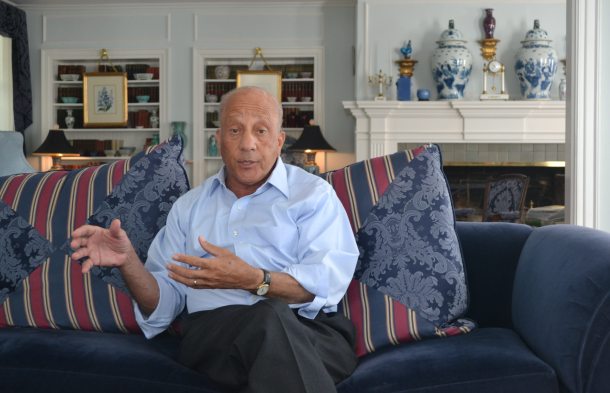
In an interview at his stately home in Swanton, a historic farmhouse that dates to 1799 with fine furniture, antiques and a theme of blue, Brock was asked if he respected Zuckerman. A full 15 seconds of silence elapsed before he suggested moving on to the next question. A moment later, Brock amended his earlier non-answer, noting he didn’t feel strongly one way or the other about his opponent.
“I don’t respect or disrespect him,” he said. “I’m just concerned about some of the things he’s said. And done.”
Brock’s gaping-hole answer came right after he excoriated Zuckerman for holding a campaign event in late September that focused on raising awareness about racism. In both the interview and an earlier open letter, Brock criticized Zuckerman’s promise of “music and fun,” a cash bar and “a good time” at the rally and said his approach showed a lack of appreciation for racism’s harsh effects. What really frosted Brock, he said, was Zuckerman’s response to his criticism and claims by some of Zuckerman’s supporters that Brock, who is African-American, hasn’t done enough to combat racism during his career.
“It just pisses me off,” said Brock, clearly annoyed, before requesting his coarse language not be published.
Brock said racism nationally remains a significant problem. He said his race is irrelevant — “no more relevant than the color of my hair, if I had any” — but he said he was so offended by Zuckerman’s comments that he felt he had to speak up.

Before losing to Shumlin, Brock served two terms in the Vermont Senate. One colleague of both Brock and Zuckerman, Sen. John Campbell, D-Windsor, said Brock viewed issues in a more black-and-white way, while Zuckerman saw more gray, sometimes a more nuanced view. Any tension between the two, Campbell said, may be generational and because of their different backgrounds.
Brock’s military background, Campbell said, may explain what appears at times to be a disdain for people “drawing outside the coloring book lines.”
“David can work in the gray areas. Randy can’t,” Campbell said, adding that neither was right or wrong and that “sometimes you have to be flexible.”
When Brock speaks, he can sound exasperated, the pitch and tone of his voice displaying disbelief over an opposing position as well as certainty of his own view. For example, Brock said Zuckerman’s comments about racism were “so far off the mark it’s insulting in recognizing a serious issue in our nation.”
Businessman’s son
Brock grew up in Philadelphia, where he attended the same high school as his father. The school was the second-oldest high school in the country and was allowed to give out bachelor’s degrees. Brock said he traveled an hour each way — a bus and two subway rides — to school but greatly valued the quality education.
Both of his parents were the first in their families to attend college. His father, at 5 feet 7 inches tall, won a basketball scholarship to attend Shaw University in North Carolina. His mother grew up in the Tar Heel state.
After working for the federal government, Brock’s father owned a series of bars.
“My father was a Democrat who woke up every day cursing the government for all the taxes and regulations,” Brock said, chuckling.
His parents believed in the importance of college. Brock graduated from Middlebury College with a history degree and earned a master’s in history from Yale before serving in the Army. He won a Bronze Star in Vietnam but noted it was for meritorious service as a military police officer. He did not see combat and said the award “was not for heroism.”
Brock started a security business after Vietnam that included lie detector tests. He met his wife, Andrea, in 1973 at a polygraph conference. They moved to Vermont and bought Rockledge Farm in 1986. They have a 29-year-old daughter, Natalia, who is a paralegal in Florida and runs an online pet supply business. She was adopted when she was 9 years old from Estonia. Andrea Brock took up bodybuilding at age 58 after having difficulty carrying a 5-pound sack of flour at the store.
Randy Brock described his upbringing as middle class, with his father facing the typical financial challenges of someone who owns a business. In 2012, Randy Brock reported a net worth of close to $6 million, including property in Florida worth $3 million and the Swanton home, valued at $1.35 million.
As a youth, Brock said, he experienced racism, particularly when he visited his mother’s relatives in North Carolina. He recalled having to “literally ride in the back of the bus.” On another occasion, his mother told him to stop drinking from a water fountain reserved for “whites” and took him to a rusty fountain designated for “coloreds.”
“I remember that distinctly,” he said emphatically.
Although Zuckerman’s Sept. 25 event on racism hit a nerve with his opponent, Zuckerman and his supporters described it as a success where many people of color shared their experiences.
Brock also condemned Zuckerman’s quip that Zuckerman would be a good financial steward as lieutenant governor because his father was Jewish, which Brock called offensive to some Jewish supporters. Zuckerman has apologized. A campaign adviser also acknowledged that Zuckerman would be wise to heed another call by Brock: for Zuckerman to stop saying at public events that he can’t refer to the illicit trade in marijuana as the “black market” because it might be politically incorrect.
Brock also questioned his opponent’s ethics.
He raised Zuckerman’s unapologetic admission that as a House member, he billed the state for the full daily allocation for meals and mileage even when he carpooled with other lawmakers and didn’t spend all the meal money. The move was allowed under statute, and many lawmakers did it, but some frowned upon the practice, including Brock. (A similar discovery 15 years earlier led some lawmakers to return expense money to the state.)
Zuckerman said taking the full reimbursement was not only allowed but justified because lawmakers were poorly compensated. The extra few hundred dollars, Zuckerman said, helped cover expenses like a cellphone or time attending meetings when lawmakers were out of session. The system was changed four years ago so lawmakers can only bill for actual mileage.
With a month until the election, Brock doesn’t plan to let go of the reimbursement issue or the racism event.
“This race is about character, integrity and trustworthiness,” Brock said.
He admitted there’s a danger of being too critical, that voters might think he’s attacking Zuckerman to get attention and perceive he’s behind in the polls.
“I don’t like to make accusations,” Brock said. “In terms of campaigning nobody likes to be ‘negative’ in their campaigning, but you’ve got to point out contrasts because people don’t necessarily know the differences. An informed electorate is important.” And counting on the media, he said, is foolhardy. When he ran successfully for auditor in 2004, Brock told reporters that incumbent Elizabeth Ready had padded her resume, but no story was published until he went public with the charge.
Like Scott, Brock said he cannot “in good conscience” vote for Republican presidential candidate Donald Trump because of public comments he’s made, the way he has conducted his personal life and differences in policy. Brock said he will write in a Republican, although he said he doesn’t know who. (Brock was interviewed before the latest Trump videotape was published.)
A numbers guy
Former Gov. Jim Douglas said Brock faces an uphill battle. He said running as a Republican in a state as politically blue as Vermont is “like swimming upstream.” The former four-term governor said Brock’s biggest challenges were having an R beside his name on the ballot and “getting people to know him.”
Brock agreed being a Republican was a handicap and said his biggest hurdle was “getting anybody’s attention.”
He admitted not being the most interesting candidate.
“I do tend to sometimes sound like a technocrat,” Brock said. “When you talk about numbers and budgets, I have a great ability to put people to sleep.”
Brock supporters, however, say his greatest strength is his financial skills. Before he served as auditor from 2005 to 2007, Brock was executive vice president for risk oversight at Fidelity Investments, a global financial firm. Prior to that, he founded a security business that he grew and later sold. His analysis of public policies has been prescient: For example, he predicted early on that the state would experience big problems with Vermont Health Connect.
Douglas said Brock’s financial skills could help the next administration and Legislature slow the growth in spending.
The $100 million he seeks to save could come in part, Brock said, from using the EB-5 foreign investment program to pay for infrastructure projects including roads. He also wants to find another industry like captive insurance, which concentrated in Vermont because of favorable regulations.
“He’s a great fiscal manager, which we haven’t seen in quite some time,” Douglas said, getting in a dig. “He’s just a bright guy. And as people get to meet and know him, they will see he would make a valuable contribution.”
Political stakes
Campbell called Brock “professional, courteous and respectful” even though they were frequently on opposite sides of an issue.
Campbell applauded Brock’s integrity, mentioning an audit he conducted that some business interests objected to. Brock lost re-election after serving one term, though Brock and others attribute his loss to Tom Salmon largely to his opponent’s name recognition. Salmon’s father served as governor in the 1970s.
Campbell said he and Brock “were polar opposites on many issues, but he was somebody that I could always have a conversation with him and know that at least he would listen to what I had to say rather than just hear it out.” Campbell, who is executive director of the Vermont State’s Attorneys and Sheriffs Association, declined to say whom he will vote for in November.
However, Campbell and Douglas noted the lieutenant governor’s race could significantly shape the direction of the Vermont Senate. The lieutenant governor is one of three members of the Committee on Committees, which selects chairs and makes committee assignments. Sen. Tim Ashe, who like Zuckerman runs as a Democrat and a Progressive, is the likely next president pro tem, the top leader and a member of the committee. The third position on the Committee on Committees is appointed by the Senate and is currently held by Sen. Richard Mazza, D-Grand Isle, one of the Senate’s more conservative Democrats.
“The choice is so clear here,” Douglas said. “What’s really at stake here is whether the Vermont Senate will remain moderate or will it swing wildly to the left.”
“I think Vermonters deserve moderation,” Douglas said.
Campbell said if Ashe secured the pro tem position and Zuckerman won, the new lieutenant governor would “be true to his Progressive roots” and likely push for more liberal chairs.
“The makeup of the committees, that’s what it would come down to,” Campbell said of the difference between Brock and Zuckerman.
Lt. Gov. Scott and Brock served together when Brock was a senator from 2009 to 2013. Scott remembered Brock as objective and intelligent.
“He was very studious. He took it very seriously and did his homework,” Scott said.
Scott described their relationship as “not close, but one of mutual respect.” Scott said he was less conservative than Brock on social issues but that they were on the same page on fiscal matters and their belief state government has been spending beyond its means.
The two are not campaigning together. Scott came under criticism by some Republicans for not using some of his popularity to help Brock more in his 2012 gubernatorial run. This time around, Scott said, they are “just doing things separately,” but he said he shares his schedule with Brock’s campaign and sometimes Brock has come to an event.
Scott is clear, however, that if he wins the governor’s race, he wants Brock in the second position.
“In terms of the fiscal reality we find ourselves in, I’m not sure Sen. Zuckerman has the same grasp on that. He and I wouldn’t see eye to eye on that and don’t share the same priorities,” Scott said. “I think Randy and I do share the same priorities.”
Brock said he’s focused on the long term, not the next election cycle.
“I think what Vermont needs is not someone who is thinking not about patching the potholes for the next two years of government, but about the long term: what Vermont ought to be going forward, dealing not only with an affordability crisis, which everyone seems to admit we have right now, what kinds of things do we need to put in place to have a vibrant Vermont five, 10, 15 years down the road. How can we turn the battleship?” Brock said.
