


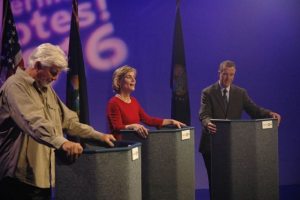
COLCHESTER — The three major party candidates for governor squared off under the purple lights of the Vermont PBS studios Thursday, jostling over the question of whether Republican, Democrat or Liberty Union ideas would catapult Vermont to the best possible future.
With just over a month before the Nov. 8 election, Republican Phil Scott and Democrat Sue Minter each turned up the heat. Former Red Sox pitcher Bill “Spaceman” Lee — the candidate for the Liberty Union Party — stretched before the event began, literally, and offered his own prophetic vision for the Green Mountain State. His answers were often delivered in proverbs.
“I am a gun-hunting right-wing,” Lee explained to the audience. “But I also have a liberal heart.”
Lee’s libertarian pitch includes higher pay, environmental protections and, above all else, better public health through vigorous exercise and access to fresh Vermont farm fare.
“Drink locally, think globally,” he said at one point. “And if you raise the minimum wage — up high — people are going to make more money and there’s going to be more taxes around.”
The state’s tax code was one of the most discussed issues of the night, with Scott frequently promising not to raise taxes on the middle class. The lieutenant governor also pledged to propose budgets that do not grow at a faster percentage rate than the state economy or average wages.
“We will find efficiencies, we will modernize state government and we’ll find the will to get through this without raising state taxes,” Scott promised.
When nudged by PBS moderator Joe Merone about what specific cuts he was willing to make, Scott demurred.
“I have all kinds of specifics,” he said. “You can go to PhilScott.org and see all those in my economic plan.’”
Beyond proposed cuts to Medicaid spending, Scott’s plan carries little detail about what programs he would actually scale back as governor.
“Phil has not mentioned what he’s planning to cut,” Minter said. She asserted that Scott may follow the lead of House Republicans. A recent GOP proposal included cuts to substance abuse recovery centers, a 1 percent reduction in state college spending and the elimination of a child care subsidy for poor mothers.
While the thrust of Scott’s campaign has been financial prudence, Minter has outlined a series of costly proposals, including two years of free tuition at state colleges, greater access to early childhood education and universal health care.
Minter pledged not to add new sales or service taxes that burden most Vermonters, but said she would pay for programs by closing tax loopholes for the wealthy, such as tax exemptions on limo rides and lobbyists. Her college plan would be paid for by instituting higher taxes on large banks, a move Scott said would result in additional bank fees and hurt middle class Vermonters.
“Nothing is free,” Scott said of Minter’s college plan. “Somebody has to pay.”
The debate got most heated on the topic of global warming, and the idea of a carbon tax. Democrats introduced a tax on gasoline in the last legislative session. The tax — which failed to gain widespread support — would have gradually ratcheted up gas prices by as much as 89 cents over 10 years.
Ninety percent of the revenue generated by the carbon tax would be used to cut other taxes, the bill’s co-sponsor told VTDigger.
The Vermont Republican Party has frequently invoked the proposed bill throughout the campaign, and Scott looked to tie Minter to her party’s tax proposal throughout the debate.
Minter insisted she did not support a carbon tax. She instead charged Scott of mixing up a carbon tax with her support of the Regional Greenhouse Gas Initiative, a cap-and-trade “market” among nine Northeastern states designed to curb regional greenhouse gas emissions and encourage states to invest in renewable energy and efficiency projects. The program has brought millions in incentives to Vermont.
“Phil, I’m so sorry you don’t understand policies that relate to reducing emissions,” Minter said. “The Greenhouse Gas initiative is actually a cap and trade program where states like Vermont, that reduce emissions, receive benefits in terms of investments.”
Scott said that her proposal “sure sounds like she supports a carbon tax, whether it’s regionally or for the state.” He pointed out that a cap and trade program in California has resulted in higher gas prices and promised that, if elected, he would veto any carbon tax bill that made it to his desk.
Making her last pitch in support of the Regional Greenhouse Gas Initiative — which was supported by former Republican Gov. Jim Douglas — Minter focused on the impacts of climate change on Vermont’s economy.
“Let’s think about last winter,” Minter said. “What happened in the Northeast Kingdom when the snow machines didn’t come to the general stores? What happened to the snowplow drivers that couldn’t actually get work? What is happening when we lose our winters? This is serious.”
In his answer on the shifting Vermont climate, Lee was even more dire.
“The problem is that we are ruining our environment, we are just killing it,” he said. “You never see a deer eating down on a river anymore, running through a pasture. They run through there like they are on fire, because they are on fire!”
