



[B]RATTLEBORO — In a sunny meeting room on a historic Brattleboro farm property, a few dozen people spent part of Friday morning talking about good news in the region’s dairy industry.
They highlighted local success stories like the Holstein Association USA and the rapidly growing Commonwealth Dairy. And they touted a resurgent interest in agriculture, with an accompanying need for workers and training.
But there was no avoiding the dark clouds over Vermont’s dairy business: Farmers are struggling with low milk prices, ineffective federal policy and global economic dynamics.
U.S. Rep Peter Welch, D-Vt., pledged to work for a “better dairy support program than we have now.” Vermont’s farmers, he argued, cannot be left alone to be buffeted by free market forces.
“The big challenge for us is to try to have, in the federal government, a program that is going to kick in at the right time, at a reasonable amount so farmers can make it through the ups and downs that are part of the agricultural economy,” Welch said.
Friday’s panel discussion, held in renovated farm buildings at the Vermont Agricultural Business Education Center, was meant in part to draw attention to the continued importance of the dairy industry in the Green Mountain State.
The business spurs $2.2 billion in annual economic activity and provides 6,000 to 7,000 jobs, according to a recent report from the Vermont Dairy Promotion Council.

Vermont’s milk industry is concentrated in Addison and Franklin counties, which together host more than half the state’s dairy cows. “That is huge for those communities, but it’s also big down here,” state Agriculture Secretary Chuck Ross told the Brattleboro audience.
That is evidenced by farmers like Rob Wheeler, representing the third generation to run his family’s Wilmington farm. Wheeler noted the state dairy council’s estimate that each cow brings $12,500 in annual economic activity to the state.
“If you could just multiply that by all of the cows in southern Vermont, you can see that’s a pretty important feature (of the economy),” Wheeler said.
Ross also hailed the size of the “working landscape” tended by dairy farmers.
“Statistics suggest 15 percent of our landscape — which is three-quarters of our open landscape — is stewarded by dairy farmers in this state,” Ross said. “That is an enormous connection to other parts of our economy that we cannot ignore.”
By “other parts of the economy,” Ross also might have been referring to businesses like Commonwealth Dairy. The Brattleboro company has built a workforce of 150 in about five years on the strength of its Green Mountain Creamery yogurt.
Tom Moffitt, the company’s founder and chief executive officer, declared that “Vermont understands milk.” And, after returning from a recent trip to the western U.S., he believes the state can play a pivotal part in a growing national emphasis on specialty, “value-added” dairy products like his own.
“Vermont dairy products (have) a very important role — a very valuable role with consumers in those markets,” Moffitt said. “When you go into a lot of those specialty stores, you see a breadth of Vermont value-added products.”
Peter Cole believes it’s not a stretch to apply the value-added label to his organization, Holstein Association USA. Billed as the world’s largest dairy cattle organization, the Main Street-based nonprofit maintains a database of more than 25 million registered Holstein cattle.
The organization uses that database to provide information and services to its 30,000 members.
“We have 125 employees at this point,” Cole said. “As a regional and national organization, we bring in millions of dollars every year to the local economy.”
In some respects, the industry’s growth has been more than the labor market can bear. At Commonwealth Dairy, expansion is continuing, said Human Resources Director Ross Gibson.
“Our biggest challenge … is not only finding good people, but more importantly retaining good people. It’s such a challenge,” Gibson said.
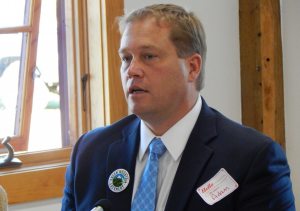
As others on the panel noted similar issues, Brattleboro Development Credit Corp. Executive Director Adam Grinold took the opportunity to discuss workforce development efforts in the Windham region. The corporation has worked to connect businesses with employees, linking students with internships and potential careers.
“A big part of (workforce development) here is the dairy industry, and the value-add to the dairy industry,” Grinold said.
But for all the emphasis on value-added dairy products at Friday’s meeting, those cannot be “the sole solution” for the ailing dairy industry, said Robert Wellington, a senior vice president for New England farm cooperative Agri-Mark.
That’s because dairy farmers are struggling mightily with low milk prices and rising costs. Experts say Vermont’s dairy industry is shrinking under the weight of those pressures.
State Rep. Carolyn Partridge — herself a small farmer — said she has noted a marked decline in the agricultural community.
At one point, when her farm equipment would fail, “I could drive a half hour or 45 minutes and get parts,” said Partridge, D-Windham, who is chair of the House Agriculture and Forest Products Committee. “And then it was an hour to Keene (New Hampshire) to get parts … and now I have to drive an hour and 45 minutes to get parts.”
In a social media post last week, the Brattleboro Food Co-op called for Congress to provide “immediate disaster-assistance relief” for struggling New England dairy farmers. The co-op cited milk prices that are 37 percent lower than 2014 levels, driving milk revenues below the cost of production.
In addition to weather-related factors affecting New England farmers, Welch pinned part of the blame on global forces that have warped the supply and demand curves for milk.
“No matter how efficient (farmers) are, no matter how frugal you are, no matter how much you fix your own equipment, no matter how much you depend on your family to help get out there for basically no pay to get the harvest in, you don’t control things,” Welch said. “You don’t control the fact that, when we imposed sanctions on Russia, it had a major impact on the price of milk.”
A federal Margin Protection Program offers farmers insurance for when milk prices dip below certain levels. But farm advocates say it’s inadequate.
“We have safety net programs that just don’t work anymore,” said Agri-Mark’s Wellington.
Jenny Nelson, agriculture policy adviser for U.S. Sen. Bernie Sanders, I-Vt., told attendees at Friday’s meeting that the federal milk pricing system “needs an overhaul.”
Welch said the task is “to try to get a farm bill that actually is as close as we can get to the high point where we had a (regional) dairy compact — where there was some production arrangement, where there was some confidence that there was a sustainable price.”
Wellington also harked back to the now-defunct Northeast Dairy Compact, which played a role in setting milk prices regionally. He didn’t express much faith that the federal government can solve the problem as it now stands.
“I think we have to look for more state and regional solutions,” Wellington said.
The crisis has spurred calls for a “new direction” in Vermont agriculture. Former state Agriculture Secretary Roger Allbee recently pitched the idea of Vermont becoming an exclusively organic milk-producing state.
Allbee’s idea, though, didn’t generate a lot of enthusiasm at Friday’s meeting.
“Organic is just another choice in what we have for consumers,” Wheeler said. “Organic is right for some people … but it’s probably not going to be right for all dairy farmers, and certainly not all dairy farmers in Vermont for a variety of reasons.”
“I think what we need to concentrate on is a dairy industry that is united and works together and supports each other,” Wheeler added.
