(Editor’s note: “Then Again” is Mark Bushnell’s Vermont history column.)
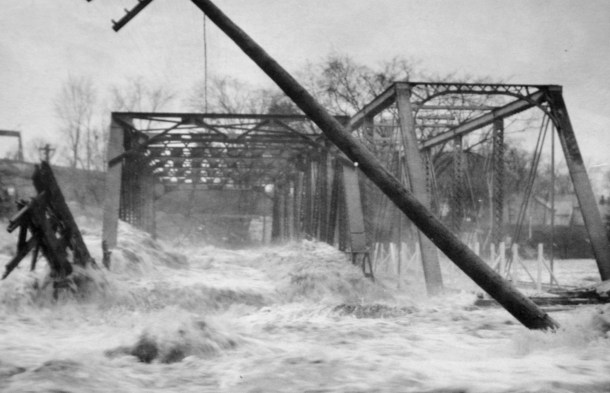
[O]nly in hindsight did Vermonters see the flood of 1927 coming. The first signs of trouble, they would later recall, had emerged in October of that year, when it rained about 50 percent more than usual. And things didn’t let up as November started. In fact, the rain only intensified. The forecast, much less reliable in those days, had called for fair weather, but a tropical storm traveling up the East Coast veered unexpectedly inland and met a rainstorm coming from the west. As a result, rain fell especially hard on the night of Nov. 2, and continued for 38 hours. Then it took an hour break, before pouring down for another four or five hours.
The first sign of trouble was water seeping into basements, as some merchants in Barre noticed midday on Nov. 3. Others living and working along the Winooski River and its tributaries were making similar discoveries.

Gerald Brock and Ralph Winter, employees at a hardware store on Main Street in Barre, went downstairs with two other men to save merchandise in a neighboring “ready-to-wear” clothing store. Unknown to the four, the basement of an adjoining building had already filled with water. The wall separating the two basements suddenly collapsed under pressure from the water. Two of the men managed to escape the waters by running upstairs or being pulled to safety by others. Brock and Winter drowned.
They were among Vermont’s first flood deaths that day.
The deadliest river
More than 80 other people across Vermont, including Vermont’s lieutenant governor, Hollister Jackson, would die in the flooding. Among them were 15 people who died when their boardinghouse was swept over Bolton Falls on the Winooski – the deadliest river to live near on that ill-fated day.
People had little time to save themselves or their possessions when the river began cresting its banks. At the flood’s peak on the night of Nov. 3, the Winooski’s water was rising 4 feet an hour.
Among those caught off guard was Frank Dawley, a former mayor of Montpelier, who found himself trapped in his workshop downtown. As the waters climbed, the 77-year-old climbed too, first onto the counters and then up the shelves built along one wall. There, for 12 hours, he was able to hold his head just above the water.
Not everyone was so fortunate.
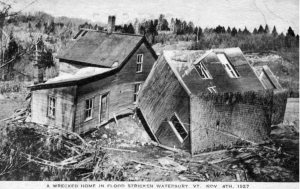
The Sargent family of Waterbury was trapped in their home on the south edge of the village. The house was in danger of separating from its foundation. Firemen tried to reach the family, but the fast current around the house made rescue impossible. Witnesses saw Walter Sargent trying desperately to get the family cow up to the second floor. Then, the house abruptly rose in the water and drifted quickly away, disintegrating as it struck obstacles in its path. Sargent, his wife, four children and mother-in-law were all killed.
Perilous trip over raging current
A group of laborers and their families in Barre also faced the agonizing decision of whether to try to escape. They were trapped in 13 neighboring story-and-a-half houses near the confluence of two branches of the Winooski. Firemen, Vermont National Guard members and other volunteers reached the scene at about 6 p.m. The water was moving so quickly that rescuers decided the only way to reach the houses was by stretching 60-foot ladders over the torrent. They lit the scene with car headlights and laid the first ladder. They reached one house and then repeated the process to reach the next.
“The people were terror-stricken,” remembered fireman John Anderson. “(T)hey faced the choice of remaining in their homes, likely to be washed away any moment, or of making the perilous trip over the shaky and bending ladders, only a few inches above the raging current.”
After everyone was rescued, one of the houses floated away and another collapsed.
In Montpelier, Mrs. George Buswell waited out the storm in her attic with her nine children. Throughout the night, Buswell played records on her Victrola to distract the children from the frightening noises outside, where uprooted trees, livestock, even houses streamed through the neighborhood.
The next day, when Vermonters ventured out to assess the damage, unforgettable images met their eyes of dead bodies, dirt everywhere; miles of roads and railroad tracks washed away; vacant lots where houses once stood.
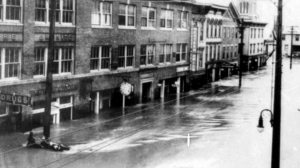
One Montpelier resident returned home to find a dead pony lodged under his piano. Another discovered a live fish in his living room. Still another found a pig swimming down his hallway.
The losses from the flood were staggering. As many as 84 people – including 26 from the little town of Bolton – had been killed. Farm losses included 1,704 cows and 7,215 chickens drowned, and 7,372 tons of hay and 16,404 bushels of grain destroyed.
And then there were the bridges – 1,258 of them were badly damaged or destroyed. In all, the state suffered an estimated $30 million in damages (when compared with the U.S. Gross Domestic Product, the damages cost the equivalent of roughly $5.5 billion).
In storm’s wake, some changes
Other effects were less easily quantified, but just as real. The flood altered the state’s relationship with the federal government and spurred Vermont’s rock-ribbed Republican leaders to look for assistance from Washington, even as Vermonters began to create a myth that no handout was ever sought.
The damage to rail lines caused the state to begin relying more on automobiles. The high cost of repairing highways and bridges prompted the governor and Legislature to shift that responsibility from towns to the state. To pay the huge highway repair bill, the state abandoned its pay-as-you-go policy in favor of a bond that would be repaid by a flood tax.
And the sudden rise in state expenses, coupled with the advent of the Great Depression a couple of years later, spurred Vermont to institute a state income tax. Supporters said the move would ease pressure on land-rich, but cash-poor, farmers.
In 1933, when President Franklin Roosevelt helped create the Civilian Conservation Corps, Vermont was among the first to suggest public works projects. CCC workers would build a series of dams along branches of the Winooski.
In the days before the flood, the idea that Vermont would invite in a federal workforce to dam its rivers might have seemed far-fetched. Vermont was too self-sufficient to need such aid. In the flood’s aftermath, Vermonters had to concede that sometimes Vermont couldn’t go it alone.