

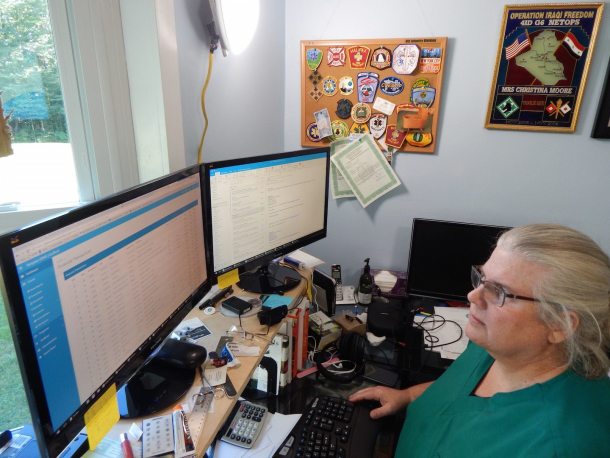
[H]ALIFAX – Christina Moore’s resume doesn’t lack for variety: She’s spent time on a research boat in Alaska, worked on communications networks in Iraq and assisted with Hurricane Sandy recovery in New York.
But two common threads — technological expertise and emergency response — run through the Halifax resident’s life and career.
The devastating floods of Tropical Storm Irene in 2011 led Moore to form Storm Petrel LLC, which has woven those two threads into a new software package designed to ensure small governments are prepared for disaster and can navigate its expensive, often confusing aftermath.
Five years after Irene, Moore said Storm Petrel is growing while saving taxpayers’ money.
“When an organization — a county, a municipality, whatever — makes a mistake in (disaster recovery) procurement, it’s the local taxpayer who pays,” Moore said.
Moore has a longtime affinity for new technology. Growing up in Massachusetts, not far from Boston, she had her first computer programming class in eighth grade and discovered she had an aptitude for it.
At college in Wisconsin in the early 1980s, Moore said, she was among a handful of students on campus with a personal desktop computer — a fresh development at the time. But she graduated with a degree in biology, figuring that computer science had too much to do with the big mainframe computers of the pre-PC era.
Moore spent some time after college working on ambulances in Boston. Eventually, she made her way to Alaska, where she spent a decade and found herself working with technology again.
“I had a number of jobs, and they were all very closely related,” Moore recalled. “I worked for FedEx. … I was part of the software development team that tried to find bad guys. We tried to find contraband freight. So we worked closely with U.S. Customs.”
Another job in Alaska involved deployment of a telemedicine system for the U.S. Public Health Service. Moore also worked for Cisco Systems, doing information technology work for the U.S. military.
That led to a one-year assignment as a civilian supporting Army operations in Iraq, where she worked on fiber optic and microwave systems.
Moore had moved to Vermont in 2005, shortly before heading to Iraq. But when she returned from overseas, she had trouble getting her life started again: She said many potential employers were quietly wary of hiring someone fresh from a war zone.
“I came back to closed doors and closed opportunities and lots of people saying, ‘We support our troops, we support what we’re doing over there,’ but the support wasn’t a job,” Moore said.
In 2008, she founded the nonprofit rescue organization Halifax EMS, and she remains its chief. But professionally, she said, “nothing really popped in a significant way between coming back from Iraq and Hurricane Irene.”
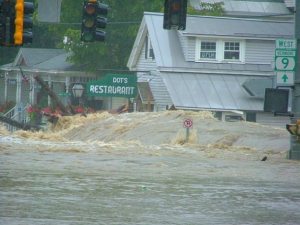
Irene slammed into Vermont on Aug. 28, 2011, bringing heavy rain and severe flooding. Halifax, like many Windham County towns, was hit hard.
“When we got done with our assessments, the town of Halifax had $4.5 million worth of damage,” Moore said. “We’d lost four bridges and miles of roads. The town of Halifax’s annual operating budget at that point was about $800,000.”
Moore was part of the town’s emergency operations center. But she also shifted into an organizational, financial role soon after the storm, drawing on her experience with federal regulatory compliance as Halifax sought disaster recovery help from the Federal Emergency Management Agency.
“When we got hit, we knew that we had to keep track of every single piece of paper and every expense and every decision that we made,” Moore said.
“We were tracking our cash flow,” she recalled. “We were able to better project our cash needs. We were able to get loans from banks because of the analysis I was able to do.”
A little over a year later, Moore took her expertise to New York City to assist with Hurricane Sandy recovery. But she found a familiar problem there: There was no efficient way to work with the “massive” documents and dollar amounts associated with federal disaster recovery funds.
“They had the same systemic problems, the same paperwork problems, the same financial problems and the same lack of tools that little old Halifax had,” she said.
So Moore, upon returning to Vermont, set about creating those tools. She had founded Storm Petrel as a consulting firm, but she shifted toward creating software designed to assist disaster-stricken communities in dealing with a maze of federal funding regulations.
“We then used that tool to do grant management in Guilford,” Moore said. “We closed out their (Irene) work on our new software.”
Guilford Town Administrator Katie Buckley said Storm Petrel handled the filing of large FEMA claims — projects that “required deep knowledge of FEMA’s rates, rules, allowable expenses, etc.”
“The amount of time and taxpayer money it would have taken for me to learn it all would have ultimately been cost-prohibitive for the town,” Buckley said, adding that Moore’s company “took all of my records and transformed them into the exact format FEMA needed from us.”
Moore describes her software, Tempest-GEMS, as a grant expense management system. While simplifying financial tracking, it also can prevent errors such as failure to follow federal procurement regulations or provide enough supporting documents.
After studying federal reports showing common mistakes made by local governments in the aftermath of a disaster declaration, Moore’s company has branched out by providing reviews of town or county policies before emergencies arise.
“We’ve developed tools that score people’s procurement policy — how good is your policy compared to the federal standard,” she said.
“And then, the other thing that we do is, every single time an organization executes on a new (disaster recovery) contract, we score their compliance for that contract,” Moore added. “The idea is that we’re making them bulletproof against FEMA. Or, if they’re not, pointing to areas where they could make those improvements.”
Moore sees further opportunities for expansion as the federal government has begun standardizing its grant and procurement rules across multiple agencies. In other words, Storm Petrel isn’t limited to storms anymore.
“Our tool now is in a position where it can accommodate managing pretty much any federal grant,” Moore said.
Storm Petrel is still young, but the company is growing. From her home base in Halifax, Moore brought on a programmer late last year and added a vice president of business development this year.
Storm Petrel also has caught the attention of others in the Windham County business community.
Laura Sibilia, director of economic and workforce development at Brattleboro Development Credit Corp., was familiar with Moore’s emergency management work after Irene. Moore came back on BDCC’s radar when she submitted her software business for consideration in the region’s comprehensive economic development strategy.
Recently, Sibilia said, a “light went on”: Why not connect Moore’s work with BDCC’s efforts to identify and nurture “green building” expertise and related services in the area?
“We think there could be some pretty exciting collaborations set off by connecting those various entrepreneurial dots,” Sibilia said.
While there may not be an obvious connection between Storm Petrel and green building, Moore said it’s not a long reach given some of the movement’s key themes: sustainability, climate change and resilience.
Local governments can receive grants to mitigate natural disaster hazards, and they get disaster recovery funds when the need arises. “We make it easier for them to get the money and hold onto the money and provide the justification that they spent the money well,” Moore said. “And that is a definition of resilience.”

