


[O]n Aug. 27, 2011, Gov. Peter Shumlin declared a state of emergency.
“We are preparing for the worst and hoping for the best. We have every reason to prepare for the worst,” Shumlin told the press that Saturday. Hurricane Irene was bearing down on the Northeast, prompting weather warnings and public transit closures throughout the region. He urged Vermonters to stay inside and wait out the storm at home. He described its anticipated impact as an “unprecedented challenge.”
Still, Shumlin recalled in an interview this week that before Irene hit — by then having weakened into a tropical storm — he thought it might be a case of overzealous weather predictors. He was at home in Montpelier when the rain started, and it seemed at first that the state may have dodged it. Then, midway through the afternoon, he got a text from his brother with a picture of downtown Brattleboro, under water.
Twelve hours later, the state psychiatric hospital in Waterbury was being evacuated and several key roads were already closed. “We were in major disaster mode,” Shumlin said.
On Aug. 28, 2011, 531 miles of Vermont state roadway and 34 bridges were closed. Some were left damaged by high waters; some were not passable; in some stretches, it was as though there had never been a road there at all.
About a dozen communities were cut off, all roads in and out impassable.
Forty-seven buildings in what was effectively the nerve center of Vermont’s government — the Waterbury state office complex — were damaged by flooding.
Five years later, the roads are open and state employees are back in Waterbury. Still, scars from the flood remain — both on Vermont’s landscape and beneath the surface. Evidence of Irene remains in the state’s roads and other infrastructure, budget and mental health system.

The aftermath
Rep. Sandy Haas, P-Rochester, realized how serious Irene was on Sunday afternoon when a friend’s house slid off its foundation into a brook.
The area around Rochester was fragmented by washed-out bridges and damaged roads. Flooding on Route 100 cut off the northern and southern entries to the town. A section of Rochester to the east of the White River was totally cut off, accessible for seven weeks only by a footbridge. Townspeople called it the island.
The town went days without power, without phones. The main mode of communication was for someone with a truck to take a cellphone to the top of a hill.
“I always choke up when I think about it,” Haas said. “It was just so hard not to be able to let people know that we were OK.”
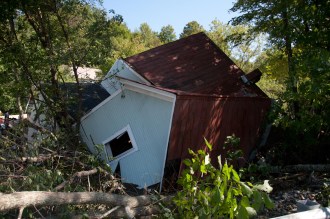
There was a daily town meeting when local officials would hear from residents and share updates. An inn in the town center held barbecues on the lawn, inviting people to bring food stashed in their unpowered freezers. A Red Cross meal site was another place where people would gather to connect, Haas recalled.
On the Tuesday after the storm, residents of Rochester got their first connection to the rest of the state. The road leading north to Hancock was cleared, which gave people in the area access to “something that was generally described as a goat path,” Haas said.
The area around Rep. Ann Manwaring, D-Wilmington, was hit hard by the storm. Her hometown’s village center was devastated by flooding. It took an enormous amount of community effort to rebuild, she said.
“That kind of spirit doesn’t really go away,” Manwaring said. “It becomes part of our soul and part of our community-ness, even today.”
From Sen. Dick McCormack’s house in Bethel, he can see the White River. Early on, he remembers seeing the streams swell and telling his neighbor they should move their cars down the road so they’d be able to get around the next day.
But the day after the storm, McCormack recalled, was a beautiful one. It wasn’t until he heard from a friend in Pennsylvania — who called him, distraught, after seeing news coverage of devastation in Vermont — that he realized how bad it was.
Route 107, running southwest from Bethel to Stockbridge, “for a half a mile simply wasn’t there,” McCormack said. “It didn’t look like flood damage to a road. It looked like no road had ever been there.”

McCormack said the post-flood period was characterized by community cooperation, appreciation for the leadership of the Shumlin administration, and a sense of unity in Vermont — citing initiatives like the “Vermont Strong” license plates.
“This was an ‘era of good feelings’ in Vermont,” McCormack said, referring to an early 19th-century period in American history so-nicknamed to reflect a sense of purpose in the young country.
One source of help in the immediate aftermath was the Vermont Community Foundation.
“This was really the first time that we had to do disaster relief work at home, and so we didn’t know very much about what we were getting ourselves into,” senior philanthropic adviser, Christopher Kaufman Ilstrup said.
The foundation aimed its efforts at helping farmers who had lost crops and land, and mobile home residents whose homes were washed away or critically damaged. It also focused on supporting nonprofits.
Shumlin remembers riding in a helicopter with Sen. Patrick Leahy, D-Vt., surveying the damage between southern Vermont and Waterbury.
“You panic,” Shumlin said. “I thought to myself, the amount of disaster and destruction I’m seeing, it could be a year before we have roads rebuilt, bridges back together, people’s lives in some semblance of normality.”
Mobilizing the recovery
While families pulled personal belongings from inundated houses and communities united in the immediate aftermath, the state government confronted its own challenges.

Floodwaters from the Winooski River had washed through the state office complex in downtown Waterbury, damaging 47 structures, affecting more than 700,000 square feet of offices and displacing more than 1,200 state employees.
In early September, Shumlin tapped Green Mountain Power executive Neale Lunderville to temporarily head the state’s Irene recovery effort.
Sue Minter, then deputy transportation secretary, took over the post in late December 2011. Shumlin said she was a key player in that role, and later as transportation secretary, in taking the experiences of Irene and carrying them forward.
Partnerships between state government and private companies were key to a swift recovery, according to the governor. Another key ingredient, he said, was community cooperation.
“We all talk about ‘Vermont Strong,’ and a lot of people think it’s awfully corny, but the fact of the matter is, it is Vermonters’ unbelievable spirit and sense of caring about their neighbors and giving them the shirt off their backs that got us through,” Shumlin said.
Rebuilding infrastructure
According to the Agency of Administration, some $600 million in federal money went toward Vermont’s recovery — the bulk of which supported rebuilding transportation systems.
The state’s cost was more than $150 million, local governments picked up more than $10 million, and more than $30 million came from private pockets. Insurance paid more than $60 million of the costs.
Richard Tetreault, now deputy transportation secretary, lived in Newport, which wasn’t too badly affected by the storm. When he went to work on the Monday after, it quickly became clear to the 30-year veteran of the agency that the damage left behind was of a magnitude he had not experienced before.
Tropical Storm Irene caused “a profound transformation of rivers,” Tetreault said.
“Geologic events have been going on for millions of years, and we only see them in isolation in a lifetime or so,” he said. “Sometimes we don’t fully appreciate the power that’s involved with these events.”
There’s a “tingly feeling” when the realization strikes that it’s your responsibility to get things back together, he said.

Several agency employees, Tetreault included, had gone through emergency training in the incident command system some years earlier. That training kicked in and helped the agency mobilize and begin rebuilding immediately.
The agency, working with a variety of players across state government, was able to meet what at first seemed like a bold goal, according to current Transportation Secretary Chris Cole: to reopen all roads by the end of December 2011.
Cole said the agency adopted some policies in the aftermath of Irene that will help the state be more prepared in the future. Every employee now receives some level of training in the incident command system, which was so helpful in the recovery effort. Regular meetings continue every two weeks with the Agency of Natural Resources, a key partner.
Still, Cole sees room for improvement in the relationship with the Federal Emergency Management Agency on codes and standards for stream alteration, which could ease the rebuilding process after another major flood. The state was able to work with the federal government to find a way to get federal funding for rebuilding after Irene, but Cole described the process as cumbersome.
The Transportation Agency’s work in recovering from Irene is nearing an end. The last projects are scheduled to be completed in the current fiscal year, which ends in June. Some local projects continue to receive federal money.
The day after the storm hit, the Department of Buildings and General Services was faced with widespread devastation at the Waterbury state office complex.
“It was an amazing period of time in that all hands on the good ship BGS came on deck,” Commissioner Michael Obuchowski said.
The situation presented two parallel emergencies: what to do about the 47 damaged structures at the complex and what to do with the 1,200 employees who worked there.

Rebuilding the Waterbury complex offered “a real opportunity,” Obuchowski said, to bring it up to date with expectations and demands of modern workplaces. The complex, which had been assembled over the course of a century, featured haphazard placement of departments.
The redesign allowed for placing departments in such a way that employees can better serve the public, according to Obuchowski. It also provided an opportunity to make the complex more energy efficient.
“A lot more happened than just building a new building,” he said.
From mucking out to move-in day more than four years later, the rebuilding of the Waterbury office complex cost about $257 million.
Still, there is more work left on the post-Irene to-do list, according to BGS. The state is trying to build a new lab for agriculture and natural resources, which is expected to be at the Vermont Technical College campus in Randolph.
Financial ripples
Five years on, many items on the rebuild list have been completed. But Sen. Peg Flory, R-Rutland, who chairs the Senate Institutions Committee, can think of a few that are still outstanding.
For one example, she brought up the Roxbury fish hatchery, a facility wiped out by flooding during Irene that has not been rebuilt. Its absence means more burden on other hatcheries, fewer fish being hatched and possibly fewer tourists coming to Vermont for fishing.

Flory is one of the lawmakers involved in crafting the capital bill, which uses bonded dollars to invest in infrastructure. Rebuilding from Irene has been a huge part of that process in recent years.
Prioritizing projects is a reality of state finance, she said, as in a family’s personal budget: “You eat macaroni and cheeses because steak’s too expensive and you had to pay for other stuff.”
Flory sees places where budget writers have opted to fix some problems in various state buildings with a bandage instead of a permanent solution, and she fears the state could need to reconcile many of those larger investments in the near future.
“That’s frustrating because that’s going to have really a long-term impact, and it’s not something that’s ever going to be directly attributed to Irene,” Flory said. “But it is. It’s because we had to spend the money on projects that are directly related to Irene.”
According to Rep. Mitzi Johnson, D-South Hero, who chairs the House Appropriations Committee, “It’s a much more subtle longer-term effect for my district.”
“Irene really offered the impetus to re-engineer how various agencies work together and how quickly things can get done,” Johnson said.
The federal government picked up many of the costs, but some fell to the state. Generally, Vermont could find a way to address those expenses in the budget, Johnson said, but “it meant that other things got starved in order to be able to do that.”
Some programs haven’t had an increase in funding in some time “because our resources got diverted to disaster relief,” Johnson said.
She listed a series of budget items — including child care, higher education, staff salaries at Vermont’s designated agencies that provide mental health and other services — that have received only small increases in funding over the last several years.
Mental health
In some ways, the devastation left by the storm presented an opportunity to tackle some long-standing conundrums, like the Vermont State Hospital.
Policymakers, advocates and officials had long bemoaned the psychiatric hospital in Waterbury. It had been decertified by the Centers for Medicare and Medicaid Services in 2003, making services there ineligible for federal funding.
“The fact that Irene destroyed the one (psychiatric hospital) that we had put some urgency into the conversation, and it gave us a way to look at it in that particular instance,” Johnson said. “It really wiped the slate clean.”
Rep. Anne Donahue, R-Northfield, who closely follows the state’s mental health system, said that before the storm, there were already many discussions about how to craft a mental health system that did not rely on the state psychiatric hospital in Waterbury. However, proposals lacked funding and consensus, she said.
“Irene actually produced money. It also forced the hand of decision-making even if there wasn’t necessarily consensus that it was the best way to go,” Donahue said.
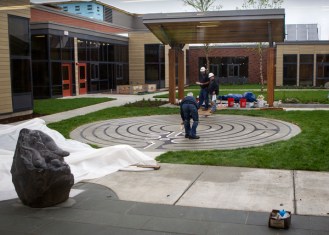
High waters in Waterbury forced the evacuation of the hospital. Patients were scattered across the state — some moved temporarily to Morrisville, others to hospitals elsewhere. The storm precipitated the Legislature’s 2012 passage of Act 79, which aimed to bolster community-based mental health services and decrease reliance on hospitalization.
Less than three years after the Waterbury state hospital permanently shuttered, Shumlin, flanked by high-ranking lawmakers, cut the ribbon on a new state psychiatric facility in Berlin.
Donahue said it was a remarkable feat to complete the new facility in such time but that the system as a whole continues to lag. For one thing, the closure of the Waterbury facility marked a decrease in the number of beds available for people experiencing acute mental health crises — meaning that more people have been held, sometimes for days, in emergency rooms waiting for treatment beds to be available.
In some ways, mental health treatment in Vermont is better today than it was before the storm, Donahue said. But there are still profound and sizable gaps.
“For those people who are admitted to a hospital, I think as a whole the system is unquestionably better,” Donahue said. “For those people who are being tied down in emergency rooms because their severe illness is being triggered by being held for days in a little room, it’s a lot worse. The system is worse as they’re experiencing it.”
Recent reforms in the mental health treatment system have put more emphasis on community-based services, often administered through nongovernmental entities called designated agencies.
Mary Moulton, executive director of Washington County Mental Health Services, the designated agency in central Vermont, said the state has created a rash of very promising programs.
However, she said, a shortage of funding has handicapped those programs. Agencies do not have the money to offer competitive salaries to professionals to staff them.
“We have more programs, and we have less ability to hire people to make the programs run,” Moulton said.
Mental Health Commissioner Frank Reed said Irene had a “tremendous” influence on the state’s system.
Reed said that today, the state has 188 acute care hospital beds — four more than when the hospital existed. He emphasized that the changes since Irene are still relatively fresh and the state is still adjusting.
He said hospitals and designated agencies were critical in the recovery process. After the state hospital closed, a spotlight was cast on the mental health system, he said. The issue of people waiting for mental health services in hospital emergency rooms, though not new, was suddenly front and center.
“This population that often was invisible to the general public was now visible in emergency departments across the state,” Reed said.
Looking back to five years ago, Shumlin heralded the post-Irene revamping of the mental health system.
Now, though no mental health system is without critics, Shumlin said he believes Vermont “has one of the best mental health delivery systems in the country.”
“Could it be better? Could we spend more?” Shumlin said. “The answer is yes.”
“Is it much better than the system we inherited six years ago? I say yes.”
’I think Vermont got it right’
Looking back, the governor said there isn’t anything he would do differently in the recovery.
“I think Vermont got it right,” Shumlin said.
Irene presented a wake-up call about what climate change-induced weather events can do to Vermont, he said.
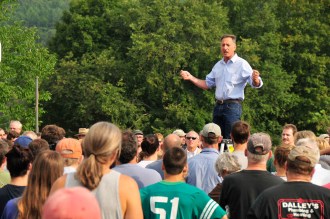
However, Shumlin fears that as the memories from Irene are less fresh, support for initiatives to try to combat climate change could wane.
“When you have a really recent brush with death because of climate change, you’re willing to embrace change more readily than when … the memories fade and you get back to life as usual,” Shumlin said.
The storm hit when he was not even nine months into his first term as governor. The recovery effort has gone on through much of his years in office. But Shumlin said he doesn’t feel his administration was hampered by that effort.
“I never felt that Irene got in the way,” he said.
Instead, he believes the state delivered on a promise that he vocalized repeatedly in the rebuilding effort: that Vermont would be left better than the storm found it.
“I think that will be one of the great legacies of Irene, that we used it to solve intractable problems,” Shumlin said.
