



[F]ederal officials are scrambling to secure a permit allowing the use of chemicals in three Vermont rivers to kill sea lampreys and they are running out of time.
With only a short window to apply the chemical, officials are trying to secure permission in time for this season. However, there are new standards that must be complied with first.
Studies have yet to firmly establish what risks the chemical — 3-trifluoromethyl-4-nitrophenol, or TFM — represent to human health. As a result the state toxicologist has recommended limiting its concentration in drinking water to detectable levels.
The Vermont Department of Health recommended that the limit be set at 3 parts per billion this summer, down from 35 parts per billion recommended by the U.S. Environmental Protection Agency since 2010.
The state set a lower ceiling on TFM concentrations because there is a paucity of reliable research on potential adverse human health effects, state toxicologist Sara Vose said. The last study was conducted in the 1970s and appears to be of questionable scientific validity, she said.
The U.S. Fish and Wildlife Service applies the chemical every four years in a few Vermont rivers to kill off sea lampreys which are considered an invasive species.
The lampreys kill Atlantic salmon, lake sturgeon and lake trout, according to officials at the Fish and Wildlife Service. They say the lampricide’s application since the 1980s has aided in the recovery or reintroduction of these species within the state. The primitive parasitic fish bear some responsibility for the local extinction of both Atlantic salmon and lake trout from Vermont waters, they said.
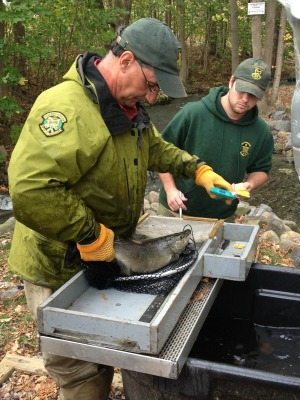
Both of those two species have since been reintroduced, and their numbers are flourishing along with those of lake sturgeon, Fish and Wildlife Service officials say. The burgeoning populations show that the lampricide works and underscores the need for its continued use, they say.
Fish and Wildlife will need to secure a permit from Vermont’s Department of Environmental Conservation within weeks before the period ends during which the chemical must be applied, according to Brad Young, a biologist for the federal agency and lamprey control program coordinator for Lake Champlain.
Members of the Lake Champlain lamprey control program submitted applications in April to apply TFM to three Vermont rivers, Young said. Vose recommended in July that the limit be decreased for allowable TFM concentrations in drinking water. Federal bureaucrats were forced to retool their application in order to demonstrate compliance with the new limit.
To meet the standard, Young said, the best likely solution is to treat water with activated charcoal at the Lake Champlain Water District water treatment plant, which is supposed to remove essentially all TFM from the drinking water the plant produces.
The treatment will cost roughly $150,000, said Jim Fay, general manager of the Lake Champlain Water District.
Fish and Wildlife Service personnel hope to apply the lampricide in the LaPlatte River and in Stonebridge Brook, Young said. They had asked in April to apply it in the Missisquoi River as well, but in the interim decided against applying it there this year.
The Fish and Wildlife Service will need to demonstrate to state officials that the activated charcoal solution will reduce TFM concentrations to 3 or fewer parts per billion, Young said. The permit will need to be secured within weeks if the lampricide is to be applied this season, he said.
If the Fish and Wildlife Service can’t get a permit this year, lamprey populations will not likely increase significantly, Young said.
The state requires that the federal agency demonstrate that TFM is safe, according to Deb Markowitz, the secretary of the Agency of Natural Resources.
Removing the chemical to levels below detectability should satisfy that requirement, Markowitz said, and it remains for the U.S. Fish and Wildlife Service to provide evidence that the activated carbon treatment will accomplish that.
Markowitz said she’s optimistic the Fish and Wildlife Service can meet Vermont’s drinking water standards.
