


[P]HILADELPHIA — Minutes after history was made with the formal nomination of Hillary Clinton as the first woman to head a major presidential party ticket in American history, more than 100 Bernie Sanders delegates left the Wells Fargo Arena to protest her candidacy.
The Vermont senator did not condone or acknowledge their behavior. He was too busy serving as the man of the hour onstage at the Democratic National Convention.
Sanders nominated Clinton during the roll call vote Wednesday night. Shortly before the Vermont delegation’s vote, Sanders rushed down the convention steps and sat down next to Dottie Deans, the chair of the Vermont Democratic Party.
Deans declared that Vermont “helped fight and win the revolution that gave birth to our United States of America, the state that helped fight and win the political revolution of 2016.”
Loud chants of “Bernie! Bernie!” erupted in the hall. The Vermont senator then officially moved that Clinton “be selected as the nominee of the Democratic Party for president of the United States.”
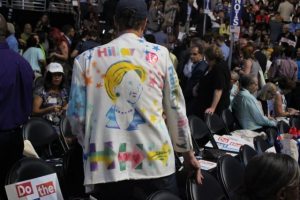
Sanders’ recognition of Clinton’s achievement was met with raucous applause as convention goers held up multi-colored “H” signs. Convention chair U.S. Rep. Marcia Fudge, D-Ohio, hailed Sanders for his “spirit of unity.”
Since his New Hampshire endorsement of Clinton earlier this month, Sanders has dropped all of the fiery attacks that once animated him in primary debates and at town hall meetings. He offered effusive praise for Clinton in his prime time speech Monday, and he has consistently urged his supporters to shift allegiance to Clinton in order to defeat Republican Donald Trump.
“I understand that many people here in this convention hall and around the country are disappointed about the final results of the nominating process,” Sanders said in his Monday speech. “I think it’s fair to say that no one is more disappointed than I am.”
Yet for the second time in two days, Sanders’ overtures fell on deaf ears. The most progressive delegates spurned pleas for party unity, booing loudly Monday and walking out Tuesday.
The walk-out — labeled “No voice – No unity” — was a relatively spontaneous affair, the result of four different actions by disenchanted state delegations. Delegates passed notes to discuss potential protest, and activists had been hinting to the press for a few days that some sort of civil disobedience by Sanders delegates was likely.
Shyla Nelson, a Vermont delegate, became an essential point of contact for the police and the press during the walkout, which turned into a sit-in near the press tents.
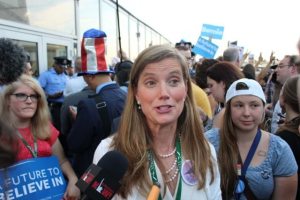
Nelson said she wanted unity in the party, but added that any forced coming together “is not unity in the purest or truest sense.”
“If there is an essential chasm between the two campaigns right now, it is the difference in the perception of the sense of urgency,” Nelson said. “We have people dying every day in our country because they can’t get the prescription medications that they need, they can’t get adequate food, they can’t get adequate health care, they are living on subsistence wages. We have people facing climate crises and environmental crises in cities all over this country.”
The frustrated Sanders delegates were a diverse crowd from across America, some sat down silently while others spoke to the hordes of reporters on the scene. Dozens of police officers also surrounded the protesters, though the atmosphere never got confrontational.
The protesting delegates derided Clinton, many saying they weren’t sure if Clinton would keep the promises she made to win over Sanderistas.
Still, many talked about the importance of unity, adding they would keep listening to Clinton ahead of the election.
Peter Corbett, a Massachusetts delegate who grew up in Burlington and worked with Jane Sanders at the King Street Youth Center, is disappointed with Clinton’s candidacy, but said he was hopeful the revolution would stay alive.
“‘Bernie or Bust’ is like loving the religion itself instead of what it points to,” he said.
In explaining their distrust of Clinton, many Sanders delegates pointed to the Trans Pacific Partnership, a controversial trade deal that Clinton once supported but now promises to stop. (Their concerns over Clinton’s shifting stances were only amplified Tuesday, when Virginia Gov. Terry McAuliffe, a close friend of the Clintons, told Politico that he believes Hillary Clinton will support the TPP trade deal if elected president.)
Caleb Humphrey, an Iowan and Iraq War veteran, blamed Clinton for supporting the war as a senator. Still, he said he would likely vote for Clinton in November. “This guy [Sanders] voted for me to stay home, and not go there, so I said I had to walk with this man,” Humphrey said, tearing up. “So I drove four hours across the state of Iowa and walked with Bernie Sanders and his wife in a Fourth of July parade.”
Vincent Venditti, a Georgia delegate for Sanders, accused local Democratic leaders of mistreating him. “I was called names by them, I was laughed at by them, I was not told of meetings by them,” Venditti said. “And they are surprised I walked out?”
A number of delegates including Tony Genovese, another Massachusetts delegate for Sanders, promised to continue the “revolution.” Genovese said that Sanders’ loss still hurts, and that the grieving process will take time.
“We were all emotionally invested, even though his loss was inevitable,” Genovese said. “It’s like when you have a pet that’s sick and then dies – you know it’s coming but when it happens, you cry.”
Tuesday’s convention featured former Vermont Gov. Howard Dean, who showed a self-deprecating side by mocking his infamous “Dean Scream.”
“Help make history, and volunteer, because this race is going to be won on the ground,” Dean began, before getting more heated. “And it’s going to be won in Colorado, and in Iowa, and in North Carolina, and Michigan and Florida and Pennsylvania and then we are going to the White House!”
While Sanders headlined Monday, former President Bill Clinton took the chief spot Tuesday. In a sweeping speech describing the life and career of his wife, Clinton said that many unfairly portrayed her as cartoon-like character.
“Cartoons are two-dimensional, they’re easy to absorb,” Clinton said. “Life in the real world is complicated and real change is hard. And a lot of people even think it’s boring.”
Clinton said his wife has “never been satisfied with the status quo,” adding “She always wants to move the ball forward. That is just who she is.”
While the former president’s speech was broadly praised as a humanizing portrait of Hillary Clinton, it likely won’t change the minds of those who walked out Tuesday.
Nelson, the Vermont delegate, said that any party unity from Sanders supporters that may come ahead of the November election was “conditional.” She said Clinton needed to know that protest was possible if she did not keep her promises. She dismissed concerns from party leaders in the arena, saying the Tuesday protest was a gesture to ensure that ordinary voices “aren’t drowned out in the cacophonous energy of the convention itself.”
Asked if Sanders delegates would organize additional protests this week, Nelson demurred.
“We shall see,” she smiled. “We shall see.”

