

[R]UTLAND — Can Vermont meet its own economic needs and still effectively address the issue of global climate change?
That question was at the heart of Tuesday evening’s well attended gubernatorial debate in Rutland, which claims the title of “New England’s solar city,” with the most solar generation per capita.
The debate at the Paramount Theater was moderated by former Associated Press reporter Chris Graff in conjunction with the Vermont Council on Rural Development and featured several questions from the audience. The five leading candidates — three Democrats and two Republicans — had one minute to respond to each question.

All the candidates agreed that climate change is real. Only Phil Scott demurred on whether it is man-made, saying there were “many reasons” for the planet’s warming. Scott said it is more important to focus on solutions.
Peter Galbraith underscored the seriousness of climate change and said that along with nuclear weapons it is “one of the two most significant threats to our planet.” Sue Minter called it the “issue of our time.”
The debate took place against the backdrop of the 14th consecutive month of record-breaking heat, according to recent figures from NASA and the National Oceanic and Atmospheric Administration. It was the hottest June on record in the United States, 3.3 degrees Fahrenheit above the 20th-century average. If current trends continue, 2016 will shatter last year’s record of warmest ever.

Candidates were asked for their views on carbon pricing; the state energy plan, which calls for large-scale investment in renewable energy, including wind and solar; preserving Vermont’s natural resource economy; reducing greenhouse gas emissions from transportation; and the decommissioning of the Vermont Yankee nuclear plant.
Not surprisingly, the candidates were largely divided along party lines, with Democrats Matt Dunne, Galbraith and Minter all supporting some version of a carbon tax and investment in rural public transportation. Minter called for bringing the Ethan Allen Express passenger train to Burlington and extending rail service to Montreal. She also called for a rural form of Uber, the controversial internet-based ride-hailing service, and dubbed it “Ruber.”
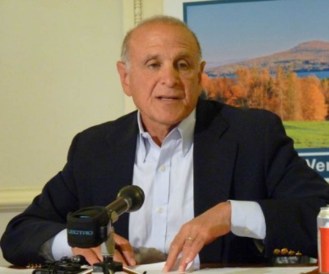
Republicans Bruce Lisman and Scott both firmly opposed a carbon tax and did not endorse the state’s vision of meeting 90 percent of its energy needs from renewable sources by 2050.
“For us to impose a carbon tax on the workforce would be detrimental,” Scott said. Lisman characterized the idea of a carbon tax as another example of state government not listening to the people, which drew applause from the audience. Whether it’s health care reform or school district consolidation, Lisman said, people are “tired of being experimented on.”
On the Democratic side Minter called for continuing the Regional Greenhouse Gas Initiative, started under Gov. Jim Douglas, and expanding it to include transportation fuels, which account for approximately 45 percent of the state’s emissions. The program is an effort to cap and reduce carbon dioxide emissions from power generation.

Dunne looked beyond a regional approach and suggested the state join California’s cap-and-trade program and also work in partnership with Canada. Galbraith also called for a national or international approach to cap and trade but stressed that the best way to reduce Vermont’s carbon footprint is through improved efficiency and conservation.
The Democratic candidates all supported the state energy plan, though Galbraith underscored that he was opposed to wind development, which he said is “destroying Vermont’s ridgelines.”
Broadly speaking, all the candidates supported efforts to promote weatherization, energy efficiency and investments in technology such as Green Mountain Power’s Energy Innovation Center in downtown Rutland. Scott, who repeatedly referred to Vermont’s “affordability crisis,” said if such programs were to be successful, low-income and working Vermonters would have to participate.

The word “innovation” featured prominently in the debate, but there were few specific policy proposals on how Vermont could lead the way in both combating climate change and creating jobs. Dunne pointed out that over the past 40 years the state has been transitioning away from large-scale manufacturing and agricultural production to something else, but he said that “we haven’t figured out what that something else is.”
Galbraith said the state has led the way on a number of issues — including the charging of deposits on more types of beverage containers; Act 250; and banning billboards — but in recent years has retreated from such high-profile campaigns due to the influence of “special interest lobbyists in Montpelier.”
The candidates had less to say about the potential effect of climate change on Vermont’s economy. According to the 2014 Vermont Climate Assessment, the state’s average temperature has increased 1.3 degrees Fahrenheit since 1960. The impact of rising temperatures and increased rainfall on agriculture, maple syrup production, winter recreation and biological diversity remains unclear.
But climate change, the Vermont Climate Assessment says, “is no longer a thing of the future; it is affecting Vermont today.”
