[M]ontpelier has been hailed for being a McDonald’s-free zone and the smallest state capital in the U.S., as well as for hosting a hops-infused shrine to suds (Three Penny Taproom), the New England Culinary Institute and, of course, the elegantly restored Statehouse.
But ask any resident or frequent visitor what distinguishes the city, and a likely answer is: the worst roads of any city in Vermont.
This isn’t the kind of accolade promoted in internet lists or travel magazines, but it is a defining trait of Vermont’s capital city, guaranteed to elicit an eye roll or earful when the topic comes up.
Take well-known photographer Roger Crowley, who has a new electric-assist bike he uses to get into the city via Towne Hill Road, a longtime symbol of asphalt dysfunction. Some parts are smooth, others humped, rutted and crumbling.
“I travel that road almost every day on my bike,” says Crowley, who was so exasperated at its condition that he posted a video on Facebook detailing his bouncing ride. Along with Barre Street and College Street, he says, “it’s pretty dangerous” getting around Montpelier on a bike.
How is it that this dining-crazy, outdoor-loving, cafe-cultured city on the Winooski River came to be a macadam misadventure?
“We’ve dramatically underfunded our infrastructure for a long time,” says Mayor John Hollar. Ask the affable attorney whether high property taxes or bad roads is the biggest complaint he hears, and Hollar laughs. “I would say roads is, by far, the No. 1 issue,” he says.
Hollar can often be found walking around downtown, exhibiting a saintly patience and a good listening ear, not to mention the thick skin and sense of humor needed to deal with the litany of things people complain about. This is, after all, a city nicknamed “Montpeculiar” for its liberal, quirky and voluble politics.
“The condition of our roads is horrible — I agree with them,” Hollar says. But he also wants people to know significant relief is on the way, though not until next summer. That’s when a long list of major road repairs begins, starting with the repaving of the city’s two major thoroughfares, Main and State streets, and continuing in the following years.
In the meantime, Montpelier will have to deal with the painful truth that downtown Barre — the often-slighted blue-collar cousin of upscale Montpelier — can lord over the state capital its smooth-as-silk driving (albeit after a long wait and the dislocations of a complete downtown roads makeover).
Paving roads in Vermont is a split jurisdiction. Route 12 (Montpelier’s Main Street) is a state road, as is Route 2 (part of State Street). So Montpelier is at the state’s mercy, money and road repair schedule on those.
State roads that are under municipal control are known as Class 1 town highways, a special category under law, according to Ken Robie, director of the project delivery bureau at the Vermont Agency of Transportation. Vermont has around 300 miles of these roads, mostly in short stretches, and they are scheduled for repairs by the agency on a 10- to 15-year schedule. The state has a budget of around $10 million annually for Class 1 repaving projects.

State and Main streets were actually scheduled to be redone three years ago, says Robie, but Montpelier needed to do a lot of subsurface work, so the state agreed to delay since it makes no sense to dig up a newly paved road.
“There’s a lot of coordination involved,” he says.
Roads such as Towne Hill and North, Clarendon, Hubbard and Barre streets are on Montpelier’s dime.
As for the sometimes invisible crosswalks and turn lanes whose arrows are more aspirational than visible, some are the state’s responsibility also, though Montpelier steps in and repaints them at times.
Vermont, of course, is infamous for its freeze-thaw cycles and the damage they do to roads. But even by Vermont standards the state capital’s roads are awful, a patchwork of asphalt patches.
For those not intimately familiar with them, follow along on this tour taken in a vehicle ideal for illustrating the conditions: a 2005 Subaru wagon that is a kind of Richter-scale seismometer on wheels, exceptionally responsive to bumps after a rough spring mud season loosened the front end. It registers every ripple with a cacophony of mysterious clunks and clatters.
Our shocks, rattle and roll tour starts by crossing the Winooski River on Main Street into the heart of downtown, past landmarks such as Charlie O’s bar, Bear Pond Books and Kellogg-Hubbard Library. A big jolt begins things, thanks to rail tracks that jut a few inches above the sunken asphalt. All the way through downtown, it’s one clunk after another, over patches and bumps and upthrust/sunken manhole covers, until you hit the patched and potholed roundabout at the north end of Main Street and continue bouncing up the hill with more of the same.
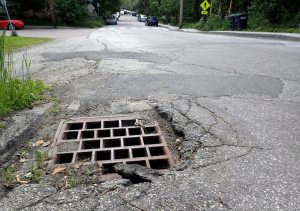
Just beyond the roundabout a left turn leads up one of the prominent and precipitous hills towering above the capital. This is well-crinkled North Street, whose ridges, depressions, bumps and patches make it a cross between a vehicular roller-coaster and bucking bronco, an un-amusement park ride.
At the top of Main Street lies Towne Hill Road, a street so cracked, rutted and depressed in places it makes a 100-year-old face look fresh by comparison. (The city has just put new patches on the road shoulder, which had disintegrated and largely vanished in places.)
At the west end of the city is Clarendon Avenue, a side street whose surface is so cracked it most resembles a shattered sheet of auto glass. Or go east on Barre Street, where, after a rare strip of smooth pavement, the road turns into a bumpfest marked by two dark asphalt stripes running down the road.
College Street, a key shortcut and home to many beautiful houses around Vermont College of Fine Arts, exhibits its own case of patches and sunken manhole covers.
The clear winner, though — if that term can apply to a bad road — is Northfield Street (Route 12), which heads directly south from downtown toward Norwich University. For a half mile or so this state road is slowly disrepairing itself in every way possible, as if it were a test strip for nonattention. There are cracks and humps and dips, asphalt patches and potholes, and skewed and sunken rain grates deep enough to blow out a tire.

(Readers, did we miss a notorious example of bad asphalt? Chime in with comments below.)
As it turns out, there is a dollar-sign logic to this disrepair. Over the years, Montpelier has undertaken myriad projects to replace antiquated piping systems and to separate stormwater and sewer pipes on its 56 miles of paved roads.
The truth is, says City Councilor Tom Golonka, “We’re old. We’re an old city.” And that old infrastructure is constantly being upgraded or fixed, such as when water mains burst. Until those pipe projects are finished, along with new curbing and sidewalks in some cases, it makes no sense to redo a road after excavations, so they are patched and repatched.
Corey Line is project management director at the Montpelier Department of Public Works and oversees the city’s road plans. The cost of repaving depends on the method, but he notes it generally ranges from $18 to $30 a square yard. That’s around $400 a yard at minimum for a two-lane road. Robie says the state estimates $750,000 to $1 million per mile depending on the width of the road. That doesn’t include curbing and new underground infrastructure, guard rails, etc. The capital has stepped up to the fiscal plate to address its problems in recent years.
According to a spreadsheet provided by Hollar, the city averaged around $280,000 for road repairs for the 10 years before he became mayor in 2012. Since then the budget has roughly doubled (it was $548,485 this year, not including $128,320 for sidewalk work and $367,098 for culverts and retaining walls).
The City Council has set a goal to achieve a “pavement condition index” of 70 by fiscal year 2019. That’s on a scale of zero to 100, and Line says the city is on target to reach that goal.
Hollar says the future looks bright — or at least smoother — and the budget reflects a big effort to improve the situation.
“I think we’re going to see a pretty significant change in the next couple of years,” he says, though he admits, “I’m not sure we’re getting there fast enough.”