

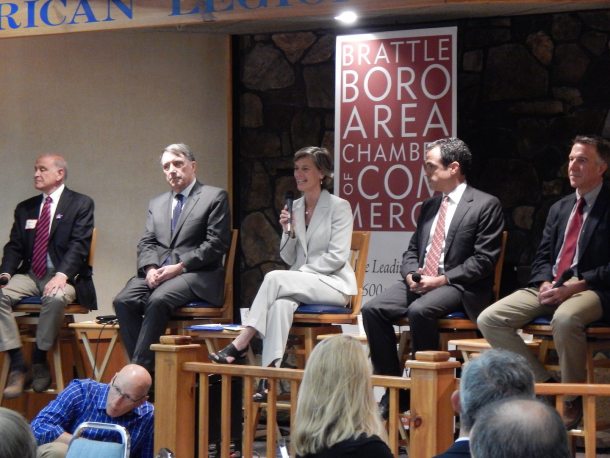
[B]RATTLEBORO — At a gubernatorial debate here Tuesday morning, Republican Phil Scott declared that the economy “should be the issue of this campaign.”
He likely didn’t need to convince an estimated crowd of 170 that jammed into Brattleboro’s American Legion post. Three Democrats and two Republicans spent most of their morning here talking about economic initiatives, affordability and small businesses.
They pitched some specific ideas for southern Vermont in light of a recent report on the area’s economic problems. And they jousted on statewide issues including taxes and raising the minimum wage, a topic that came up repeatedly throughout the forum sponsored by the Brattleboro Area Chamber of Commerce.
“You want to talk about making Vermont more affordable? Let’s raise the minimum wage,” Democrat Peter Galbraith said. “Whatever we do for affordable housing is a drop in the bucket. But a $15 minimum wage by 2021 … that is the best anti-poverty program we could have.”
Scott, on the other hand, said a $15 minimum wage would be a mistake because it would hurt employers.
“Let me be clear: I think that everyone should make more money in Vermont,” Scott said. “I think that’s the end goal. How we get there gets kind of messy.”
Scott, a Berlin resident and construction business owner who has been the state’s lieutenant governor for six years, faces a challenge in the Aug. 9 primary from fellow Republican Bruce Lisman, a Shelburne resident and retired businessman.
They took the stage Tuesday morning with three Democratic candidates. Galbraith, of Townshend, is a former U.S. ambassador and Windham County state senator; Matt Dunne, of Hartland, is a former state senator and Google executive; and Sue Minter, of Waterbury, is a former House member who most recently served as Vermont’s transportation secretary.
Also vying for the Democratic nomination for governor are Cris Ericson, of Chester, and H. Brooke Paige, of Washington.
Moderator Chris Graff wasted no time in asking the five candidates at Tuesday’s forum about the economic fate of southern Vermont, quoting directly from a December state report detailing the woes of Bennington and Windham counties.
Minter touted her own innovation and investment proposals, citing in particular the need for investing in infrastructure and affordable housing. She also praised the Windham region’s comprehensive economic development strategy and its internship program via the Six College Collaborative.
“Businesses can’t grow because they can’t find a qualified workforce,” she said. “That’s why I’m excited about your workforce development program.”
Dunne said he would focus on issues such as housing and poverty. “We also need to bring the electricity of our time, which is high-speed internet, to all of southern Vermont,” he said. “If we do that, we can actually support our entrepreneurs, create an entire community … that are telecommuters.”
Dunne also told the crowd that, as someone who lives south of Route 4, “I have a unique understanding of the southern part of this state.”
But Galbraith laid claim to his home county. During his two-term Senate stint, he said, he directed funding to Southeastern Vermont Economic Development Strategies; helped get cellular service for Newfane after Tropical Storm Irene; secured legislative approval of a 5 megawatt landfill solar proposal in Brattleboro; and extended a Vermont Yankee-related property tax break in Vernon.
“As governor, I’m going to be an advocate for Windham County, as I was as your senator,” Galbraith said.
Scott, both during the forum and in an interview afterward, said he doesn’t believe the economic challenges in the southern part of the state are much different from those elsewhere in Vermont. “I’ll be putting out an economic plan in the really near future that will address a lot of these issues,” he said.
Scott cited two statewide problems that he believes need attention: population loss and an aging demographic. “We have a shrinking workforce,” he said. “We need to repopulate that 25-to-45 age group throughout Vermont.”
Lisman, citing the 2014 closure of Vermont Yankee, said the state can’t afford to lose more employers. Echoing a common complaint in this part of the state, Lisman said that “economic growth has been quite modest, particularly outside of Chittenden County.”
Lisman talked about workforce development and said the state should build strong relationships with job creators. He also said Vermont must nurture its small businesses, because “we can keep them right here if we give them the right level of support.”
One way to support small businesses throughout the state, Lisman said, is to be cautious about any proposed minimum wage increases. The state’s base wage is currently $9.60 an hour and is scheduled to rise to $10.50 by 2018.
Lisman said he would favor raising the minimum wage “slowly, over time,” but he also called for restraint on that topic. Given the number of small businesses in the state, he argued that “we’re talking about squeezing a significant part of our population” when mandating a higher minimum wage.
Scott, who co-owns a construction business, worried that raising the minimum wage would have a ripple effect by causing salary increases farther up the pay scale. “This just ratchets up the cost of living,” he said.
“We have to grow the economy,” Scott said. “We have to grow wages at the same time. And that will be done through competition.”
Galbraith, who said he got into the governor’s race mainly due to the minimum wage issue, took umbrage at Lisman’s remark about squeezing small business owners.
“Actually, the people who are being squeezed are the people who are doing the hard work,” Galbraith said. “And we the taxpayers are being squeezed because we are subsidizing the low-wage employers with the earned income tax credit.”
Dunne said he’s in favor of a $15 minimum wage “over a period of time.” Echoing Galbraith’s claim that raising the minimum wage would save the state money, Dunne said any savings should be reinvested in Vermont-based companies.
“Imagine a state where the Agency of Commerce is focused on working with all the small businesses in Vermont to be able to boost their sales 20 or 30 percent,” he said.
Minter also said she supports moving toward a $15 minimum wage, though she did not commit to a time frame. “I’m looking to a more gradual step up, as we have started already,” she said.
She followed that by reiterating her plea for investing in Vermont businesses. As an example, Minter cited the success of recent public investment in Barre infrastructure, saying that has subsequently leveraged a much larger amount of private investment.
“That’s what I want to do in communities around Vermont,” Minter said. “My Agency of Commerce is going to be focused on customer service for the business community and creating great opportunities for growth.”
