

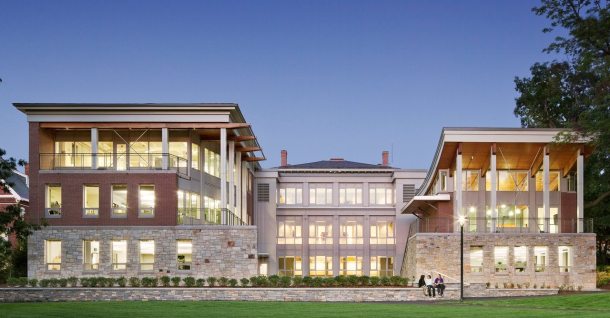
[A]mid the bustle of Burlington sits Champlain College, a small nonprofit private school that has won high praise in recent years. U.S. News & World Report has called it the “most innovative school,” and it has been ranked by Princeton Review and Fiske. The college has grown, too, with campuses overseas, offering 30 undergraduate degrees and a dozen or so online graduate degrees.
It isn’t exactly the setting expected for an imbroglio that has pitted a majority of the teaching staff against the administration. But this past year, the school has become a microcosm of a conflict playing out across the nation in colleges and universities.
For several decades, colleges have been abandoning the traditional teaching force of full-time tenured professors in favor of hiring adjunct or part-time teachers at a lower cost — and in most cases without benefits — to provide the lion’s share of instruction. This has happened at the same time that college tuitions have raced past inflation and the price of most consumer goods. In response, adjuncts across the nation have been joining unions.
At Champlain College, part-time faculty make up two-thirds of the workforce, outnumbering the 110 full-time professors two-to-one. In October 2014, 220 adjuncts voted to join the Service Employees International Union and contract negotiations began.
But, after 20 meetings and more than a year and a half of negotiating, adjunct faculty at Champlain College are no closer to a contract agreement that would increase their pay than they were before they unionized. Both parties have agreed to go to mediation.
“Our negotiations with the Service Employees International Union toward a first contract agreement for Champlain’s on-campus adjunct faculty are now proceeding to a mediation phase, by mutual agreement,” stated Laurie Quinn, provost and chief academic officer, in an email.
Quinn described the conversations to date as productive, and said the administration is optimistic they will find an outcome “that responsibly serves our students, all of our faculty, and the college.”
Champlain College officials denied VTDigger a request for an interview, citing ongoing negotiations.
Rob Williams, an adjunct professor who has been at Champlain since 2002 and is a member of the negotiating team, said he was a bit taken aback when the college’s management called for mediation. “I don’t think going into mediation is a bad thing, but we felt like our latest offer was pretty reasonable,’’ he said.
The part-time faculty members want their pay to be brought up to the same rate as adjuncts at the University of Vermont over the course of three years. They have lowered their ask three times since negotiations began, but wages remain a sticking point.
Champlain pays about $3,300 per course, according to Williams; at UVM, where he also works, he makes about $6,600 a course.
UVM has a three-tiered payment and rewards structure for adjuncts based on credit hours and performance. Williams has worked his way to the top of that pay scale.
But at Champlain College he has made the same amount since the day he started there almost 15 years ago.
“Basically, for the same work, I make double at UVM what I make at Champlain,” said Williams.
Because Champlain is where Williams began teaching he feels a sense of loyalty to the school. Joining a union was a last resort, he said after trying for more than a decade to work within the system to change the wage structure.
“The phrase ‘falling on deaf ears’ doesn’t do it justice,” Williams said.
Genevieve Jacobs, a psychotherapist who teaches in the Communications and Creative Media division at Champlain College, said that she and her fellow adjuncts have worked for flat pay for the last 20 years. “It is a contract that works out to an equivalent of $20 an hour.”
During recent negotiations, Jacobs said, the administration of the college claimed that adjunct pay was dependent upon tuition. In the last decade, she says tuition has risen 134 percent but their pay hasn’t risen one cent.
Champlain College has about 2,000 undergraduates paying around $50,000 a year in tuition, room and board. That is about double what students paid 10 years ago – $26,450 – but in the ensuing years the college expanded, building new dorms, classrooms and dining facilities.
Jacobs said that students pay approximately $1,150 per credit hour and a three credit course is equivalent to paying for one part-time or adjunct faculty member for the entire semester. “A typical class size is 18 students so if only one student’s tuition is all it takes to pay the professor, where is the rest of that going?”
The adjuncts don’t believe it is going to instruction. Jeanne Lieberman, a part-time professor at Champlain, said she uncovered a chart published by the Integrated Postsecondary Education Data System (IPEDS) National Center for Education Statistics that indicates that only 29 percent of the college’s total expenses were spent on instruction in 2014.
“We are the faculty that is directly involved in the core mission – — education — of a nonprofit enterprise called college,” Jacobs said. “But the current pay scale treats us like an afterthought.”
Some longtime Champlain professors think the increases could be absorbed by what appears to be a growing number of administrative jobs, the average annual pay for these jobs, by their estimates is $90,000.
“A big question on everyone’s mind is about administrative bloat,” said Williams. “Champlain College has not changed its student population numbers at all since I started there — 2,000 undergraduates are physically on the campus and every year the college administration apparatus gets larger and larger.”
Citing ongoing negotiations, the college would not respond to questions about the faculty-to-student ratio nor the number of administrators. They denied to be interviewed for this story for the same reason.
Jacobs asked, “How many administrators does it take to administer X number of faculty and 2,000 students?” She said that instead of trying to justify their demands for a living wage, adjuncts should ask the trustees to address the money budgeted to support the administration.
In 2013, the last year that 990s are available online, 15 employees with executive staff titles such as vice president, provost and dean made $3,365,298 in salaries and benefits. Then-President David Finney’s total compensation was $719,527. That same year, Tom Sullivan, the president of UVM was paid $429,093, according to the Burlington Free Press.
Williams says he understands that running a college is a very big and challenging job, but he thinks the compensation is excessive. “Truly astonishing,” Williams said. “Three quarters of a million dollars just shows the gross inequalities of our part-time pay scale.”
At Champlain College part-time professors, who have the same credentials as full-time faculty, are paid about $3,300 per course per semester, and they can teach no more than three courses each term. That means the most they can make is around $20,000 a year. They do not get benefits or job security, they have no office space, and are not paid for attending faculty meetings or professional development sessions as their full-time colleagues are.
Median pay at colleges in New England is $3,400. The American Association of University Professors, a national trade group, recommends a salary of $7,000 per course for part-time faculty.
Full-time professors at Champlain make an average of $60,000 plus benefits, but usually teach four courses, hold office hours for students and handle administrative tasks. They are limited to three-year contracts that have to be renewed.
Williams, who teaches core programs, global studies and world history classes at Champlain, said he likes being able to teach in different settings. “I like the flexible part-time work even though there is no job security and the pay stinks,” he said.
The lack of guaranteed work is what makes being an adjunct difficult for April Howard, who teaches Spanish at Champlain College and also at SUNY Plattsburgh. “My salary changes every single semester. If I thought I had three classes at Champlain and three at SUNY, I could make maybe $30,000 a year, but I never do because something is always dropped.”
SUNY offers Howard health insurance if she teaches two classes and for years she was afraid that one of those classes would get dropped and leave her and her family uninsured, and then it happened. She had to switch all the doctors for her family and sign up for new care but in the end she said it was a relief. “I was so frightened it would happen it is almost better it did because now I know what to do when it happens again.”
Jacobs calls this exploitation: “Nobody goes into teaching for the money but this level of exploitation has gotten to the point where we cannot support the sacrifices we have to make to our families, to our communities, in order to continue teaching.”
Adjunct Action, a national campaign of the SEIU, produced a report, The High Cost of Adjunct Living: Vermont, that found an adjunct teacher would need to teach between 11 and 17 classes a year to pay for a home and utilities in Vermont. An adjunct who works four classes a year can qualify for Medicare.
At least one publication, the American Prospect, has gone so far as to call part-time faculty a “subset of the new working poor – the subset with Ph.D.’s.”
Howard said that when adjuncts at Champlain decided to unionize it was over pay. “It was clear from our members that wages were the issue that people were most interested in addressing. So I don’t think that we nor the administration should be surprised that this is a sticking point.”
When negotiations began, the administration hired a lawyer from Boston with experience in union negotiations. Williams said that was a clear indication they were going to be adversarial and play hard ball with the adjuncts.
So far they have told the part-timers that they don’t have the money to pay them more without raising tuition or raiding scholarship funds.
“Those are the things we have been told in our negotiation sessions, but given the president’s salary numbers, multiple vice presidents, deans and assistant faculty coordinators, it is just not very convincing. We don’t feel like asking for equitable pay will be a hardship for the institution,” said Howard.
Riffing on the U.S. News & World Report’s moniker for Champlain as an innovator, Howard said the administration is in a great position to be innovative and take a leadership position by treating their adjunct professors in an “equitable and innovative way.”
The adjuncts say they have nothing to lose and are in the fight for the long haul.
“We have all the time in the world and we are not giving up,” Howard said.
