

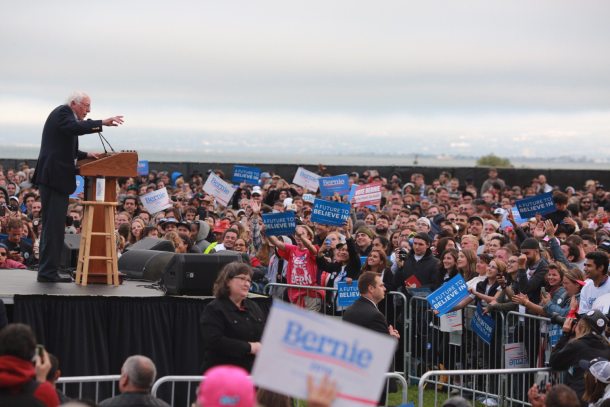
(Editor’s note: “Bernie Briefing” is a weekly campaign-season look at how Vermont U.S. senator and Democratic presidential candidate Bernie Sanders is playing in the national media.)
[T]hursday was supposed to be “Bernie Sanders’s big day in Washington,” predicted a major D.C. newspaper as he set out for scheduled visits with President Barack Obama, Vice President Joe Biden, U.S. Senate Democratic Leader Harry Reid and thousands of supporters at an outdoor rally.
“Our campaign has been about building a movement, which brings working people and young people in to the political process to create a government which represents all of us and not just a handful of wealthy campaign contributors,” Sanders told reporters as he left the White House. “We will continue doing everything that we can to oppose the drift which currently exists toward an oligarchic form of society, where a handful of billionaires exercise enormous power over our political, economic and media life.”
But seemingly by the time cable news had come back from commercials, Obama — and everyone else on Sanders’ schedule — was endorsing former secretary of state turned presumptive Democratic presidential nominee Hillary Clinton.
That wasn’t what her Vermont challenger had planned. But, unbeknownst to him, it was what many behind the scenes knew was coming.
Earlier in the week, Sanders had hoped to snag enough votes in the balloting in California, Montana, New Jersey, New Mexico, North Dakota and South Dakota to continue his candidacy until the Democratic National Convention in Philadelphia on July 25-28.
Then The Associated Press surprised everyone the night before the voting by reporting “Clinton will become the first woman to top the presidential ticket of a major U.S. political party,” capturing commitments Monday from the number of delegates needed to win the Democratic nomination.”
The next day, as other national news outlets tried to explain — take the Washington Post story “Why the Associated Press Called the Race for Hillary Clinton When Nobody Was Looking” or The New York Times’ “Early Nomination Call for Hillary Clinton by Associated Press Sent Media Scrambling” — Clinton won the big prizes of California and New Jersey.
Sanders, for his part, was left with a flurry of less flattering headlines, be it the Post’s “How Bernie Sanders Missed His Chance to Beat Hillary Clinton” (“Bernie didn’t grow up thinking he was going to be president — to come as close as he has, it’s damn hard to let go,” former Vermont Gov. Howard Dean is quoted) to Politico’s “Inside the Bitter Last Days of Bernie’s Revolution” (a story so blistering that Vox posted a link with the advisory “You should read it in full — seriously, go do that right now” and the addendum “any campaign that leaked this much to Politico is not in a functional place.”)
On Thursday, cable news viewers saw Sanders enter and exit the White House, followed by Obama endorsing Clinton. Off-camera, it unfolded differently.
“A senior administration official said Obama had told Sanders on Sunday that he was planning to endorse Clinton,” the Post reports. “The Sanders campaign asked that Obama wait until after meeting with Sanders, according to the administration official.”
And so “The Sanders Wind-Down Begins,” Politico notes in its latest headline.
“The courtship letters his campaign had planned to send superdelegates have been put on hold,” Politico reporter Gabriel Debenedetti writes. “His go-to argument — that he polls better against Donald Trump than Clinton — has been scrubbed from his public statements. There are mass staff departures, and his digital firm set up a new site to help laid off staffers find their next gig. Even his Senate relationship rebuilding effort has begun.”
Sanders is set to continue on to Tuesday’s concluding District of Columbia primary and next month’s national party convention, although Reid told The New York Times, “I didn’t hear a single word about him wanting to change the fact that she’s the nominee.”
(The Times also reports “Bernie Sanders to Meet With His Inner Circle on Sunday” — the day its Styles section is playing up an unusual profile of campaign manager Jeff Weaver.)
The candidate himself summed up his future in one sentence.
“I’m going to do everything I can,” he said on ABC’s “This Week” program, “to defeat Donald Trump, to do everything I can to make sure that the Democratic Party transforms itself into becoming a grass-roots party that represents working people and young people and not just a party that goes out raising money from the wealthy, to make sure that we have a platform that is the most progressive platform in the history of the Democratic Party, to make sure that it is clear that we’re going to fight for health care for all people, making public colleges and universities tuition-free and addressing the global crisis of climate change, to make sure that we transform America and tell the wealthiest people in this country they cannot have it all.”
But first, Sanders will meet with Clinton on Tuesday night.
“After we have that kind of discussion,” he told NBC, “I will be able to make other decisions.”
