


BRATTLEBORO — Since late 2013, Vermont residents have had access to free doses of naloxone, a drug that can reverse the deadly effects of an opiate overdose.
But the state’s biggest users of naloxone — its ambulance services — have had to pay out of their budgets for the increasingly costly drug.
That’s about to change: A new $32,000 allocation in the state Health Department’s budget for the next fiscal year will fund distribution of free naloxone — also known under the brand name Narcan — to all of Vermont’s emergency medical services agencies.
The state is still working out the details of how and when those doses will be distributed, and the financial benefit will vary based on how much naloxone a service uses. But officials say the change will provide some relief for ambulance organizations that have been facing acute financial pressures.
“It’s going to definitely have an impact,” said Drew Hazelton, operations chief for Brattleboro-based Rescue Inc. “The number of heroin overdoses we’ve seen has increased. Quite often, we end up using Narcan on those patients.”
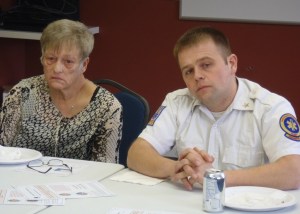
Medics from across the state took their concerns to Montpelier during the 2016 legislative session, saying the high demand for complex, expensive services is far exceeding available funding. One major problem is the state’s stagnant Medicaid reimbursement rates, with ambulance administrators saying they’re losing hundreds of dollars for every run that involves a Medicaid patient.
State lawmakers “were, I think, surprised by some of the issues that we’re seeing,” said Hazelton, who also serves as the Vermont Ambulance Association’s legislative chairman. “They were very receptive to working out solutions.”
One of those solutions, paradoxically, is a new 3.3 percent tax on all Vermont ambulance providers. Officials say the state will use the revenue — projected at roughly $1 million a year — to draw down more federal funding, then put that money toward raising emergency medical providers’ reimbursements.
The impact of the new tax is reflected in the final budget bill for fiscal 2017, which says the Department of Vermont Health Access will allocate $2.3 million “for the purpose of increasing emergency and nonemergency reimbursement rates to ambulance agencies … for services provided to Medicaid beneficiaries.”
But increased Medicaid reimbursements don’t solve all the ambulance services’ problems. For example, there is no specific Medicaid reimbursement for medications, and drug prices continue to rise.
Naloxone is no exception. Earlier this year, Wilmington-based Deerfield Valley Rescue reported that a single dose of Narcan priced at $16.95 in 2014 had jumped to $45.99.
Last week, Hazelton said Rescue Inc. now is paying more than $50 per dose.
Those who use Vermont’s naloxone distribution pilot program need not worry about such costs. The drug is distributed for free at 10 sites around the state, and the state has reported that nearly 7,000 doses were dispensed between December 2013 — when the program began — and September.
Gov. Peter Shumlin, who has made the state’s opiate problem a high priority, said in January that naloxone “has saved hundreds of lives” over that time period.
But some ambulance providers were left wondering why they were paying full price. “There seemed to be a disparity in that members of the community were able to pick up the drug for free, but these (medical) organizations still had to purchase it,” said Chris Bell, who directs the state Health Department’s Division of Emergency Preparedness, Response and Injury Prevention.
Language added to S.243, a bill aimed at combating opiate abuse, is expected to address that disparity. The Legislature approved a special $32,000 allocation from the state’s Evidence-Based Education and Advertising Fund to purchase and distribute naloxone to emergency medical providers.
Bell said that dollar amount is based on recent naloxone usage. Last year, the drug was given to 452 patients by emergency medical personnel in Vermont, with some of those patients needing multiple doses.
State officials still are working through the logistics of the new naloxone program and deciding “what mechanism will be used to get it out,” Bell said. “We’ll have that ready this summer.”
Allocations likely will be based on an emergency medical service’s past usage of the drug. But Bell also stressed that “every agency will get several doses” from the state regardless of whether they’ve used naloxone recently.
That includes ambulance providers as well as first-response organizations that don’t transport patients — for instance, a medical unit based at a fire department. It’s important for all such organizations to have naloxone, said Jim Finger, the Rutland-based president of the Vermont Ambulance Association.
“Everybody will be able to use it and have it,” Finger said. “It’s a help no matter what size they are.”
For Deerfield Valley Rescue, Business Administrator Heidi Taylor anticipates that free naloxone will save hundreds of dollars.
“It is very positive,” Taylor said, noting that both the drug allocation and the Medicaid reimbursement boost were approved relatively quickly after ambulance administrators raised the alarm.
“I was hopeful but didn’t expect this much to happen (in 2016), so we’re grateful for that,” she said.
At Rescue Inc., Hazelton expects a larger savings due to free naloxone. “It’s probably several thousand dollars a year in medications that we won’t have to buy,” he said.
Bell noted that the overdose reversal drug has a shelf life of one to two years. So medical response services don’t have to use it quickly, and the state doesn’t have to buy it often.
“Our hope is to just do this as a once-a-year purchase of naloxone,” he said.
