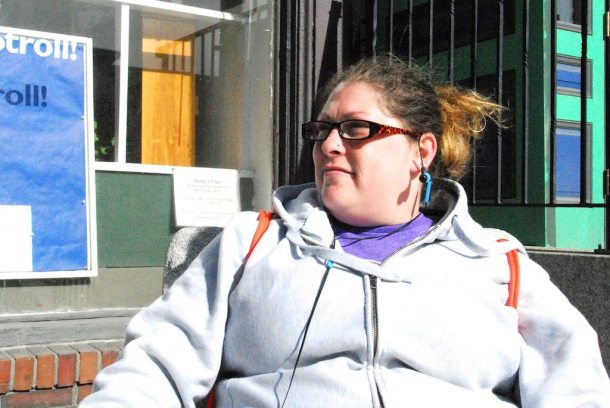
Hope Nisen has a new apartment.
There’s a yard where she will be able to keep a small garden, and Nisen is especially excited about the claw foot bathtub. It reminds her of one her family had when she was growing up.
But the apartment is special for another reason. This is the first time she will have her own space since she got out of prison and off drugs two years ago.
Nisen, a bright 31-year-old with frizzy blond-ish hair and an energetic way, is blunt about her background. She is a convicted felon and a former drug dealer. But she says she is also trying very hard to carve a fresh path.
Getting clean is just the first of many steps for recovering addicts. As Nisen has learned, the next steps are very difficult, too. Recovery depends on certain building blocks, like a steady job and a safe and comfortable place to live. But for someone with a criminal background and a history of addiction, those can prove elusive.
Drug addiction recovery is not black and white. Now, as more people move through Vermont’s treatment system, landlords, employers and communities are still feeling out how to help those who are trying to recover.
Hope’s history
Nisen was born in Barre and grew up in central Vermont.
She says she began drinking when she was 15. After alcohol, Nisen tried marijuana. When she was 18, she began using cocaine. It picked up from there.
Pregnant at age 19, Nisen says she cleaned up while she was expecting her son. He was born in 2004, but she began using again and racked up charges of driving drunk. In 2011, the Department for Children and Families became involved. Nisen says someone reported she was using drugs in her son’s presence and that he had started a fire in a trash can in their home.
After that intervention, DCF took custody of her then-8-year-old son. He went to live with members of his father’s family. Nisen spiraled.
“From that point until 2013, it was a big, big struggle,” she says.
Nisen was using a lot then, mainly crack cocaine and alcohol, she recalls. She was shooting heroin and using pills. She was selling drugs too, mainly crack cocaine and heroin, to support her habit, she says. “It was my job,” she says. “I did it for six years.”
Then, one day in September 2013, she got arrested.
Following reports of an assault, law enforcement went to a motel room in Barre, where they found several types of drugs as well as weapons. Nisen was in the room with three men. She faced three felony charges — two related to possessing and conspiracy to distribute cocaine, and one for carrying a firearm while committing a felony. Nisen pleaded guilty. She describes that period of time as “my bottom.”
“I lost everything and everyone, and I was sitting in jail, detoxing, with three felony charges,” Nisen says.
She went to prison for 88 days, then to rehab. She got out Dec. 31, 2013. She relapsed that same day.
According to Nisen, the next five months were a blur. She unsuccessfully went back to rehab in May, then went back to prison and served about another month and a half.
But this time when she got out, things went differently, she says. She went to Serenity House, a residential recovery facility in Rutland County where she spent 28 days. From there, she moved to Grace House, a sober living facility in downtown Rutland. After several months there, she moved back to Barre.
Recovery
“It’s true for everybody in recovery. They come into it and they really have no clue what they need to do,” says Bob Purvis of Turning Point Recovery Center in Barre.
Purvis, a soft-spoken man with a mop of white hair, sits in his office at the center on North Main Street.
“It’s a good thing in certain respects, because if you knew all that you would have to do, you just would go back out,” he adds. “You wouldn’t even try.”
One of the difficulties, he says, is that the pieces of the puzzle that are critical for success in recovery are very hard to put in place with a criminal background. It can be discouraging for people who are trying to live a drug-free life when they can’t find housing and they repeatedly get turned down for jobs.
“Through this insane drug war, we piled all the sanctions on the back end,” Purvis says. “Once a person’s trying to go straight and be a productive member of society, that’s when we impose the penalties.”
Purvis says Vermont has done a good job of expanding treatment services for opiate addicts in recent years, but changes still need to come. More effort and resources should be put into recovery, he says. He also notes that criminal backgrounds are common among recovering opiate addicts.
“When you’re addicted to opiates or crack, crime becomes part of that lifestyle in a way that it doesn’t necessarily with alcoholism, and so you’re going to accumulate certain violations in the course of your addiction that are serious, but in the case of the addict don’t necessarily reflect their being a criminal,” Purvis says.

Renee Davis, substance abuse and criminal justice program director at the Clara Martin Center, says the path for people who are recovering from drug addiction can be very difficult when they get out of the correctional system.
“People who are trying to re-establish their lives in the community after being incarcerated, they’re faced with a lot of barriers,” Davis says.
For one thing, the process of recovery consumes time and energy, she says, which can make full-time employment difficult.
“Being in early recovery is a job in itself, so it I’m sure feels that they’re needing to work, but also their job right now is to focus on themselves,” Davis says.
The amount of time it takes people to move forward with recovery and stabilize themselves varies greatly depending on the case, she says. Some people may need help and sober-living resources to support them for much longer than others.
Job search
Purvis first met Nisen in the fall of 2011. She came to Turning Point once in support of her cousin, who was participating in a program called Making Recovery Easier. She didn’t come a second time, he says.
The next time Purvis and Nisen met was years later. Nisen, recently relocated from Rutland, came to participate in the program. This time, she completed it.
“It was clear that Hope was really determined to stay straight this time,” Purvis says. “And of course a lot of people come through that way but … few make it stick the way she did.”
Nisen’s personal history was a particularly difficult one, Purvis says, but she showed real dedication to straightening her life out. “Hope is one of these people who is really tough but also really sensitive,” he says. “She wants more than anything to be a good mom and a good person and to work.”
When Nisen moved back to Barre, she started looking for a job.
Over the years, she has logged hours in a number of different fields. She worked in factories — at one point doing metalwork for snowshoes, at another working for Cabot Hosiery Mills. She did a stint as a grocery store cashier and put in time as a roofer. But it was tough finding a job after her conviction.
While she was living in Rutland, she says, she had tried to find some work. She applied for a job at an orchard. When she showed up for an interview, she says, they handed her a basket and told her to come back in a few hours to start picking apples. She also had a gig cleaning floors at night.
In Barre, Nisen had a tough time getting traction. She put together a resume and got some help from an adviser. She supports herself on money she gets from the state’s general assistance program and from other benefits, she says.
She recalls filling out applications for jobs around the Barre-Montpelier area but never hearing anything back. She believes her criminal history was a major contributing factor to the way employers considered her application.
At a certain point, Nisen began skipping the initial application form, she says. Instead, she began sending only her resume and a cover letter. For the first time in a search that had stretched for more than a year, Nisen got some calls.
An employer in Montpelier invited Nisen in for an interview. When she showed up, she was asked to fill out an application. “And I wrote in there, ‘The chance to discuss my charges and explain them to you,’” Nisen says.
After an interview, Nisen was hired on a probationary status, she says.
Nisen had some concerns about how she would feel when she got her first paycheck.
“I was worried that I would want to, like, go get high with it, you know. Because I haven’t had money like that in my pocket without wanting to go do coke,” Nisen says. “And I didn’t even think about it.”
Instead, she thought about things she wanted to treat herself to. She put aside some of the money to pay for her storage, she says, and bought herself some new tongue and nose rings. She took her son out to see “Batman v Superman: Dawn of Justice” in 3-D.
Ultimately, that job did not last. She was fired. It was “really a big kick,” Nisen says.
“It’s been hard for me to get motivation now to go out and look for jobs again,” she says. “It always feels like the carpet’s being pulled out somewhere.”
The job search is time-consuming and stressful, she says. She goes to Turning Point to use the Internet connection there, and the applications can be lengthy. She says she recently spent two hours filling out a multipart application for a retail job.
But Nisen says she tries to stay hopeful despite being let go. She went to a job fair in April. She filled out applications at two retailers, without success.
She has started practicing touch-typing with a Mavis Beacon Teaches Typing program. She is signed up to participate in a program through the Department of Labor to help her become a more competitive job candidate.
Employers, landlords and communities
The impact a criminal record can have on a job search is well-documented.
Earlier this year, lawmakers passed legislation that bars employers from asking that question in the first round of applications as of July 1, 2017. Gov. Peter Shumlin signed the bill into law earlier this month.

“If you have a criminal record, we want to give a chance after you have served your time, after justice has been served,” Shumlin said at the signing. “There’s no reason why you can’t return to the workforce as a productive member of Vermont’s society.”
Many employers have been working out how to best approach candidates with criminal histories themselves.
Bob Nelson, owner of Nelson’s Ace Hardware in downtown Barre, reports that he is willing to give job candidates with addiction or a criminal conviction in their background a shot.
“If somebody is up front with me, I’m probably going to give them an opportunity,” Nelson says. “I’m not going to say no just because they have a record.”
Nelson says he has employed recovering addicts before, as well as people with a criminal history. Many times it has worked out, but other times it has not. One former employee was not up front about her background, he says, and was accused of stealing from the store. Those experiences have a lingering impact that can spill over onto future job applicants, he says.
“Moving forward for the next person, now you’ve got this, call it a bad taste in your mouth. You’ve been burned,” Nelson says. “You can use any of the old adages you want to use, but now you’re more cautious.”
Nelson says more job applicants recently have been open about their backgrounds. “Today you’ll find that there are more people out there that are willing to be a little more frank with you,” he says.
Barre Mayor Thom Lauzon thinks his city has done fairly well in taking on the opiate epidemic.
Speaking across a conference table of local granite in his South Barre office, Lauzon says the city has been adapting to the crisis.

In addition to the Turning Point Recovery Center, there’s a homeless shelter in town. The shelter requires people who stay there to be sober.
However, Lauzon says, the emphasis is on the front end.
“As we are coming to grips with this opiate crisis, we are stomping out fires,” Lauzon says. “And unfortunately, I don’t believe we have done enough to support people who are two years sober.”
In fact, he says he’s not aware of what programs and supports there are for people who are several years into recovery.
“We told you that if you got sober your life would be better,” Lauzon says. “And if it sucks and you’re two years sober, then there’s something wrong with our programs. Then we’re not being supportive enough.”
Lauzon says he personally likes to give people a second chance: “I’m a big fan of redemption.” He says he has made calls to potential employers to vouch for people trying to straighten out their lives.
However, he says there are limits, and people do not get an endless supply of second chances.
Moving forward
Recovery has not always been a smooth path for Nisen.
A little over a year ago, she violated the terms of her probation. She was feeling a tremendous amount of stress, she says, and she slipped. She took three hits of crack. The substance turned up on a urinalysis screening.
More recently, when she was on a temporary suspension from her living program, she stayed with her cousin, who uses drugs. While there, she took seven hits of crack, she says.
Afterward, Nisen says, “I feel really guilty, and I feel like crap.”
For the rest of her suspension, she stayed at the shelter. “So I wouldn’t be tempted again,” she says.
Nisen is learning to manage the temptations. An accident years ago left her with a badly injured tailbone. It’s been an ongoing source of pain and was leading her to think of drug use, she says. But she was determined not to, so instead she decided to go on a medication-assisted therapy maintenance program.
When asked about her background, Nisen answers frankly. She does not shy away from discussing her addiction to drugs, or her conviction on three felony charges, or her prison sentence, or her time in rehab.
“I mean, I know what I did was wrong. I know that, you know,” Nisen says. “I’m not going to do it again.”
Often, she says, she feels like that chapter in her life is firmly in her past. She does not want to use drugs again. She does not want to go back to selling drugs.
Her criminal background, however, casts a long shadow.
In December, The Times Argus reported on a Brooklyn man who faced federal charges of dealing heroin in Barre.
Byron Mathews had been convicted three years earlier on charges related to cocaine. The story dug into Mathews’ history and the 2013 incident that resulted in the arrest of him and three others, including Nisen.
When the story came out, Nisen had been in recovery for a year and a half. Asked about the incident, she quickly volunteers that she takes responsibility for her actions in the past.
“You can move on every day in your own life, but if people keep bringing it up and rehashing it, who’s going to give you a chance?” she says.
Nisen is doing her best to move on.
She moved out of transitional housing and into her new apartment last week. She got the apartment with the help of Pathways Vermont, a housing organization.
Nisen sees the apartment as one step forward in moving toward her big goals: getting a job, and spending more time with her son.
Nisen has some concerns about managing the financial obligations that come with renting. However, she says she truly believes that by settling her living situation she will be able to expand her network to support her in recovery and to find a job. She’s launching into new efforts to find employment, including beginning a course through the Vermont Department of Labor to help her through the job market.
Aside from her concerns, she is excited at the responsibilities that come with having her own place. She says she has been looking forward to getting the electricity bill set up in her name. “It makes me kind of feel proud,” she says.
She’s also excited for what the apartment will mean for her relationship with her son, now 12.
“In the last few years I haven’t had my own place,” Nisen says. “He couldn’t really call it ‘my mom’s house.’”