


(Editor’s note: Jon Margolis is VTDigger’s political columnist.)
[T]wo Vermont women who had not known one another met and chatted for a while. The way Karen Richards related the conversation, one of them said to the other: “You speak really good English.”
A compliment.
Except that the woman receiving that compliment had been born, raised and educated in the United States. English was her first language, the one she’d been speaking all her life.
But she wasn’t white.
Her “really good English” was grammatically correct and clearly enunciated, which appeared to surprise the other woman, who was white.
And who no doubt meant well. Like so many white Vermonters, the woman who issued the compliment had probably had very little contact with anyone who was black, Hispanic, Asian or an immigrant. To Richards, the executive director of the Vermont Human Rights Commission, the woman “did not recognize her comment as racism.”
But it was, even if it was not mean-spirited and was what Richards called “an unconscious bias.” In assuming that an African-American would not speak really good English, the woman was acting on “the belief that race accounts for differences in human character or ability,” the dictionary definition of racism.
Race is a subject easily avoided in Vermont, where 93.5 percent of the people are non-Hispanic whites, most of whom likely consider themselves not the least bit racist.
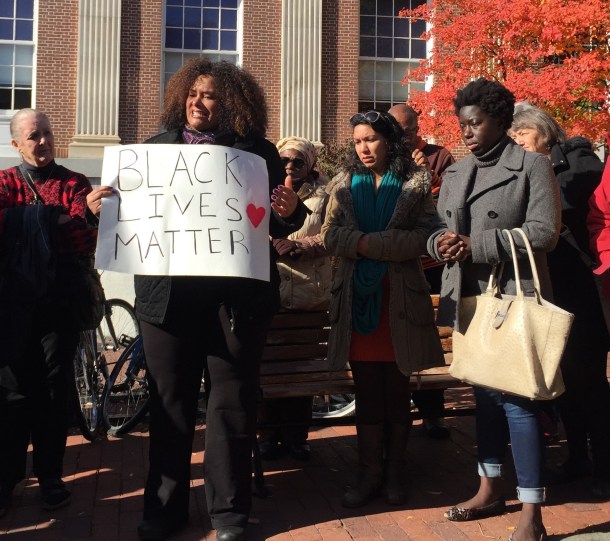
The topic emerged this year because of the difficulties Vermont’s Sen. Bernie Sanders had getting black and Hispanic voters to support his presidential campaign. Sanders, who demonstrated against segregation as a college student, had a strong civil rights record in Congress. But when confronted with protesters from the Black Lives Matter movement, he seemed at first confused about how to respond, as though he were in unfamiliar territory.
Most Vermonters are when it comes to dealing with racial minorities, even though the state and its people can point to evidence supporting the claim that they are open-minded and without prejudice.
Vermont’s civil rights laws are among the strongest in the country. Its political leaders are reliable advocates of anti-discrimination laws and affirmative action, and those leaders keep getting re-elected. Comparative academic studies of racial resentment find less of it in Vermont than in most other states. Only in multiracial Hawaii did America’s first African-American president get a higher percentage of the vote than he did in Vermont, one of only five states in which most white men (according to the exit polls) voted for Barack Obama.
Of course it’s easier to be open-minded toward those other people when there are hardly any of those other people around. As recently as 2000, Vermont was 97 percent non-Hispanic white. With most of the nonwhites in and around Burlington, a rural Vermonter could live, work, play and go to school for years without seeing anyone who looked very different from him- or herself.
That leaves many ill-equipped to deal with people of other races when they do come in contact with them.
And they increasingly will. Slowly but steadily, more people of color are moving into Vermont — as refugees from Africa, as farmworkers from Mexico, as immigrants from China. That means many Vermonters unaccustomed to mingling with people who look very different are finding themselves doing just that.
Some seem not to be ready for it. A few respond with expressions of old-fashioned, blatant racism. But as Curtiss Reed Jr., the head of the Vermont Partnership for Fairness and Diversity, pointed out, “There are knuckleheads everywhere.” What may be a greater problem in Vermont is the “unconscious bias,” those “micro-aggressions” blurted out by people who are convinced they are not racist.
Richards, of the Human Rights Commission, said those micro-aggressions are so common in Vermont that many nonwhites in the state call Vermont one of the worst places they have ever lived.
Sha’an Mouliert, an African-American activist who lives in St. Johnsbury, doesn’t go quite that far. But she was distrustful of “people who say, ‘We don’t have any racism here.’ They mean it according to their definition.”
And while that definition means Vermonters will rarely use racial slurs, they do things like “commenting on somebody’s hairstyle, or coming out and saying things like, ‘Race wasn’t an issue until you came,’” Mouliert said. “It’s people who think they are not racist who diminish the value of people of color in everyday conversation.”

According to Ebony Nyoni, a Winooski businesswoman who is active in Vermont’s Black Lives Matter organization, the fact that there are so few nonwhites in the state allows Vermonters to “shy away” from facing up to what she called the institutional racism that infects all white Americans “while other parts of our country have been forced to face it head on.”
Patrick Brown, the executive director of the Greater Burlington Multicultural Resource Center, is more optimistic.
“In general, we have more diversity today,” said the Jamaican-born Brown, who once owned a Caribbean restaurant in Burlington. “Vermont is now on the list of places (for nonwhites) to move to.”
He seems to have a point. More people of color are in fact moving to Vermont. Its 6.5 percent racial minority population, according to the Census Bureau’s 2014 estimate, may be the second-lowest in the nation (only Maine’s is lower), but that means twice as many live in the state now than in 2000. If that growth rate continues, by 2030 people of color will make up almost 15 percent of the population, and there will be more than 50,000 of them.
Curtiss Reed isn’t just waiting for this to happen. He’s trying to make it happen by urging African-Americans to move to the state, and he’s using a strategy that seems to make sense: He wants Vermont to attract blacks the same way it has attracted whites for decades.
“They came here as college students, as summer campers, as tourists, and they liked what they saw,” Reed said. “So why should we not encourage black skiers, snowboarders, motorcyclists and marathoners?”
And so he is, making sure, he said, that “the message of Vermont makes its way into the recreation associations of people of color — campers, hikers, skiers, motorcycle clubs.”
State government, though it has no specific policy designed to recruit by race, is cooperating. The Vermont African-American Heritage Trail, which Reed helped develop, is a project of the Department of Tourism and Marketing. Reed said he hoped it would attract black tourists, some of whom would see that “we have the great outdoors, the air is clean, the water clean, people are nice” and decide to move to the state.
For several reasons, perhaps white Vermonters should hope they (and other people of color) do. Vermont’s population is barely growing, and most of the newcomers seem to be black, Hispanic, Asian or mixed race. It’s the white population that appears to be shrinking. Without more influx of nonwhites, the state’s overall population could decline.
No change comes without its troubles, and a big increase in Vermont’s nonwhite population would be no exception. As Patrick Brown candidly noted, some of the new minority Vermonters are drug dealers. Then there is the possibility of tension among the minority groups. African-Americans, though perhaps the most visible of Vermont’s minorities, are the smallest, slightly outnumbered by both Hispanics and Asians.
Still, a steady increase in the population of all these groups could have its economic and cultural benefits. More good food and good music, to start with. And maybe, especially if Reed succeeds in attracting some of those affluent African-American skiers and hikers, in a decade or so even the most insular white Vermonter won’t be surprised that some of them speak really good English.
