

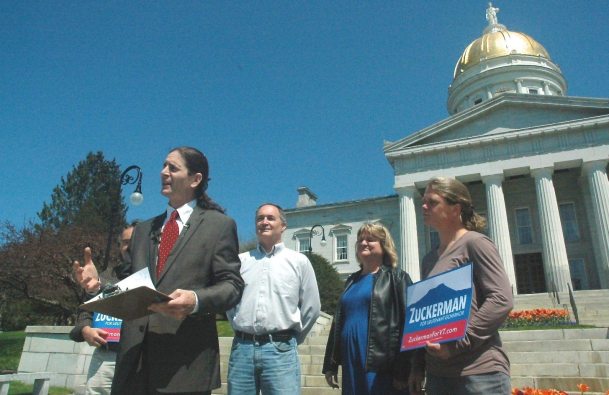
[D]emocratic candidate for lieutenant governor David Zuckerman laid out his vision for the position Wednesday, promising that if elected he will tour Vermont and gather ideas so he can become an effective “spokesperson for the whole state.”
“I’ve always operated with one foot in the building and one foot outside the building, organizing, getting people involved in the process,” Zuckerman said in front of the Statehouse. “As lieutenant governor you can really do that in a way that you can’t as much as a legislator.”
Zuckerman, a state senator from Chittenden County elected under the banner of both the Democratic and Progressive parties, said he would create task forces of engaged community members — on issues ranging from broadband Internet availability to forestry regulations — and push for the best ideas to become legislation.
His first task force would focus on the rural economy, he said, and he was flanked Wednesday by a number of farmers who offered ideas about how to improve the state’s food economy. Zuckerman and his wife operate Full Moon Farm in Hinesburg.
Christa Alexander from Jericho Settlers Farm talked about having integrated solar energy production into her operation and called for better Internet and cellphone service across the state to enhance agricultural communication. Cheryl Devos from Kimball Brook Farm talked about the economic benefits that come from fully processing, packaging and distributing the milk produced on the North Ferrisburgh farm.
Clark Hinsdale, former president of the Vermont Farm Bureau, praised Zuckerman’s experience as “someone whose livelihood depends not on politics, but on the soil that we share.”
Zuckerman acknowledged that some of the big ideas he pushed during the last legislative session — including marijuana legalization and efforts to divest state retirement accounts of fossil fuel investments — didn’t see success.
But Zuckerman claimed that as lieutenant governor he could more effectively sell his big proposals through community support.
“People were afraid to speak up (on marijuana) because of the stigma,” Zuckerman said, adding that another impediment was that pot talk from legislators “wasn’t happening with constituents.”
Sen. Anthony Pollina, P/D-Washington, endorsed Zuckerman’s planned outreach as lieutenant governor, agreeing that progressive public proposals needed a high-profile champion in the Legislature.
“The best ideas for Vermont don’t necessarily start in this building,” he said. “The best ideas for Vermont start around kitchen tables and in town halls and church basements around the state.”
Zuckerman’s only primary challenger is Rep. Kesha Ram, D-Burlington. The only announced Republican in the race is Randy Brock, a former state auditor and senator.
Democrat Brandon Riker, a Marlboro businessman and political organizer, was in the race for a few months before dropping out and endorsing Zuckerman.
Zuckerman initially hoped to run a publicly funded campaign, but he was disqualified from receiving state money after he announced his candidacy before the rules allowed. Now collecting cash from private donors, Zuckerman was more than $30,000 behind Ram in fundraising as of March, according to fundraising reports filed then.
On Wednesday, Zuckerman said he is seeing a healthy number of donations and expects to mount a well-funded campaign before the primary in August.
“All the pistons are firing,” he said.
