


[B]URLINGTON — Prosecutors say the 23-year-old police officer who shot and killed a mentally ill man armed with knives after several hours of standoff won’t face charges.
The March 21 incident raises larger questions about the structures in place to help the poor and mentally ill, which failed to get Ralph “Phil” Grenon, 76, the help he needed, according to law enforcement, treatment providers and people who knew Grenon.
At a news conference Tuesday, Chittenden County State’s Attorney TJ Donovan said his office and the attorney general’s analysis and review of the case were limited to whether Officer David Bowers was justified in his use of force.
“It is clear that criminal charges are not supported by the evidence,” said Bram Kranichfeld, Donovan’s top deputy.
According to officials, Grenon was advancing at Bowers and other officers as he exited the bathroom in his cramped downtown Burlington apartment, swinging knives and ignoring officers’ commands. Grenon continued to advance even after being shocked with a Taser, officials say.
Bowers knew Grenon had made threats to kill people and had seen him acting erratically over several hours before Bowers shot six times, Kranichfeld said.
Only 12 seconds elapsed from the time Grenon was shocked with the Taser to when Bowers shot him with his handgun, according to officials. In those moments, any reasonable person would have believed that Grenon posed an imminent threat of death or serious bodily injury to Bowers or his fellow officers, Kranichfeld said.

It is rare for prosecutors in the United States to charge police officers with a crime for their use of force, but in Grenon’s case, his own daughter, Niki Carpenter, said “on the black-and-white facts” she believes Bowers was justified in killing her father.
“I do not dispute Officer Bowers’ decision, and like I have said, I do, based on the facts, agree with the finding of the state’s attorney’s office,” Carpenter said.
Carpenter, who addressed reporters via conference call Tuesday, said that although she agrees criminal charges aren’t warranted, she has lingering questions about why it was so difficult to get her father the help he needed.
Grenon was well-known to Burlington police, who went to his apartment three previous times in 2016 to check on his well-being or in response to noise complaints, and the Howard Center street outreach team was “engaged in an ongoing effort to put Mr. Grenon in contact with mental health services,” according to the state’s attorney’s report.
Grenon was also facing eviction from his apartment at 101 College St., a building that caters to the elderly and disabled. He was also a paranoid schizophrenic, according to Carpenter. At the time of his death, Grenon had stopped taking his medication for several weeks, she said.
Carpenter said her father was not violent by nature, and it was the delusional aspects of his illness, especially when not properly treated, that led to the erratic and threatening behavior that brought him in contact with police.
“He was a wonderful man,” Carpenter said, becoming emotional for the only time during her remarks to the media. “I just hope that he’s remembered for who he was as a whole and not the last few hours of his life.”
Questions about access to mental health treatment
Carpenter, who lives in Arizona, said she had noticed Grenon’s condition deteriorating over several months during weekly phone conversations. She reached out to his psychiatrist on a number of occasions, asking to discuss his medication levels.
She said she was told her father was competent enough to make his own decisions about medication, and Grenon refused to let anyone adjust the dosage of medications he was receiving.
“Hospitalization was always the goal for us,” Carpenter said Tuesday. In 2007, the family was able to have Grenon committed to a psychiatric hospital. While hospitalized, his medication was adjusted and his condition improved, according to Carpenter.
It’s unclear, given the efforts of social workers and Grenon’s family, why he didn’t receive inpatient psychiatric care. Vermont has struggled with a shortage of available inpatient psychiatric beds since the closure of the state psychiatric hospital in 2011, and people with acute psychiatric needs still routinely wind up in hospital emergency departments.
Carpenter said she was told several times that Grenon did not fit the criteria for involuntary committal, which requires that he be considered a threat to himself or others.
“And although he was making threats, it was loophole after loophole of ‘Well, the wordage isn’t such that we deem him, you know, violent enough to have him committed,’” Carpenter said.
In a recent commentary, Nolan Rampy, a Howard Center clinician, argued that the “chronic underfunding” of Vermont’s community mental health system is partly to blame for police confrontations with people experiencing psychotic episodes.
After the state hospital closed because of storm damage, the community mental health system was supposed to augment the private psychiatric hospitals that would take inpatient placements, but Rampy and others have said it was never adequately paid for. Even with the opening of a new smaller state hospital, the situation is still strained.
Carpenter said she has other questions about the events that led to her father’s death, but that she didn’t want to raise them publicly until she’s had a chance to speak with the people involved.
“I do think there needs to be an awareness and conversation, and possible changes in law and procedure with the way that the mentally ill in the Burlington area are dealt with,” she said.
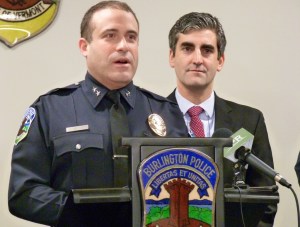
Burlington Police Chief Brandon del Pozo, who has faced criticism for not waiting Grenon out when he was backed into the bathroom of his apartment, said this situation has prompted his department to pursue further training to teach officers patience and restraint when dealing with the mentally ill.
“(Grenon) was the man we were trying to serve that night, by subduing and getting him back on his medicine. We consider our efforts a failure in this case,” he said.
At the same time, Grenon’s shooting shows there is a systemic problem with access to treatment in the region, del Pozo said, that is increasingly placing his officers in untenable situations.
“This is not the first case I’ve heard where people have struggled to get someone into treatment,” del Pozo said. Whether it’s substance abuse or mental health, people aren’t getting the help they need before becoming dangerously unstable, he said.
“When the police are there it’s become acute, and when it’s acute, it’s unpredictable, and when it’s unpredictable, things happen in seconds and we have the type of outcomes we had in this instance,” del Pozo said.
Del Pozo also defended his officers’ use of force, saying police will take risks to subdue a person without causing harm, but those risks become unreasonable at the point where an officer could be stabbed or seriously injured.
“Officers are not expected to be stabbed. … They’re expected to go home safely to their families,” he said.
Del Pozo has said the incident has exacted a heavy toll on Officer Bowers. At a recent police commission meeting, del Pozo said Bowers is receiving counseling and had returned to administrative duty.
Bowers will undergo psychiatric evaluations to requalify for carrying a firearm. After a period of supervised patrol, Bowers will return to full active duty, del Pozo said.
Media cautioned over use of body camera footage
During her remarks, Carpenter criticized Burlington police for giving an interview to media while the standoff with her father continued. That interview captured audio from Grenon’s final moments. Carpenter said she felt that giving an interview before the situation was resolved was disrespectful and unprofessional.
Del Pozo said reporters had been waiting outside the apartment for hours and he had asked Deputy Chief Jannine Wright to go down and speak with them. At that point he still believed there would be a different outcome, he said, and did not anticipate the interview would coincide with a shooting.
“The media ran it. It was sensational. It sounded harrowing,” he said.
His department plans to release the body camera footage from the event to media outlets that request it, del Pozo said. Both the chief and Donovan called on media outlets to exercise restraint in their handling of the video.
VTDigger requested the footage Tuesday but had not received it prior to deadline.
A warning of history repeating itself
Jim Leddy, a former state senator and former executive director at the Howard Center, also addressed reporters at Tuesday’s news conference.
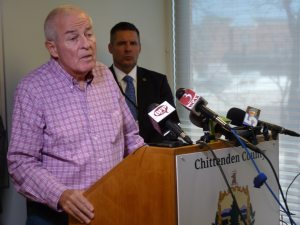
Leddy said he knew Grenon for more than 60 years. He said Grenon had a hard life as the oldest of eight children, grew up in the old St. Joseph’s orphanage, and went into the military after graduating from high school. Each of the five Grenon brothers whom Leddy knew returned from the military and attended the University of Vermont.
Grenon followed the news and issues of the day with concern and interest, Leddy said, and would often call or stop him on the streets to discuss them during Leddy’s time in the Legislature.
“I saw Phil’s mental illness progress over the years to the point in time when he shut me and others close to him out of his life,” Leddy said. “I don’t want him to be defined by a stigmatizing label of being mentally ill.”
“When someone 76 years old dies as Phil died, we have to question why. We have to question when somebody who is 76 is being evicted, even for good reason, what is next for them. This can’t be the ‘what’s next,’” Leddy said, referring to Grenon’s breakdown and subsequent killing.
“The camera on the last narrative of Phil’s life tells us what happened when. It doesn’t tell what didn’t happen and why,” Leddy said.
It’s the latter set of questions that law enforcement, treatment providers and the community need to answer, he suggested. Without better planning and coordination, Leddy said, he could guarantee another tragedy like Grenon’s killing.
