

(Editor’s note: Katie Jickling is a former intern for VTDigger.)
[I] expected chaos in Portoviejo, Ecuador, 27 hours after a 7.8 magnitude earthquake rattled the country.
But when we arrived Sunday evening, April 17, the city of 300,000 stood dark and exhausted, as if in the raw silence after an argument.
Our group of 30 young adults happened to be in Ecuador at the time of the quake, concluding a two-week missions and service trip. We were staying just outside Quito when we felt the earth jostling beneath us, a tremor just strong enough that the eucalyptus trees swayed and I bent my knees to steady myself.
We had packed planning for one last trek up one of Ecuador’s rugged peaks. Instead, we got permission papers, established a connection with a local church that would host us, and made a 12-hour, mudslide-ridden drive to Portoviejo, one of the hardest hit cities, on the western edge of the country.
When we arrived the day after the quake, the death toll stood at 278 across the county. By April 23, over 650 dead had been found and identified, and 12,000 more injured.
I hesitate to write about a disaster of such proportions for fear of falling into sensationalism or melodrama. In Portoviejo, the reality was neither. It was a time of waiting, of listlessness.
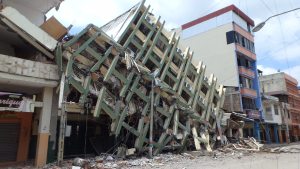
Remaining buildings leaned precariously, with cracks running up their sides like veins.
Even families with homes intact slept in the streets, afraid to enter their houses for fear of an aftershock. Red dust is everywhere: clouding the air, plastered to arms and eyelashes, accumulating in folds of clothing. A smell of death prevails, the smell of a musty attic combined with the acrid sharpness of decomposition.
A Night of Work
We spent the first night cleaning up at the hospital; restacking everything from staplers and medical files to boxes of prescription medication. Little is quick and efficient in South America, especially during an earthquake. The frenzied hospital staff ferried us around, confused where we should start. We swept rooms until nearly 3 a.m., waited for directions, tried not to stare at the patients lying in rows along every room and courtyard.
We stumbled across the path of Rafael Correa, the president of Ecuador, who also happened to be passing through the hospital parking lot at 1:30 a.m. He shook hands with a congenial sense of authority. “Thank you, thank you for your help,” he kept repeating. “What a tragedy.”
We slept on a church floor, in tents to ward off the Zika virus-carrying mosquitoes, and returned to the downtown early the next morning.

We were divided into groups, told we would be looking for and exhuming bodies, and cautioned: “It’s been a warm 48 hours: They smell.”
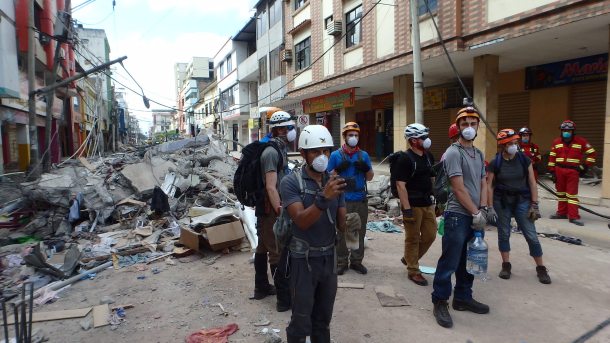
The city was a sepulchre of what used to be: mountains of bricks and concrete, shattered kitchenware, downed power lines, remnants of furniture. A Barbie doll, chemistry notes, single shoes, a mattress. I found a will, half-buried; that too would be scooped up and discarded by the bulldozers.
Our group was assigned one particular pile of rubble, which had once been a five-story complex housing apartments and shops. Now, an excavator gently scraped layer upon layer from the wreckage.
Looking for Bodies
At intervals, we ran in to unearth personal possessions or to shine headlamps tentatively into dark caverns in the concrete, looking for the bodies of the two girls who were said to be trapped inside.
We sat on the curb for long hours, with too much destruction or too little organization to be assigned to effective work.
Meanwhile, we offered what we had in our backpacks: a few apples and tuna packets to one father, my chocolate bar to a haggard firefighter, five water bottles to a family who asked us for them. They thanked us profusely.
We extricated family photos from the rubble, clothing, a jar of peanut butter, a vase, passing them down an assembly line to the house owners, who tossed the bags into a pickup truck. Here were the lives of strangers laid bare. It was like being trapped into voyeurism, with no place to avert my eyes.
We hadn’t found the girls’ bodies when the excavator halted at sunset. But the acrid smell that remained hinted that there was little to hope for.
But that was the afternoon when other Portoviejo rescue workers did find that a man was alive, trapped between the third and fourth stories of a collapsed six-story building. He had been drinking his own urine, news organizations reported afterward, and had called the police when cellphone service was restored 40 hours after the quake. The building was nearby, and we joined hundreds of rescue workers and citizens hungry for hope.
The rescue took an hour, as the team used saws and drills, as painstakingly as a surgeon with his patient. The onlookers stood expectant, craning their necks, hushing any motorcycles or shouts that disturbed the silence.
When rescuers lifted the man out onto a backboard and down toward the ambulance, the man raised his arm in a wave. The crowds cheered and whistled, jubilant. The rescuers gave each other fist bumps. It was a resurrection from the dead; his wife had already bought his coffin, we heard later.
The rescue lent vitality to the whole day. Deep in the concrete amidst the desolation and stench of death, there was life.
We kept working until long after dark, clearing bricks out of a home built just last year. We were sorry, we told a young woman named Diana, that we could not safely crawl under the layers of concrete to look for her life savings buried somewhere below. She nodded.
“What will you do?” I asked her as we shoveled. She paused, running her fingers over a teacup that had emerged miraculously intact. “I don’t know,” she said, quietly. And then with a mournful smile: “Pray.”
We left for the day, plastered with dirt and sweat. As a string of us passed, Ecuadoreans seated on the curb or in plastic chairs burst into applause. They clapped slowly at first, then louder, reaching their arms out to shake our hands, asking us where we were from.
Unearned Generosity?
Others ushered us through a crowd toward an army truck, where meals were distributed. Women, ignoring our protests, pressed into our hands warm chicken and rice wrapped in banana leaves.
We found there were few words to say but “thank you,” as we received compliments we didn’t deserve, food we didn’t want, generosity we didn’t ask for. It was, I thought later, a perhaps-subconscious act of defiance thrown into the face of desperate circumstances: serving up richness even while mountains of rubble stood stories high and when loss and uncertainty hovered so tangibly in the air.
We ate seated in a parking lot, half-guiltily licking grease from our fingers.
Later, after church ladies scrounged together another meal for us, we loaded on the bus in the warm night air. We had a flight to catch.
As we pulled away, silhouettes of a desolate city and piles of rubble loomed large against the starry sky.

