


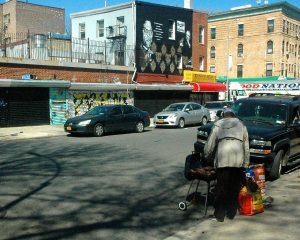
[N]EW YORK — Splashed across a large brick wall on Putnam Avenue in Brooklyn is a political mural featuring two faces: famed civil rights activist Malcolm X and Vermont Sen. Bernie Sanders.
The mural — painted in black, white and gold — features a quote from Malcolm X discouraging blind patriotism. It also bears the political declaration “Brooklyn for Bernie.”
It stands in the heart of Bedford-Stuyvesant, a historical center of African-American life in the city. One of the first free black communities in America, Bed-Stuy has produced luminaries in every field, including famed rapper Jay Z and baseball legend Jackie Robinson.
Across the street from the mural, James Singleton is grilling chicken outside a beautiful old brownstone. He says he’s lived in Bed-Stuy for 14 years, considers himself a Democrat and is voting for Hillary Clinton in Tuesday’s Empire State primary.
Singleton says he’s impressed by Clinton’s history working with world leaders as secretary of state. He adds in other accomplishments from her years of service in many political roles. Clinton’s been around so long, Singleton says, that he feels like he knows her.
“I’m going with experience, the person I know can deal with other countries,” he says.
Asked about Sanders, Singleton closes the lid on his grill, looks up at the mural in front of him, and shrugs.
“Bernie will do the same things as her, I know that,” he says. “I’m sure he can probably get the job done and is a good man. But I never knew him, and that means a lot to me. I know Obama, and I know Ms. Clinton. But I don’t know nothing about him. I never knew him.”
As Sanders works for a win in next week’s primary, where polling shows him behind Clinton, his chances are hobbled by the fact that his message does not seem to be garnering significant attention or support in African-American communities.
Clinton, meanwhile, has paid special attention to black communities in voting from the South to the North. She has visited churches, reached out to families affected by gun violence, and served as a powerful voice condemning the lead contamination in the public water system of Flint, Michigan.
In her first policy address as a presidential candidate, Clinton spoke about her concerns around mass incarceration and the criminal justice system.
“We can heal our wounds,” Clinton said at Columbia University a year ago. “We can restore balance to our justice system and respect in our communities. And we can make sure that we take actions that are going to make a difference in the lives of those who for too long have been marginalized and forgotten.”
Clinton’s hard work has paid off, as black voters have helped her clinch decisive wins in a number of states including Georgia, South Carolina, Alabama and Louisiana.
In Thursday’s CNN debate, Sanders bluntly acknowledged Clinton’s strength with African-Americans in the South, saying that “we got murdered there.”
In New York, Sanders could face another political slaying, as Clinton leads among blacks 65 percent to 28 percent, according to a recent Quinnipiac poll.
Sanders fares best with white voters of many ages and backgrounds, and he has demonstrated support among younger blacks in some states.
In New York, Sanders is performing best in the west. But although it’s a large region, the Vermont senator must also earn wide support in the city if he hopes for a win.
A diverse place, the Big Apple has more than 40 percent of the state’s entire population, including more than 1.89 million black non-Hispanics.
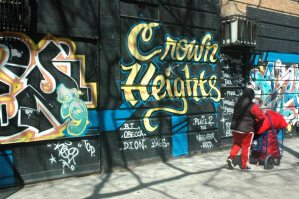
During a recent trip down Malcolm X Boulevard, which runs through the neighborhoods of Bed-Stuy and Crown Heights, interviews turned up few African-American voters who knew much about Sanders, besides that he is running.
There was broad consensus that Clinton was more experienced, and more familiar. The better choice.
Many of the voters said they preferred Clinton’s effective pragmatism over Sanders’ bold proposals that don’t seem feasible.
“She is more realistic, but she still knows what Americans want and need,” said Tony Sanchez, a middle-aged man with Jamaican roots. “There’s not all this talk with her about something you can’t do. You need to live in reality.”
As for Sanders, Sanchez said that “he means well, but he is too hasty to be a leader. You need to be more mild, more settled.”
Selling $1 slices of sweet potato pie on a Crown Heights corner, Robert Gollman, 62, said his support for Clinton was partly based on her husband’s success.
“I remember, when Bill was in office, the economy was really swinging. I mean it was really in full force,” Gollman said. “I assume that whatever she doesn’t know, he knows. It’s like he would be back in office.”
Although a 1994 criminal justice reform bill supported by Bill Clinton as president turned out to increase incarceration rates, and has proved a potent issue in this campaign, the former president remains popular. Under his leadership in the 1990s, unemployment rates among blacks plummeted and household incomes shot up.
A number of voters in Brooklyn invoked Bill Clinton while explaining their support for his wife.
John Andrew boiled his whole defense of Hillary Clinton down to the thriving economy under her husband’s presidency, reminiscing that “things were nice in his days.”
When asked to reflect on Sanders’ candidacy, Andrew kept things short.
“I don’t know much about him,” he said.
The Brooklyn voters varied in their top campaign issues, though a majority spoke about the need for criminal justice reform and economic help to low-income black communities. A few also put foreign policy near the top of the list, as well as health care reform.
A couple of residents said they were planning to vote for Sanders, adding their decisions had been made after researching his record.
Wearing a black velour jacket and a pink bowtie, Robert Wiggins, 50, said he had swung to the Sanders side.
“I think Sanders is a bit more progressive,” he said. “If you look at Clinton’s body language, she’s just not believable.”
Che Smith, 42, said that after learning of Sanders’ past civil rights work, which includes attending the March on Washington that culminated with Martin Luther King Jr.’s famous speech, she was won over.
“I’ve been a big Hillary supporter, but I’ve been going back and forth,” Smith said. “But after seeing Bernie talk, and looking at his background, I now support him.”
James Battista, a professor of political science at SUNY-Buffalo, said Sanders’ lack of more widespread early outreach to communities of color could end up becoming the campaign’s Achilles’ heel.
“What interests me is the world where in 2012 or 2013, Sanders really started informally appealing to black voters, by going to South Carolina, by meeting with members of the Congressional Black Caucus,” Battista said. “If he had been making those overtures, he could have been doing better here.”
Sanders has made some overtures, and his proposed criminal justice reforms have been shaped by multiple meetings with activists from the Black Lives Matter movement. Sanders is also advised by a number of high-profile black surrogates on the trail, including political rapper Killer Mike, former Ohio state Sen. Nina Turner and former NAACP President Ben Jealous.

On Saturday afternoon, fresh off a plane from Vatican City, Sanders went to another church, in Brooklyn. He spoke with faith leaders in a social justice roundtable at the First Unitarian Congregational Church aimed at reeling in black supporters before Tuesday’s primary.
While most Sanders events are jam-packed rallies, the Saturday roundtable had a number of empty pews, and a large percentage of the audience was white.
Political philosopher and socialist Cornel West got the crowd clapping with a vigorous defense of Sanders, declaring “he’s our brother.”
“He is the real thing,” West said. “I come from a blues tradition, a jazz tradition — we know the difference between the real thing and the copies. We know the difference between the original and the imitation.”
West’s words were powerful, and he gave a full-throated endorsements of Sanders’ candidacy. But the most prominent black leader scheduled to attend the Sanders event, the Rev. Al Sharpton, canceled his appearance at the last minute, citing a scheduling conflict.
“I don’t know what happened,” said Sanders spokesman Michael Briggs. “I remember being backstage at (Sharpton’s) conference Thursday and Bernie invited him. He said he’d be happy to come.”
