

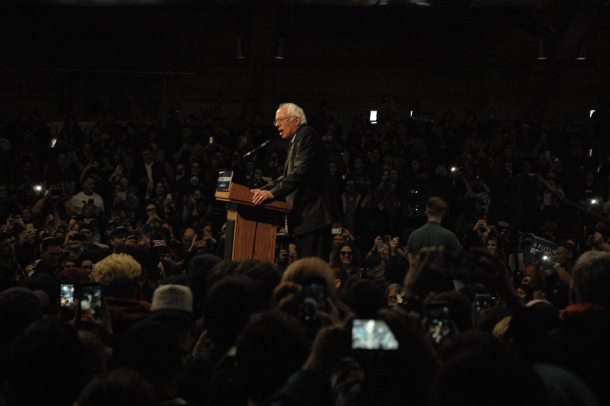
[S]en. Bernie Sanders drove home his message of income inequality in upstate New York this week, hoping to turn out support in an economically struggling region with many dilapidated homes and shuttered factories for a crucial win in next week’s primary.
Sanders spoke to thousands west of the Hudson River, promising to bolster the middle class and make up for jobs that have been sent overseas. He offered a stern critique of American trade policy, which he said had hurt the region and that his opponent for the Democratic presidential nomination, Hillary Clinton, largely supported.
Despite her eight years as a New York senator, Sanders portrayed Clinton as a Wall Street wheeler and dealer who cared more about downstate issues.
The swing through the Albany area also gave Sanders a chance to pitch his ideas in the backyard of a personal hero — President Franklin Delano Roosevelt, who had lived in Albany and Hyde Park.
For his part, Sanders tried to match FDR’s New Deal boldness.
Wall Street reform. Major infrastructure projects and job programs. Free public college tuition.
Sanders also praised recent progressive accomplishments in the Empire State: a $15-an-hour minimum wage and a ban on the fracking method of extracting oil and gas.
“In 2012, I was very proud that my state of Vermont became the first state in America to ban fracking,” Sanders said in Albany on Monday. “The growing body of evidence tells us that fracking is a danger to our water supply, our most precious resource. We cannot poison our water.”
The core message was over jobs and trade, an economic message that has found success in other Rust Belt regions of America, including Wisconsin and Michigan, where he pulled off victories. Sanders is trying to tap into that same anxiety as he travels to areas that were once thriving manufacturing hubs — places like Corning, with its history of glassware production, and Rochester, home of the once-mighty Kodak.
His success upstate will be key as he tries to chip away at what the polls say is a large lead for Clinton in delegate-rich New York. In Tuesday’s primary, 291 delegates are up for grabs, and Clinton holds a commanding lead in the latest Quinnipiac poll, 53 percent to 40 percent.
Polling shows Sanders losing to Clinton by double-digit margins in New York City and the suburbs. It’s upstate where the Vermont senator is faring best, trailing 5 points behind Clinton, 45 percent to 50 percent.
Sanders needs to pick up the votes of working class whites in next week’s primary if he hopes to blunt Clinton’s strong support among nonwhites in the state’s urban centers, experts say.
But even if Sanders can capture the bulk of voters upstate, it may not be enough to secure victory, according to James Battista, a professor of political science at SUNY Buffalo.
“Upstate and western New York has not entirely recovered from the Great Recession in ways other parts of the country have,” Battista said. “But the places where the most people live are where things are doing better. The bulk of voters live downstate.”

Sanders embarked Monday on a frantic tour that included stops in the economically fragile cities of Buffalo, Albany, Rochester, Poughkeepsie and Syracuse.
In his upstate trip, he tore into Clinton’s past support for trade deals, including the North American Free Trade Agreement and the Trans-Pacific Partnership, which Clinton now opposes. He decried “corporate greed” and the closing of factories across the Empire State.
“If corporate America wants us to buy their products they damn well better start investing in America,” he told more than 6,000 people in a Rochester hockey arena Tuesday.
Sanders’ economic indictments were specific, calling out companies that had shut down factories in the region.
He also voiced strong support for the nearly 40,000 Verizon workers who started striking Wednesday in a push for improved benefits and limits on outsourcing.
“They want to cut benefits for their employees,” Sanders said about the communication company. “They want to throw their workers out on the street and move their calling centers to low-wage countries around the world.”
Sanders met Verizon workers at a union hall outside Buffalo on Monday to support the cause. Alongside him was Larry Cohen, the former president of the Communications Workers of America, who is on the trail with the democratic socialist. Sanders has won the support of the union.
Sanders also took General Electric CEO Jeffrey Immelt to task, accusing him of outsourcing and downsizing.
GE has laid off hundreds of New York workers over the past few years, and Sanders was met with applause when he promised Immelt that, if elected president, “you will have to contend with me.”
A number of other communities nestled in the New York hills are seeing companies scale back or shut down.
In January, Eastman Kodak announced 50 layoffs at its Rochester facility. Buffalo has seen a number of plants close, including Niagara Ceramics, which left 110 workers out of work after closing a shop in 2013. Over the winter, GlobalFoundries, the company that acquired IBM’s chipmaking operations last year, laid off 150 people in two factories in New York.
From Albany to Buffalo, many houses are boarded up and good jobs seem scarce.
While New York’s economy is showing signs of resurgence and the state is investing billions toward economic revitalization, growth in the west continues to lag.
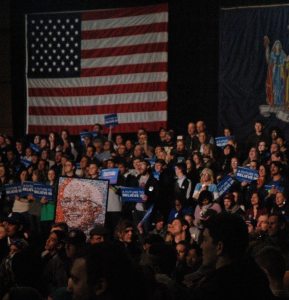
And while the people who came to Sanders’ upstate rallies were mostly college students, many of the older attendees seemed to be working-class.
In conversations with nearly two dozen Sanders supporters, a deep set of economic anxieties emerged: Health care is too expensive. Wages today don’t allow homeownership. Good manufacturing jobs will never come back.
Elizabeth Emanation, of Troy, said that in her years of volunteering at a local food pantry, “We give away more food now than I’ve ever seen.”
“We are the richest country in the world, but we are giving food to people to survive,” she continued. “The line is out the door, and we are feeding the average Joe. It’s not poor people or homeless people. It’s the person having two jobs and three kids who can’t afford rent.”
Gus Alden, of Canandaigua, said he was laid off from his job at the Ultrafab factory in Farmington and has found it hard to find work without further educational opportunities.
“Back in my day you could get a high school education and it would take you through for the rest of your life,” Alden said. “Sanders is trying to bring education up to 16 years, which would help a lot of people that can’t afford it.”
Annie Herman said she grew up on a Buffalo block populated by steelworkers with good benefits and fair salaries.
“It was hard, dirty work, but they were proud of what they did, and they were able to send their children to school,” she said. “But nobody can do that anymore. It’s a dream that eludes most people.”
Another Buffalo resident, Greg Copeland, talked about the struggles of paying health care bills. He faulted President Barack Obama’s Affordable Care Act and said the country’s aging population remains unable to pay for health costs.
“The elderly have no place to go,” Copeland said. “They are against the wall, they can’t afford insurance, and they are virtually sitting and waiting to die.”
“They are thinking about how much better they would be dead,” he added.
The frustrations of Sanders and his supporters were perhaps best boiled down by progressive radio host Jim Hightower, who hailed the Vermont senator as an FDR-style reformer who would take down corrupt, entrenched interests.
“I’m talking about the downsizers and privatizers,” Hightower said in opening remarks in Rochester. “I’m talking about the big oil frackers and Wal-Mart wage-whackers. I’m talking about the bosses and the bankers, the bastards and the bullshitters.”

The upstate New Yorkers who support Sanders were desperate to see their man get into office. Nearly every voter interviewed expressed distrust of Clinton, though many acknowledged they had supported her for U.S. Senate.
Albany resident Rose Mitchell, 31, said she was once an energized Clinton supporter, volunteering for her campaign at the age of 16.
“I worked for her campaign, and I wrote letters to the editor,” Mitchell said. “But she spent her time in office violating the promises she made during her campaign.”
Herman, 63, said her first political donation went to Clinton’s first Senate race. But she added that Clinton is now too close to Wall Street executives who wreaked financial havoc in 2008.
“I disagree with her views on what it looks like to be a public servant,” Herman said.
When Sanders referenced Clinton in his New York stump speeches, supporters booed loudly, and a few yelled that she was not truthful.
“She’s not a New Yorker,” one man yelled in Rochester.
While it’s hard to claim that either Clinton or Sanders is as synonymous with New York as pizza pie, an unquestioned New Yorker was FDR. He served as a state senator and governor.
On Tuesday evening, at the end of Sanders’ upstate tour, he visited the former president’s gravesite in Hyde Park.
The New York political icon would have been thrilled with his state’s recent adoption of a $15 minimum wage.
In a 1938 fireside chat before signing the Fair Labor Standards Act that instituted the federal minimum wage, Roosevelt gave a staunch defense of fair pay that could have come straight from Sanders’ Twitter page:
“Do not let any calamity-howling executive with an income of $1,000 a day, who has been turning his employees over to the government relief rolls in order to preserve his company’s undistributed reserves, tell you – using his stockholders’ money to pay the postage for his personal opinions — tell you that a wage of $11 a week is going to have a disastrous effect on all American industry.”
Standing near a bust of the 32nd leader of America on Tuesday, the democratic socialist called him “one of the greatest presidents in the history of our country.”
“There is a lot we can learn from Roosevelt’s life,” he said.

