


[W]ith a bit of wind at their backs, Bernie Sanders’ top staffers say the campaign is preparing to spend big bucks and long hours contesting the most important upcoming primary contests.
With Sanders having lost a number of critical, delegate-heavy states throughout the first half of the primary calendar, the Vermont senator must win virtually every remaining race, and by large margins.
It will require a lot of energy as well as money. Luckily for Sanders, his donor base is resilient and supportive, offering cash in good times and bad. After Sanders’ blowout wins in three states Saturday, the campaign said it brought in more than $4 million in about two days.
The recent wins also trimmed Hillary Clinton’s pledged delegate lead over Sanders, though her hand remains strong.
While current delegate counts could change during state nominating conventions, Sanders appears to have shrunk Clinton’s lead from more than 300 delegates to roughly 240 over the past two weeks.
“Reports of our death are greatly exaggerated,” said Jeff Weaver, Sanders’ campaign manager, in a press call Monday. “We are moving ahead. As Bernie said yesterday, ‘We are on a path to victory.’”
Unlike Republican presidential contender John Kasich, who has been mathematically eliminated from the race for the required number of delegates, Sanders still has a path, but it’s rocky and narrow.
While polling data is scant for many of the upcoming contests, Sanders isn’t favored in any of the big states.
Wisconsin doles out 96 delegates April 5, and the Vermont senator has effectively burrowed into the Badger State in hopes of a win. He is holding big rallies across the state and has injected new attacks into his stump speech against Republican Wisconsin Gov. Scott Walker’s work to diminish union power.
On Monday, Sanders earned the backing of the state’s former Lt. Gov. Barbara Lawton. She called him a “visionary leader,” praising the democratic socialist for understanding “that incremental politics brought us to this moment where our economy has been reshaped to favor the wealthiest few, and locked us into inequality.”
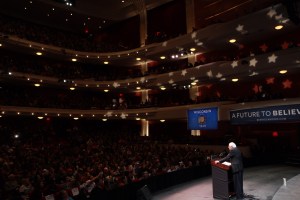
A few days after Wisconsin’s primary, a mere 18 delegates will be awarded in the Wyoming caucuses, where Sanders will likely perform well because of the voting format. His best margins have come out of caucuses, where only the most ardent supporters show up to debate and vote in a somewhat protracted process.
Then comes New York, with a hefty 291 delegates. Clinton has served two terms as its U.S. senator and has close connections with political leaders across the state.
The state also participates in a closed primary format, meaning a key Sanders constituency — independents — is prohibited from casting ballots.
Team Sanders opened its first New York office over the weekend in Brooklyn, a few miles from Clinton’s national headquarters.
Sanders was born and raised in Brooklyn, a fact the campaign is already playing up. During Monday’s press call, Weaver said Sanders was the “voice of New York.”
The campaign is ramping up resources for the Empire State with a combination of large ad buys and big rallies. It’s a strategy in a similar mold to Michigan, where Sanders pulled off an astonishing upset this month.
The campaign is also lobbying for a New York presidential debate, because advisers believe Sanders’ strong attacks on Clinton’s trade record in the Michigan debate gave him a boost.
On Sunday, Weaver wrote a letter to Clinton’s campaign manager, Robby Mook, demanding a New York debate, pointing to Sanders’ willingness to engage Clinton in a last-minute debate scheduled before the New Hampshire primaries.
“It is difficult to understand your motivation,” Weaver wrote. “Can you please explain why New York should not host the April debate? Is the secretary concerned about debating before the people who twice elected her to the U.S. Senate?”
The Sanders campaign tweeted out a Clinton video clip Tuesday from the 2008 election where she said, “You should be willing to debate anytime, anywhere.”
“You should be willing to debate anytime, anywhere.” — @HillaryClinton in 2008.https://t.co/UruLT1afY3
— Bernie Sanders (@BernieSanders) March 29, 2016
Weaver acknowledged Clinton’s big polling lead in the Empire State but insisted Sanders is “less far behind in New York than in many states we have won.”
After New York, there remain only four states that dole out more than 100 delegates: Maryland, Pennsylvania, New Jersey and California.
Sanders has visited California a number of times throughout the campaign and will be visiting Pennsylvania on Thursday. Earlier this week the campaign announced a Maryland steering committee, chaired by former NAACP President Ben Jealous.
The campaign is also claiming that Sanders’ collection of wins has made it mathematically impossible for Clinton to earn a majority of the pledged delegates by the Democratic National Convention this summer.
Top Sanders advisers also asserted that they are upping their outreach to superdelegates. Clinton currently holds a stunning lead over Sanders with this group, 469 to 29. The superdelegates may change their minds at any time until the party convention in July.
Sanders superdelegates are now making calls to persuade unpledged delegates, and the campaign sends periodic newsletters to the group of politicians and party leaders.
“We have a number of superdelegates who are not prepared to go public at this point,” Weaver said, adding that dozens have privately expressed support for Sanders.
