

[A]dvocates continue to oppose a reduction in state benefits for hundreds of families.
The policy change was approved by the House nearly a year ago. In the fiscal year 2016 budget bill, lawmakers sought to save $1.6 million in Reach Up, one of the state’s most widely used benefit programs for families.
The reduction in Reach Up payments is carried through in the fiscal year 2017 budget.
Under the new policy, if an adult in the household receives supplemental security income (SSI), a federal disability benefit, the household’s monthly benefit is reduced by $125. The annual cost to families is about $1,500; about 860 families are impacted.
Kaiya Andrews, of Waterbury Center, and her partner have a 3-year-old child and a 1-year-old baby. Her partner applied for Reach Up in December, and the benefit is a critical part of their income, Andrews said.
Andrews visited the Statehouse Wednesday for the annual Disability Awareness Day. She has visual and hearing impairments, and a form of autism, as well as a learning disability, post-traumatic stress disorder and attention deficit hyperactivity disorder. “When you lay it out like that, it’s a handful,” she said.
She receives both SSI and Social Security disability insurance, and her partner receives workers’ compensation in addition to Reach Up.
However, Andrews said, the $600 benefit the family gets on Reach Up each month “is just not enough between our rent, child care, the bills you have to survive on, plus the food.”
Andrews said that the $125 that is deducted from the family’s benefit every month would make a big difference to their finances. That extra money could go toward food or child care, she said.
“Heck, I can live without my electric bill. I’m OK with that,” Andrews said. “But I really need the kids in child care because with my type of disability it’s very unsafe for the kids to be at home because I can’t hear them or see them.”
The Department for Children and Families, which administers the Reach Up program, proposed the change, to bring Reach Up in line with other benefits programs in the state.
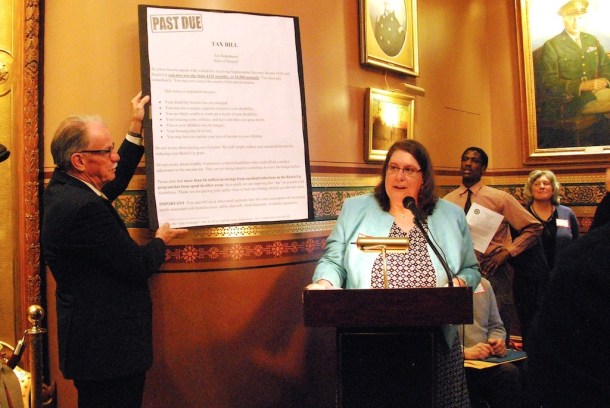
But advocates argued fiercely against the proposal, and they have dubbed it a “disability tax.”
Vermont Legal Aid led an effort to fight the cut in federal court and halted the implementation of the program for six months. Ultimately, the lawsuit was dismissed. This year, advocates have returned to the Statehouse to push lawmakers to repeal the law in next year’s budget.
Sarah Launderville, of the Vermont Center for Independent Living, talked about how the cut is impacting families at an event that was part of Disability Awareness Day at the Statehouse Wednesday.
“This is just unacceptable to us that this far into the session this hasn’t changed,” Launderville said to dozens of supporters.
The SSI Reach Up reduction has been discussed in committee rooms during this session. The House Human Services Committee included a recommendation to repeal the policy change, but the policy reversal was not ranked as a top priority. Funding an increase in the child protection system, a needle exchange program, and a bump in the state’s child care subsidy program took precedence.
Rep. Matt Trieber, D-Bellows Falls, the member of the House Appropriations Committee who has oversight of that part of the budget, said that the budget writers looked to the memo for guidance on priorities in the arena of human services.
Trieber said now that the SSI Reach Up deduction is a part of state law, “it’s a really important issue to make sure that we keep looking at and that it doesn’t just fall back to the concept of being existing policy, and it’s been in place for years, so it doesn’t need to be evaluated.”
As lawmakers prepared to take the FY 2017 budget up for second reading on the floor, Rep. Johanna Donovan, D-Burlington, asked the appropriations committee to include a study of the disabilities cuts in a report to the Legislature on the Reach Up program.
Christopher Curtis, of Vermont Legal Aid, said he would support anything that “takes this terrible policy off the books.”
“We would certainly welcome any amendment that casts a spotlight on this problem,” Curtis said.
