

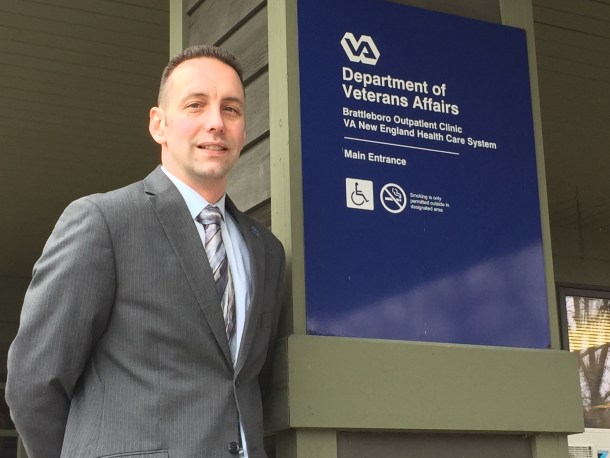
[B]RATTLEBORO — Al Montoya spent more than a decade in the Air Force, working as a Russian cryptologic linguist and training others on the intricacies of a C-130 transport plane system.
He’s also logged almost seven years with the U.S. Department of Veterans Affairs, most recently serving as assistant director at Connecticut’s VA health care system.
But when Montoya took over Vermont’s VA health care system late last year, he received a two-word introduction from an employee: “Welcome home.” He believes that’s symbolic of the strength of Vermont’s system, which serves about 25,000 veterans and has patient wait times consistently better than national averages.
“I’ll never forget that statement, because I think it goes to show the level of care and commitment — everything that our staff tries to provide to our veterans here,” Montoya said.
Montoya took over as Vermont’s interim director after the December departure of Deborah Amdur, who was reassigned to the VA health care system in Phoenix.
The White River Junction medical center is the centerpiece of Vermont’s VA system, which covers all of the Green Mountain State and a portion of New Hampshire. White River Junction also hosts the Department of Veterans Affairs national center for research on post-traumatic stress disorder.
The Vermont VA system has seven community-based outpatient clinics: Bennington, Brattleboro, Burlington, Newport and Rutland in Vermont, as well as Littleton and Keene in New Hampshire. Additionally, there are mobile units in northern New Hampshire.
All told, the Vermont VA has more than 1,200 employees and directly serves a little more than a third of the roughly 74,000 veterans in the area. Montoya says that’s a higher-than-usual service percentage for a VA system, and he attributes that partly to extensive outreach efforts here.
“We have staff that are out in the community, going to different events to make sure that our veterans know that we’re out there, and in some cases that they may be eligible for services and to bring them into the system,” he said.

The VA’s community clinics play a key role in that outreach. Brattleboro’s clinic opened in 2010 and now serves nearly 800 veterans, said Sharon Levenson, a registered nurse at the facility on GSP Drive.
Ease of access is a big deal for many veterans. For example, Levenson said patients on the blood-thinning medication Coumadin need regular blood tests.
“There are veterans who have to have this done on a weekly basis,” she said. “If an elderly veteran lives in Brattleboro, that person would have had to drive to White River Junction for that blood draw in the past. And now they come here.”
Montoya also sees value in having VA staffers who know their patients well. He cited a recent incident in which Levenson asked police to check on the welfare of a patient who failed to show for an appointment; the veteran was found unresponsive at his home and received lifesaving treatment.
“That’s the importance of our community-based outpatient clinics — to be able to forge those relationships, to be a part of the community, so that we can bring new veterans in and really make sure that we’re that conduit to getting the care that they need,” Montoya said.
These days, there are more veterans looking for VA care, both nationwide and in Vermont. In announcing Amdur’s departure, officials noted an 11.6 percent hike in the number of veterans seeking care over a five-year period as well as an 8.6 percent jump in outpatient clinic appointments over the past year.
Montoya credited Amdur with boosting Vermont’s resources to meet that demand: Since 2010, he said, the Vermont VA has increased staff by about 25 percent. “That’s a tremendous amount of growth to be able to make sure that we take care of our veterans,” he said.
Nationally, the VA has made headlines in recent years for not meeting the growing needs of veterans. In 2014, a scandal over long patient waits to get appointments shook the VA, with the Phoenix system serving as ground zero.
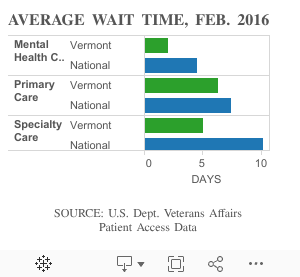
Given those recent controversies, the Department of Veterans Affairs maintains comprehensive, month-by-month data on patient access for its clinics nationwide.
And Vermont’s VA system has stayed above the fray, consistently posting better-than-average patient access times.
Montoya said he is a “firm believer in data,” and he uses data to praise the White River Junction-based system. In January, for instance, the Vermont VA had 18,480 patient visits, and nearly 98 percent of those were completed with a wait time of 30 days or less. The national average was 96 percent.
In each care category — primary, specialty and mental health — Montoya said the Vermont VA is outperforming U.S. averages, sometimes shaving several days from the average national wait time.
“How we actually schedule appointments now is by preferred date,” Montoya said. “So when a veteran comes in and (says), ‘I would prefer to be seen on X date,’ that’s where we start looking for and start planning for their next visit.”
When accepting the Vermont assignment, Montoya said, “I knew that I was walking into a very high-performing medical center.”
But that doesn’t mean the Vermont VA will be resting on its laurels: Montoya said outreach efforts will continue, and he was among those participating in a “veteran town hall meeting” on a Saturday morning late last month in White River Junction.
“The focus was really to zero in on (patient) access,” Montoya said. “Our access, could it be better? Absolutely.”
