

[V]ermont’s four candidates for governor agree that something needs to be done about Vermont Health Connect, and now both Republican candidates have made campaign promises to abandon the exchange.
Lt. Gov. Phil Scott, who is seeking the Republican nomination against Bruce Lisman, a former Wall Street executive, released an ad Thursday saying that if he becomes governor he will transition Vermont to the federal health exchange or to a multistate exchange.
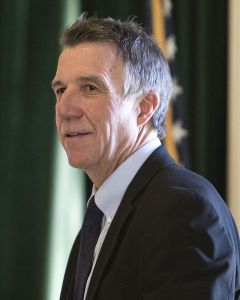
In 2015, Scott investigated whether Vermont should team up with another state such as Connecticut to build an exchange. On Feb. 19, he stood with Republicans and one Democrat to say that if lawmakers demand an independent review of Vermont’s exchange, the Shumlin administration should not have oversight of it.
“Make no mistake,” a news release from the campaign says. “If the current administration continues to stubbornly refuse to do the right thing, Phil Scott will solve the problem when he’s elected governor by transitioning to the federal exchange or a multistate alternative that offers better, more affordable choices.”
Scott said in an interview: “This isn’t a partisan issue. This is, it’s not functioning properly, and sometimes you have to admit when there’s a failure. You have to admit it and move to find another solution.”
“We’ve gone through three years now of missed deadlines and assurances that it’s going to be working, and those goals have not been met,” Scott said. “The latest revelation was from (Gartner Inc.), who was saying that they’ve had concerns since the very beginning.”
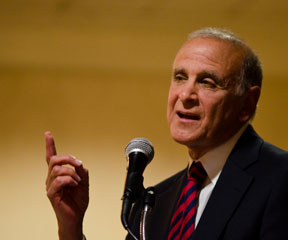
Lisman called on Shumlin on Feb. 19 to abandon Vermont Health Connect and transition to the federal exchange. Lisman’s recommendation followed testimony from a consultant for Gartner Inc. who said Vermont should not spend new money on Vermont Health Connect technology. In his campaign “kick off” speech on Oct. 19, Lisman called for repeal of the mandate, the shut down of Vermont Health Connect, and transition to the federal exchange.
In October, the Shumlin administration estimated it would spend $198.7 million in state and federal money setting up Vermont Health Connect and an additional $103.6 million on operations in 2015 and 2016. The last contract for performing new work ends in April, according to Lawrence Miller, the administration’s chief of health care reform.
“We spent good money after bad,” said Shawn Shouldice, Lisman’s campaign manager. “The system’s dysfunctional. It’s very clear that it’s not going to work. … Well, you can’t maintain a system that’s dysfunctional. So that’s throwing even more good money after bad.”
The Shumlin administration says moving to the federal exchange would mean about 19,000 Vermonters would have immediate access only to HealthCare.gov’s federal subsidies, and the state would have to set up a separate system to get state-funded subsidies to enrollees.
“We can figure out how to make sure that those who need subsidies get subsidies, and there’s nothing to say that we can’t have a mechanism to ensure that those folks who need subsidies get them, regardless of the transition,” Shouldice said.
Vermont’s two Democratic candidates for governor are both resisting a transition to the federal exchange.
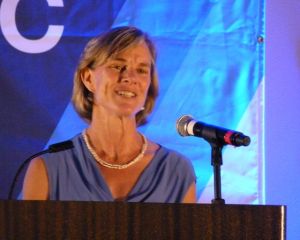
Sue Minter, who served as transportation secretary, said she would call for an analysis of Vermont Health Connect on day one as governor. However, Minter said she would not go straight to the federal exchange, because she doesn’t want Vermonters to pay more money for their health care.
“It’s not a simple decision to go from one (health exchange) to the next,” she said. “Our goal should be to make the one that we have work for everyone and provide excellent customer service. That’s what Vermonters expect from their government.”
Minter, who left her job at the Transportation Agency to run for governor, said she uses Vermont Health Connect to get health insurance. “For me personally, it’s working well,” she said.
Minter said Vermont needs “a new team” to look at Vermont Health Connect, but she did not criticize the Shumlin administration. “I do believe we need an analysis that can help us understand how we get this fully functional,” she said. “If that requires fresh eyes, new project management, that’s what I’ll be looking for.”
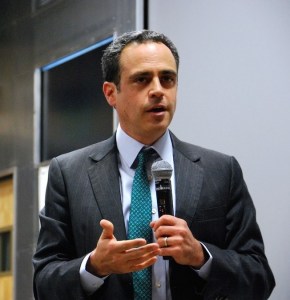
Matt Dunne, the other Democratic candidate, who recently left his job as a Google executive, said he would leave all options on the table, “but I will say from the outset that I don’t think it’s a good idea for us to turn over our interaction with health insurance to the federal government.”
He said audits are “always helpful,” but his main recommendations had to do with management.
“Being able to develop a website that people can use predictably and that has a back-end that can work with insurance providers and others should not be that complicated,” Dunne said.
He pointed to the Medicaid and Exchange Advisory Board, which advises the Shumlin administration on Vermont Health Connect. He said the board has no members with a background in information technology and that he would appoint at least two as governor.
“I’m not sure we could find a company in Vermont to actually do the website, but I know many Vermonters who are in the IT industry who would be happy to serve in an advisory role to support the state that they love,” Dunne said.
“Turning it over to the feds or turning it over to a larger state will mean that Vermonters will not be able to design and guide the direction for the exchange,” he said. “If at the end of the day that looks like the much, much better option, then we can certainly look at that.”
