

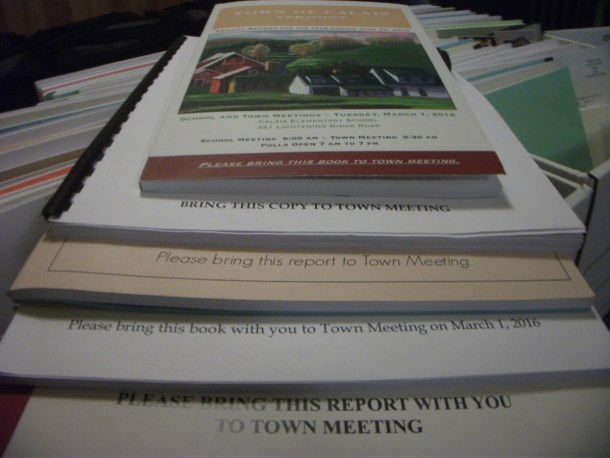
[V]ermonters seeking to save tax money at March town meeting usually forage for fat in the budget mailed to them beforehand. But now they’re competing with local leaders who have figured out a way to make cuts even earlier in the process.
“In an attempt to control printing costs, the town auditors have limited committee reports to one page and have in some instances edited reports to fit this limit,” officials have written voters in Cabot, population 1,433. “In order to fulfill our statutory obligation to mail reports to all legal voters and still maintain fiscal responsibility, we have mailed one copy of the report to each voter household. Other town residents and additional voters can pick up copies at the town clerk’s office.”
Vermont law requires municipalities to publish an annual auditor’s statement, which many communities supplement with exposition from everyone from their town clerk to dogcatcher. But as the state relaxes distribution rules, a rising number of communities are saving on printing and postage by delivering only the budget basics and sharing the rest in person or online.
The Vermont League of Cities and Towns has assured its members they are free to reduce the flow of printed information. “Although many towns choose to provide significant information in their annual report (such as reports from municipal departments, next year’s proposed budget, vital statistics, etc.), there is no law that requires the creation or distribution of a ‘town report’ other than the auditor’s report,” the league has written to local leaders. “Therefore, your town could decide that it will still provide the annual report to all voters and residents, but that it will cut costs by only printing and distributing the report from the town auditors.”
Communities once mandated to deliver copies to all “voters or residents” now have to provide them only to registered voters and not second-home owners or others. In addition, annual town meeting warnings must be posted on a municipality’s website, allowing people to access them on smartphones and tablets.
“Towns may use this change in the law as an opportunity to save money by reducing the number of reports that are printed and distributed,” the league has written local leaders. “However, towns should be aware that if they stop providing their non-voting residents with the report, those residents may feel alienated from their local government.”
The organization suggests that a better way to cut costs is to advertise how residents can access the report.
“A copy of the town report should, at the very least, be available for inspection at the town clerk’s office,” it writes. “Not only is this best practice and good customer service, it is also required by the Public Records Law because the town report is considered a public record under that law.”
Manchester, population 4,391, is dividing its report into two parts.
“Part A includes the proposed budgets for the municipal government and school district, tax information, town meeting warning, minutes from last year’s town meeting, and contact information,” explains a note in a booklet mailed to all postal patrons of ZIP codes 05254 and 05255.
Part B — featuring everything else — is available to anyone who requests it.
“Also, Part A and Part B are available for download at manchester-vt.gov,” the note adds. “This format is designed to save the taxpayers money and reduce paper consumption.”
In Guilford, population 2,121, the Selectboard is proposing the town stop mailing reports to all residents starting next year and instead publish notices in local newspapers about how people can have one sent to them, pick one up at the town office or read it online.
“It is expensive to produce and mail the printed booklet to every voter in Guilford,” local leaders write in this year’s report. “Many of those mailed end up being returned as undeliverable, or in people’s recycle bins or trash.”
If approved, the change could save Guilford 80 percent (or $3,000) of its annual printing budget, the board estimates.
The idea of pruning pages to cut costs goes back a decade to decisions by towns like West Rutland, population 2,326, which began mailing an abridged report before receiving calls from other interested communities.
Nearby Wallingford, population 2,079, switched around 2010, when its cover celebrated “Our 150th Town Report” — an eight-page mailing that cut printing and postage costs by two-thirds, from $1,500 to $500. Locals can access the remaining pages if they request them at the town office or download them online.
“We used to send out 1,000 reports,” the Wallingford town clerk said upon the shift, “and now we’ll be lucky if people take out 100.”
Bolton, population 1,182, is perhaps the most frugal of all: Its printed auditor’s report features the single sentence, “The full auditor’s report is available at www.boltonvt.com.”
Then again, most municipalities aren’t looking to eliminate them entirely.
“The town’s annual report,” local leaders in Guilford write in this year’s edition, “is loaded with helpful and useful information. Please don’t drop it in the recycle bin. Keep it handy until next year!”
