

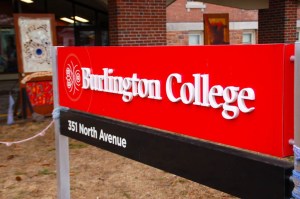
[B]URLINGTON — Burlington College is being sued by the estate of a former faculty member in a case alleging that the school used an endowed scholarship fund for other purposes.
The fund was created with $70,000 from the estate of G. Jason Conway. He and his wife, Marcia Vance, were longtime faculty at Burlington College. Vance helped to found the Vermont Institute for Community Involvement, which became Burlington College, and Conway taught at the school for more than 30 years.
VTDigger reported in August 2014 that Burlington College “borrowed” $50,000 from the Conway Vance scholarship fund to cover operating costs. An audit conducted in 2013 showed the money had not been repaid.
Attorney Norm Blais, who is representing Marjorie Lemay — the executor of Conway’s estate — said Burlington College has given no indication that any money was returned to the scholarship account. Current school officials say they’re not aware money was ever borrowed from the fund.
“We think now that the full $70,000 has been depleted,” Blais said Tuesday. The $70,000 was donated in two gifts in 2011 and 2012. Conway died in 2010.
Lemay has received no evidence from the college that scholarships were awarded from the fund in the last three years, according to the complaint filed in Vermont Superior Court earlier this month.
Burlington College issued a news release Tuesday morning that praised Conway’s generosity and said scholarships provided to students “may not have been labeled with the donor’s name” but were nonetheless awarded.

In a subsequent interview, Burlington College President Carol Moore said it was only last year that scholarships were awarded without the Conway Vance name. “In the tumult of presidents coming and going, that just slipped through,” Moore said.
Former President Christine Plunkett resigned under pressure from students amid allegations of financial mismanagement in August 2014. Mike Smith, a Cabinet secretary in the Douglas administration, took over as interim president until Moore was hired in December 2014. Scholarships for the 2015 school year were awarded during that period, Moore said.
Plunkett served as Burlington College’s chief financial officer under former President Jane Sanders, wife of U.S. presidential candidate Bernie Sanders. Plunkett took over as president in 2012 after Jane Sanders was forced out by the college’s board of trustees.
As president, Jane Sanders purchased 32 acres of lakefront land in 2010 for the college using $10 million in loans. She resigned a short time later when plans to increase enrollment to fill the new campus faltered and donations she used to secure the loans never materialized.
As a show of “good faith,” Burlington College will add $30,000 to the scholarship fund and use it to make awards in the Conway Vance name, Moore said. The school gives out close to $400,000 in scholarships annually, she added.
Significant disagreement remains between Lemay and Burlington College as to the nature of the Conway Vance scholarship fund and how the money has been used.
Moore said Tuesday that she has no knowledge of any money being borrowed from the fund. Lemay’s lawsuit states that she became concerned about how the money was being used in the fall of 2012.
After inquiring with Burlington College officials, she was told by Plunkett and former Chief Financial Officer Bill Breen that $50,000 from the fund was being used for other purposes, according to the complaint.

In an email sent Oct. 2, 2012, Plunkett told Lemay that, “The decision to borrow funds from the endowment was not taken lightly and was agreed to only with the understanding that the loan was temporary due to extreme financial circumstances and would be repaid in as timely a manner as possible.”
Breen told VTDigger in 2014 that he discovered Conway scholarship money had been spent on operating costs when Lemay inquired about who had received the scholarship that year. Breen said he also discovered that the college’s board had approved that use.
The money was always supposed to be for scholarships, according to Breen. When he informed the board of trustees of that restriction, it passed a resolution to repay the $50,000 in $3,000 monthly payments. Several months later the school could barely make payroll every two weeks, and that goal was abandoned, Breen said.
Moore said the attorney general’s office investigated the allegation that $50,000 in scholarship money was used for operations in the fall of 2014, not long after VTDigger’s initial report. Attorney General William Sorrell chose not to pursue the case, according to Moore.
“I can only assume that that decision was made because there was no evidence,” she said. A call to Sorrell to ask if his office had concluded that investigation was not immediately returned.
Blais said that proving criminal fraud requires a much higher standard of proof. The attorney general would have to prove “beyond a reasonable doubt” that fraud occurred, while a civil suit needs only to show that it’s “more likely than not” there was fraud or a breach of the contract, he said.
Lemay and the college also disagree about how the scholarship fund was to be managed in the first place.
In its news release, Burlington College said scholarships will be awarded until the fund is “exhausted.” Lemay contends in her suit that the agreement creating the fund required it be operated in perpetuity with scholarships being awarded using only the interest and income it would generate.
Moore said the original agreement between the college and Conway’s estate was for scholarships to be awarded until the $70,000 was spent. There may have been a subsequent agreement that the scholarship operate in perpetuity, but Moore said the college has no documentation if there was.
“We are searching the archives for that,” she said. Blais said he was not aware of a previous agreement, but Lemay has an unsigned copy that stipulates the scholarship operate in perpetuity. The only signed copy was held by the college, he said.
Blais said Conway’s estate made similar bequests to the Vermont Student Assistance Corp. and the Community College of Vermont. Both institutions are managing the Conway estate endowments as stipulated in their agreements, Blais said, using only the interest and income to award scholarships.
“We have a measure of what should have been done,” he said, adding that both VSAC and CCV provided Lemay with annual reports on the fund balance and awards — something Burlington College never did.
The two sides both said they hope to settle the matter before the lawsuit proceeds. Moore said a meeting is scheduled next week to discuss the terms of a possible settlement. Lemay is seeking the $70,000 be returned to the estate with interest and estimated income as well as punitive damages.
Moore said she’s eager to put this episode to rest and return her attention to Burlington College’s future. She said she doesn’t anticipate this suit will have any bearing on the accreditation process with the New England Association of Schools and Colleges.
That regional accrediting agency put Burlington College on probation a year and a half ago due to concerns about its finances. The association is to decide in April whether to continue accrediting the school.
“The constant referral to past events is hindering our forward momentum. The college has a very bright future, but we need to focus on our work for the future,” Moore said.
