

Editor’s note: This story by Rick Jurgens was first published in the Valley News on Feb. 14.
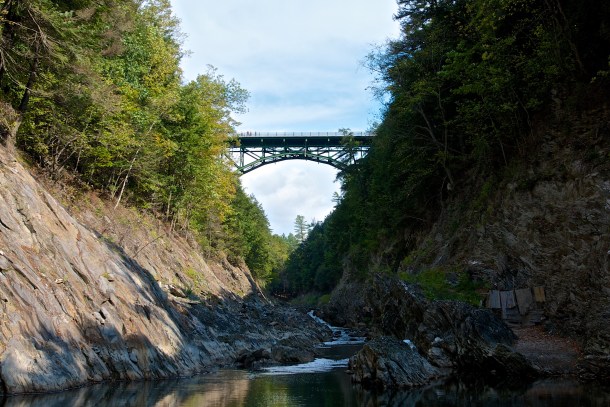
Quechee — The Quechee Gorge Bridge, a scenic and historic structure that provides a key Upper Valley highway link and draws tourists from near and far, also poses a threat to public health.
That’s the premise of a bill in the Vermont Legislature that would require the state Agency of Transportation to come up with measures to prevent suicides at the bridge, which stands 160 feet above the Ottauquechee River.
Rep. Teo Zagar, D-Barnard, is the author of H.593, which would give the agency until next January to come up with a plan to make the bridge safer and until Oct. 1, 2017, to complete work.
The bill also calls for measures to make the bridge safer for pedestrians and first responders.
Zagar said he began pressing for suicide prevention measures at the bridge after he was contacted by the family of Derek Cooper, a 21-year-old Hartland man who died by jumping from the bridge on July 4, 2011. “His parents called me … and suggested that we should do something,” Zagar said.
Cooper’s parents declined to be interviewed. However, a letter signed by Regina-Anne Cooper and sent to local organizations urging them to support the bill says, “Every time there is a new injury at the Quechee Gorge Bridge, we families of victims experience repeated post-traumatic stress disorder as we relive the horrid events of the day our loved one died.”
Suicide-prevention measures on the bridge sound good as “a first effort” to Laird Bradley of Woodstock, who says the Quechee Gorge Bridge has “become kind of a mecca for that kind of thing.” Prevention measures at the bridge should be part of a larger effort that includes steps to educate the public and raise awareness, he said.
Bradley speaks with authority. Five years ago, he and his wife, who had both lost friends to suicide, were driving home from an evening in Hanover when they observed a man on the bridge and turned around to investigate.
Bradley got out of his car, talked to the man for about 10 minutes and then, when he started to climb over the bridge’s shoulder-high rail, grabbed him and held him until police arrived.
Rep. Patrick Brennan, the Colchester Republican who chairs the House Transportation Committee, said the bill was “kind of in a holding pattern for now” but on the radar screen of his panel.
“We’d like to do something,” Brennan said. “It’s a question of what, and the cost weighs into it.”
After 11 months as Hartford police chief, Phil Kasten is very aware of the Quechee Gorge Bridge. During his short tenure, there have been three suicides at the bridge, and the department has responded to at least as many calls about people experiencing mental health or similar crises on the bridge, he said.
Rescue and recovery efforts are risky for emergency personnel. Kasten also noted that a fall of nearly 200 feet results in a violent death and an experience that is “traumatic for all of the public safety employees that respond.”
This isn’t a recent trend. Since July 1, 2008, eight people died in suicides at Quechee Gorge, according to the state Health Department Vital Statistics System. Records of four of those incidents mention the bridge, while the others are less specific, said Ben Truman, a department spokesman.
Over that same period, only three deaths resulted from jumps or falls from other Vermont bridges, he said.
A Public Health Issue
The initiative at Quechee Gorge comes as Vermont continues efforts to address suicide as a symptom of mental illness.
“We have a really severe public health problem with death by suicide,” said Rep. Anne Donahue, a Republican who represents Northfield and also edits the newspaper of Vermont Psychiatric Survivors, an advocacy organization.
Between July 1, 2008, and Dec. 31, 2015, there were 833 suicide deaths in the state, according to Truman. In neighboring New Hampshire, the suicide toll in the eight-year period that ran through 2014 was 1,535. In 2015, Vermont authorities counted 97 deaths by suicide. In New Hampshire there were at least 224 suicides, according to the Office of the Chief Medical Examiner.
Suicide prevention is now a focus for the Vermont Department of Mental Health, which in 2015 participated in a training program for clinicians and a public awareness and education campaign in conjunction with gun store owners.
Concentrating on the places and tools used in suicides is part of a broader public health response to the issue, advocates say.
“We usually focus on why people take their lives,” said Elaine Frank, director of the Counseling on Access to Lethal Means program at Children’s Hospital at Dartmouth. “We should focus at least some attention on the how.”
While it’s true that a person determined to take his or her own life can find a way, Frank said, “we want to make it a little more difficult for people who are ambivalent.”
“Many people are ambivalent up to the last moment,” she noted.
Donahue said suicides are often impulsive acts, so it makes sense to limit the access to a bridge or other site that has developed a reputation as a location for suicides: “If you reduce (access to) that site, you actually save many of those lives.”
Measures and Costs Remain to Be Seen
Exactly what would be done to the 285-foot-long bridge if H.593 passes remains unclear. The bill would leave it to the state Agency of Transportation to develop and implement safety measures on the bridge, and doesn’t spell out how much should be spent.
A 2010 study of suicide prevention measures for seven bridges in Ithaca, N.Y., described activities ranging from improved community mental health care, non-barrier approaches including signage, surveillance and security patrols, and barriers.
At the Golden Gate Bridge in the San Francisco Bay Area, a $76 million project has been approved that would that would install steel mesh nets under each side of the bridge.
In Ithaca, chain link fences were built on the bridges after a series of suicides during the 2010 academic year. After three years, the fences were taken down and steel mesh nets were installed underneath the bridges.
So far, the Quechee Gorge Bridge proposal has not been unanimously embraced.
“I sympathize with any family who has had someone commit suicide,” said Kipp Miller, the owner of Quechee Gorge Gifts and Sportswear.
But, he added, “the bridge is not at fault.”
“It’s a fine line” for the business owners in the area, who employ about 70 people in establishments ranging from Quechee Gorge Village to the Vermont Institute of Natural Science, said Miller. “We don’t want to seem unsympathetic to the families who have had this occur.”
Miller said he could accept suicide prevention measures “if they don’t affect the view or the experience of the 100,000 people” who visit the gorge each year.
Two years ago, Zagar introduced a bill that would have required the Agency of Transportation to “update its structures design standards to address the prevention of suicide and the safety of first responders” using the Quechee Gorge Bridge as “a case study.” That bill, which had 31 co-sponsors, failed to make it out of Brennan’s committee.
This time around, the bill pinpoints action at the Quechee Gorge Bridge, and does not cast the project as a “case study” or talk about new “standards.”
Zagar’s co-sponsors are Reps. Kevin Christie and Gabrielle Lucke of Hartford and John Bartholomew of Hartland, all Democrats, as well as Donahue, a Republican.
Zagar said he had “received assurances that there will be a hearing” but referred questions about what would come next to Brennan.
Brennan said that he had “been getting a ton of emails on this.”
He said he had also heard from business owners concerned about “scenic beauty and historic preservation.”
A History of Changes
Change has been a constant in Quechee Gorge Bridge’s rich history.
The original bridge across what was then called Quechee Gulf was a wooden truss structure that was completed in 1875 to provide a railroad connection between White River Junction and Woodstock, according to 2011 corridor management plan submitted to the AOT and Vermont Scenery Preservation Council.
In 1911, a steel arch bridge replaced the wooden bridge. In 1933, the last passenger train ran on the line.
The next year, after the railroad tracks were replaced by a highway, a ribbon cutting at the bridge marked the opening of Route 4 connecting White River Junction to Whitehall, N.Y.
The bridge continued to evolve. A 1972 rehabilitation project added sidewalks, and in 1989 the cement decking was replaced.
Rich Tetreault, the AOT’s deputy secretary, worked as an engineer on the 1989 project, which entailed replacing concrete surfaces and making some repairs to the structural steel.
Aside from health and safety concerns, factors to consider in weighing a bridge project include the “tourism component,” any potential impacts on endangered species such as bats that nest under the bridge and its status as a “historical treasure,” Tetreault said.
Action on the bill will come after the committee passes out its omnibus transportation bill and another bill relating to the Motor Vehicle Department, Brennan said. “By then I’m hoping we have a recommendation from the agency to give us a couple options to proceed.”
Tetreault said his agency is awaiting a call to testify before whatever committee takes up the bill.
Rep. Mark Huntley, D-Cavendish, who is a member of the Transportation Committee, has not yet decided his position on the legislation.
“From a transportation committee, tax dollars standpoint, what do you do?” Huntley asked. What, if after expending time and money, he said, “it doesn’t work at all?”
Brennan also was non-committal.
“We want to be sure the community is on board with us,” Brennan added. “We’ve got to be sure (whatever is done) would serve as a deterrent.”
Rick Jurgens can be reached at rjurgens@vnews.com or 603-727-3229.
Help Is Available:
If you or someone you know is depressed or suicidal, you can call the National Suicide Prevention Lifeline at 1-800-273-TALK (1-800-273-8255), visit the website of the Vermont Suicide Prevention Center at http://vtspc.org or call Headrest’s 24-hour crisis support line at 603-448-4400 or toll-free teenline at 1-800-639-6095.
